 MedLens
Loading…
TABLETS, USP · Aphena Pharma Solutions - Tennessee, Inc.
Dosage Form
TABLETS, USP
Manufacturer
Aphena Pharma Solutions - Tennessee, Inc.
This medication contains important usage instructions, warnings, and side effect information that you should review before use.
Lactic acidosis is a rare, but serious, metabolic complication that can occur due to metformin accumulation during treatment with Glyburide and Metformin Hydrochloride tablets; when it occurs, it is fatal in approximately 50% of cases. Lactic acidosis may also occur in association with a number of pathophysiologic conditions, including diabetes mellitus, and whenever there is significant tissue hypoperfusion and hypoxemia. Lactic acidosis is characterized by elevated blood lactate levels (>5 mmol/L), decreased blood pH, electrolyte disturbances with an increased anion gap, and an increased lactate/pyruvate ratio. When metformin is implicated as the cause of lactic acidosis, metformin plasma levels >5 μg/mL are generally found.
The reported incidence of lactic acidosis in patients receiving metformin hydrochloride is very low (approximately 0.03 cases/1000 patient-years, with approximately 0.015 fatal cases/1000 patient-years). In more than 20,000 patient-years exposure to metformin in clinical trials, there were no reports of lactic acidosis. Reported cases have occurred primarily in diabetic patients with significant renal insufficiency, including both intrinsic renal disease and renal hypoperfusion, often in the setting of multiple concomitant medical/surgical problems and multiple concomitant medications. Patients with congestive heart failure requiring pharmacologic management, in particular those with unstable or acute congestive heart failure who are at risk of hypoperfusion and hypoxemia, are at increased risk of lactic acidosis. The risk of lactic acidosis increases with the degree of renal dysfunction and the patient’s age. The risk of lactic acidosis may, therefore, be significantly decreased by regular monitoring of renal function in patients taking metformin and by use of the minimum effective dose of metformin. In particular, treatment of the elderly should be accompanied by careful monitoring of renal function. A combination of Glyburide and Metformin Hydrochloride treatment should not be initiated in patients > 80 years of age unless measurement of creatinine clearance demonstrates that renal function is not reduced, as these patients are more susceptible to developing lactic acidosis. In addition, Glyburide and Metformin Hydrochloride should be promptly withheld in the presence of any condition associated with hypoxemia, dehydration, or sepsis. Because impaired hepatic function may significantly limit the ability to clear lactate, Glyburide and Metformin Hydrochloride should generally be avoided in patients with clinical or laboratory evidence of hepatic disease. Patients should be cautioned against excessive alcohol intake, either acute or chronic, when taking Glyburide and Metformin Hydrochloride, since alcohol potentiates the effects of metformin hydrochloride on lactate metabolism. In addition, Glyburide and Metformin Hydrochloride should be temporarily discontinued prior to any intravascular radiocontrast study and for any surgical procedure (see also PRECAUTIONS ).
The onset of lactic acidosis often is subtle, and accompanied only by nonspecific symptoms such as malaise, myalgias, respiratory distress, increasing somnolence, and nonspecific abdominal distress. There may be associated hypothermia, hypotension, and resistant bradyarrhythmias with more marked acidosis. The patient and the patient’s physician must be aware of the possible importance of such symptoms and the patient should be instructed to notify the physician immediately if they occur (see also PRECAUTIONS ). Glyburide and Metformin Hydrochloride should be withdrawn until the situation is clarified. Serum electrolytes, ketones, blood glucose, and if indicated, blood pH, lactate levels, and even blood metformin levels may be useful. Once a patient is stabilized on any dose level of Glyburide and Metformin Hydrochloride, gastrointestinal symptoms, which are common during initiation of therapy with metformin, are unlikely to be drug related. Later occurrence of gastrointestinal symptoms could be due to lactic acidosis or other serious disease.
Levels of fasting venous plasma lactate above the upper limit of normal but less than 5 mmol/L in patients taking Glyburide and Metformin Hydrochloride do not necessarily indicate impending lactic acidosis and may be explainable by other mechanisms, such as poorly controlled diabetes or obesity, vigorous physical activity, or technical problems in sample handling. (See also PRECAUTIONS .)
Lactic acidosis should be suspected in any diabetic patient with metabolic acidosis lacking evidence of ketoacidosis (ketonuria and ketonemia).
Lactic acidosis is a medical emergency that must be treated in a hospital setting. In a patient with lactic acidosis who is taking Glyburide and Metformin Hydrochloride, the drug should be discontinued immediately and general supportive measures promptly instituted. Because metformin hydrochloride is dialyzable (with a clearance of up to 170 mL/min under good hemodynamic conditions), prompt hemodialysis is recommended to correct the acidosis and remove the accumulated metformin. Such management often results in prompt reversal of symptoms and recovery. (See also CONTRAINDICATIONS and PRECAUTIONS .)
Glyburide and Metformin Hydrochloride Tablets are indicated as an adjunct to diet and exercise to improve glycemic control in adults with type 2 diabetes mellitus.
Glyburide and Metformin Hydrochloride Tablets are contraindicated in patients with:
Glyburide and Metformin Hydrochloride should be temporarily discontinued in patients undergoing radiologic studies involving intravascular administration of iodinated contrast materials, because use of such products may result in acute alteration of renal function. (See also PRECAUTIONS.)
Although it is not known whether glyburide is excreted in human milk, some sulfonylurea drugs are known to be excreted in human milk. Studies in lactating rats show that metformin is excreted into milk and reaches levels comparable to those in plasma. Similar studies have not been conducted in nursing mothers. Because the potential for hypoglycemia in nursing infants may exist, a decision should be made whether to discontinue nursing or to discontinue Glyburide and Metformin Hydrochloride, taking into account the importance of the drug to the mother. If Glyburide and Metformin Hydrochloride is discontinued, and if diet alone is inadequate for controlling blood glucose, insulin therapy should be considered.
The safety and efficacy of Glyburide and Metformin Hydrochloride was evaluated in an active-controlled, double-blind, 26-week randomized trial involving a total of 167 pediatric patients (ranging from 9 to 16 years of age) with type 2 diabetes. Glyburide and Metformin Hydrochloride was not shown statistically to be superior to either metformin or glyburide with respect to reducing HbA1c from baseline (see Table 5). No unexpected safety findings were associated with Glyburide and Metformin Hydrochloride in this trial.
| Glyburide and | |||
| Metformin | |||
| Glyburide | Metformin | Hydrochloride | |
| 2.5 mg | 500 mg | 1.25 mg/250 mg | |
| Tablets | Tablets | Tablets | |
| Table 5: HbA1c (Percent) Change From Baseline at 26 Weeks: Pediatric Study | |||
| Mean Final Dose | 6.5 mg | 1500 mg | 3.1 mg/623 mg |
| Hemoglobin A 1c | N=49 | N=54 | N=57 |
| Baseline Mean (%) | 7.7 | 7.99 | 7.85 |
| Mean Change from Baseline | -0.96 | -0.48 | -0.8 |
| Difference from Metformin | -0.32 | ||
| Difference from Glyburide | 0.16 |
Of the 642 patients who received Glyburide and Metformin Hydrochloride in double-blind clinical studies, 23.8% were 65 and older while 2.8% were 75 and older. Of the 1302 patients who received Glyburide and Metformin Hydrochloride in open-label clinical studies, 20.7% were 65 and older while 2.5% were 75 and older. No overall differences in effectiveness or safety were observed between these patients and younger patients, and other reported clinical experience has not identified differences in response between the elderly and younger patients, but greater sensitivity of some older individuals cannot be ruled out.
Metformin hydrochloride is known to be substantially excreted by the kidney and because the risk of serious adverse reactions to the drug is greater in patients with impaired renal function, Glyburide and Metformin Hydrochloride should only be used in patients with normal renal function (see CONTRAINDICATIONS, WARNINGS, and CLINICAL PHARMACOLOGY: Pharmacokinetics). Because aging is associated with reduced renal function, Glyburide and Metformin Hydrochloride should be used with caution as age increases. Care should be taken in dose selection and should be based on careful and regular monitoring of renal function. Generally, elderly patients should not be titrated to the maximum dose of Glyburide and Metformin Hydrochloride (see also WARNINGS and DOSAGE AND ADMINISTRATION).
Glyburide and Metformin Hydrochloride tablets, USP contain two oral antihyperglycemic drugs used in the management of type 2 diabetes, glyburide and metformin hydrochloride.
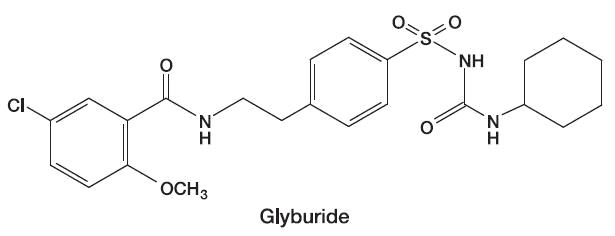
Glyburide is an oral antihyperglycemic drug of the sulfonylurea class. The chemical name for glyburide is 1-[[p-[2-(5-chloro-o-anisamido)ethyl]phenyl]sulfonyl]-3-cyclo-hexylurea. Glyburide is a white to off-white crystalline compound with a molecular formula of C23H28ClN3O5S and a molecular weight of 494.00. The structural formula is represented below.
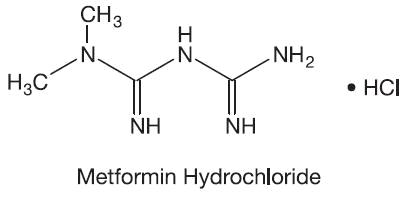
[image: MM1]Metformin hydrochloride is an oral antihyperglycemic drug used in the management of type 2 diabetes. Metformin hydrochloride (N,N-dimethylimidodicarbonimidic diamide monohydrochloride) is not chemically or pharmacologically related to sulfonylureas, thiazolidinediones, or α-glucosidase inhibitors. It is a white to off-white crystalline compound with a molecular formula of C4H11N5 ∙HCl and a molecular weight of 165.62. Metformin hydrochloride is freely soluble in water and is practically insoluble in acetone, ether, and chloroform. The pKa of metformin is 12.4. The pH of a 1% aqueous solution of metformin hydrochloride is 6.68. The structural formula is as shown:
[image: MM2]Glyburide and Metformin Hydrochloride tablets are available for oral administration in tablets containing 1.25 mg glyburide with 250 mg metformin hydrochloride, 2.5 mg glyburide with 500 mg metformin hydrochloride, and 5 mg glyburide with 500 mg metformin hydrochloride. In addition, each tablet contains the following inactive ingredients: ammonio methacrylate copolymer (type B), croscarmellose sodium, hypromellose, magnesium stearate, microcrystalline cellulose, polydextrose, polyethylene glycol, povidone, sodium hydroxide, sorbic acid, titanium dioxide and triacetin. The 2.5 mg/500 mg tablet also contains: black iron oxide, D&C Yellow #10 Aluminum Lake, and yellow iron oxide. The 5 mg/500 mg tablet also contains: black iron oxide, FD&C Blue #2/Indigo Carmine Aluminum Lake, and FD&C Yellow #6/Sunset Yellow FCF Aluminum Lake.
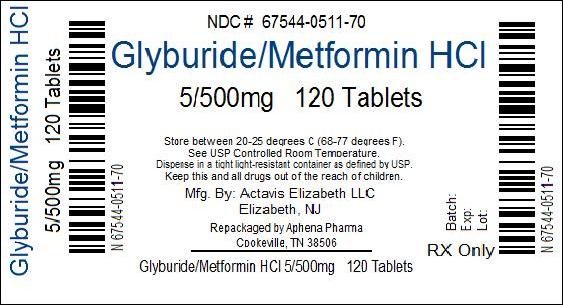
NDC 67544-511 - Glyburide/Metformin HCI 5/500mg - Rx Only
[image: mm5-500mg]
|
Repackaged by Aphena Pharma Solutions - TN. |
| [image: mmAphena] |
Glyburide and Metformin Hydrochloride Tablets, USP are available as follows:
1.25 mg/250 mg —Each white to off-white, capsule-shaped, film coated tablet imprinted with [image: MM3] and 751 on one side and plain on the other side contains 1.25 mg of glyburide USP and 250 mg of metformin hydrochloride USP. Tablets are supplied in bottles of 100 (NDC 0228-2751-11) with a child-resistant closure and bottles of 500 (NDC 0228-2751-50) without a child-resistant closure.
2.5 mg/500 mg —Each yellow, capsule-shaped, film coated tablet imprinted with [image: MM4] and 752 on one side and plain on the other side contains 2.5 mg of glyburide USP and 500 mg of metformin hydrochloride USP. Tablets are supplied in bottles of 100 (NDC 0228-2752-11) with a child-resistant closure and bottles of 500 (NDC 0228-2752-50) without a child-resistant closure.
5 mg/500 mg — Each blue, capsule-shaped, film coated tablet imprinted with [image: MM5] and 753 on one side and plain on the other side contains 5 mg of glyburide USP and 500 mg of metformin hydrochloride USP. Tablets are supplied in bottles of 100 (NDC 0228-2753-11) with a child-resistant closure and bottles of 500 (NDC 0228-2753-50) without a child-resistant closure.
Store at temperatures up to 25° C (77° F). [See USP Controlled Room Temperature.]
Dispense in a tight, light-resistant container as defined in the USP.
Manufactured by:
Actavis Elizabeth LLC
200 Elmora Avenue
Elizabeth, NJ 07207 USA
40-9070
Revised — March 2010
Micronase® is a registered trademark of Pharmacia & Upjohn Company.
Photos of the product and/or packaging supplied by the manufacturer.



40-9070
Revised - March 2010
Rx only
The Glyburide and Metformin Hydrochloride product combines glyburide and metformin hydrochloride, two antihyperglycemic agents with complementary mechanisms of action, to improve glycemic control in patients with type 2 diabetes.
Glyburide appears to lower blood glucose acutely by stimulating the release of insulin from the pancreas, an effect dependent upon functioning beta cells in the pancreatic islets. The mechanism by which glyburide lowers blood glucose during long-term administration has not been clearly established. With chronic administration in patients with type 2 diabetes, the blood glucose lowering effect persists despite a gradual decline in the insulin secretory response to the drug. Extrapancreatic effects may be involved in the mechanism of action of oral sulfonylurea hypoglycemic drugs.
Metformin hydrochloride is an antihyperglycemic agent that improves glucose tolerance in patients with type 2 diabetes, lowering both basal and postprandial plasma glucose. Metformin hydrochloride decreases hepatic glucose production, decreases intestinal absorption of glucose, and improves insulin sensitivity by increasing peripheral glucose uptake and utilization.
SPECIAL WARNING ON INCREASED RISK OF CARDIOVASCULAR MORTALITY
The administration of oral hypoglycemic drugs has been reported to be associated with increased cardiovascular mortality as compared to treatment with diet alone or diet plus insulin. This warning is based on the study conducted by the University Group Diabetes Program (UGDP), a long-term prospective clinical trial designed to evaluate the effectiveness of glucose-lowering drugs in preventing or delaying vascular complications in patients with non-insulin-dependent diabetes. The study involved 823 patients who were randomly assigned to one of four treatment groups ( Diabetes 19 (Suppl. 2):747-830, 1970).
UGDP reported that patients treated for 5 to 8 years with diet plus a fixed dose of tolbutamide (1.5 g per day) had a rate of cardiovascular mortality approximately 2 ½ times that of patients treated with diet alone. A significant increase in total mortality was not observed, but the use of tolbutamide was discontinued based on the increase in cardiovascular mortality, thus limiting the opportunity for the study to show an increase in overall mortality. Despite controversy regarding the interpretation of these results, the findings of the UGDP study provide an adequate basis for this warning. The patient should be informed of the potential risks and benefits of glyburide and of alternative modes of therapy.
Although only one drug in the sulfonylurea class (tolbutamide) was included in this study, it is prudent from a safety standpoint to consider that this warning may also apply to other hypoglycemic drugs in this class, in view of their close similarities in mode of action and chemical structure.
No animal studies have been conducted with the combined products in Glyburide and Metformin Hydrochloride. The following data are based on findings in studies performed with the individual products.
Please reference the How Supplied section listed above for a description of individual tablets or capsules. This drug product has been received by Aphena Pharma - TN in a manufacturer or distributor packaged configuration and repackaged in full compliance with all applicable cGMP regulations. The package configurations available from Aphena are listed below:
| Count | 5/500mg |
| 120 | 67544-511-70 |
| 360 | 67544-511-94 |
Store between 20°-25°C (68°-77°F). See USP Controlled Room Temperature. Dispense in a tight light-resistant container as defined by USP. Keep this and all drugs out of the reach of children.
Repackaged by:
[image: mmAphena]
Cookeville, TN 38506
20120730KRW
Create a free account to view complete drug information, save medications, and more.
Free forever · No credit card required