 MedLens
Loading…
Generic name: Hydrocodone Bitartrate and Acetaminophen
Physicians Total Care, Inc.
Dosage Form
N/A
Manufacturer
Physicians Total Care, Inc.
This medication contains important usage instructions, warnings, and side effect information that you should review before use.
LORTAB (pronounced LOR-tab) is used to relieve moderate to moderately severe pain. You should not take LORTAB Elixir if you are allergic to hydrocodone or acetaminophen. The most common side effects of LORTAB Elixir are abdominal pain, dizziness, drowsiness, light-headedness, nausea, shortness of breath, unusual tiredness, and vomiting. Take this medicine as directed by your doctor. Do not take more of it, do not take it more often, and do not take it for a longer time than your doctor ordered.
LORTAB Elixir (hydrocodone bitartrate and acetaminophen oral solution) is indicated for the relief of moderate to moderately severe pain.
Dosage should be adjusted according to severity of pain and response of the patient. However, it should be kept in mind that tolerance to hydrocodone can develop with continued use and that the incidence of untoward effects is dose related.
The usual adult dosage is one tablespoonful every 4 to 6 hours as needed for pain. The total daily dosage for adults should not exceed 6 tablespoonfuls. The usual dosages for children are given by the table below, and are to be given every 4 to 6 hours as needed for pain. These dosages correspond to an average individual dose of 0.27 mL/kg of LORTAB Elixir (providing 0.135 mg/kg of hydrocodone bitartrate and 9 mg/kg of acetaminophen). Dosing should be based on weight whenever possible.
| BODY WEIGHT |
APPROXIMATE AGE |
DOSE every 4 to 6 hours |
MAXIMUM TOTAL DAILY DOSE (6 doses per day) |
|
12 to 15 kg 27 to 34 lbs. |
2 to 3 years |
¾ teaspoonful = 3.75 mL |
4 ½ teaspoonfuls = 22.5 mL |
|
16 to 22 kg 35 to 50 lbs. |
4 to 6 years |
1 teaspoonful = 5 mL |
6 teaspoonfuls = 30 mL |
|
23 to 31 kg 51 to 69 lbs. |
7 to 9 years |
1 ½ teaspoonfuls = 7.5 mL |
9 teaspoonfuls = 45 mL |
|
32 to 45 kg 70 to 100 lbs. |
10 to 13 years |
2 teaspoonfuls = 10 mL |
12 teaspoonfuls = 60 mL |
|
46 kg and up 101 lbs. and up |
14 years to adult |
1 Tablespoonful = 15 mL |
6 Tablespoonfuls = 90 mL |
The total daily dosage for children should not exceed 6 doses per day.
It is of utmost importance that the dose of LORTAB Elixir be administered accurately. A household teaspoon or tablespoon is not an adequate measuring device, especially when one-half or three-fourths of a teaspoonful is to be measured. Given the inexactitude of the household spoon measure and the possibility of using a tablespoon instead of a teaspoon, which could lead to overdosage, it is strongly recommended that care givers obtain and use a calibrated measuring device. Health care providers should recommend a dropper that can measure and deliver the prescribed dose accurately, and instruct care givers to use extreme caution in measuring the dosage.
This product should not be administered to patients who have previously exhibited hypersensitivity to hydrocodone, acetaminophen, or any other component of this product.
Patients known to be hypersensitive to other opioids may exhibit cross sensitivity to hydrocodone.
Potential effects of high dosage are also listed in the OVERDOSAGE section.
Cardio-renal: Bradycardia, cardiac arrest, circulatory collapse, renal toxicity, renal tubular necrosis, hypotension.
Central Nervous System/Psychiatric: Anxiety, dizziness, drowsiness, dysphoria, euphoria, fear, general malaise, impairment of mental and physical performance, lethargy, light-headedness, mental clouding, mood changes, psychological dependence, sedation, somnolence progressing to stupor or coma.
Endocrine: Hypoglycemic coma.
Gastrointestinal System: Abdominal pain, constipation, gastric distress, heartburn, hepatic necrosis, hepatitis, occult blood loss, nausea, peptic ulcer, and vomiting.
Genitourinary System: Spasm of vesical sphincters, ureteral spasm, and urinary retention.
Hematologic: Agranulocytosis, hemolytic anemia, iron deficiency anemia, prolonged bleeding time, thrombocytopenia.
Hypersensitivity: Allergic reactions.
Musculoskeletal: Skeletal muscle flaccidity.
Respiratory Depression: Acute airway obstruction, apnea, dose-related respiratory depression (see OVERDOSAGE), shortness of breath.
Special Senses: Cases of hearing impairment or permanent loss have been reported predominantly in patients with chronic overdose.
Skin: Cold and clammy skin, diaphoresis, pruritus, rash.
Following an acute overdosage, toxicity may result from hydrocodone or acetaminophen.
Signs and SymptomsToxicity from hydrocodone poisoning includes the opioid triad of loss of consciousness, pinpoint pupils, and respiratory depression (Cheyne-Stokes respiration, cyanosis, decrease in respiratory rate and/or tidal volume). Convulsions may occur.
The toxic dose of acetaminophen for adults is 10 grams. In adults, hepatic toxicity has rarely been reported with acute overdoses of less than 10 grams, or fatalities with less than 15 grams.
Early symptoms following a potentially hepatotoxic overdose of acetaminophen may include diaphoresis, general malaise, nausea, and vomiting. Clinical and laboratory evidence of hepatic toxicity may not be apparent until 48 to 72 hours post-ingestion.
Other signs and symptoms of overdose of this product include bradycardia, cold and clammy skin, extreme somnolence progressing to stupor or coma, hypoglycemic coma, hypotension, renal tubular necrosis, skeletal muscle flaccidity, thrombocytopenia.
In severe overdosage, apnea; circulatory collapse; cardiac arrest; dose-dependent, potentially fatal hepatic necrosis; and death may occur.
TreatmentA single or multiple overdose with hydrocodone and acetaminophen is a potentially lethal polydrug overdose, and consultation with a regional poison control center is recommended.
Immediate treatment includes support of cardiorespiratory function and measures to reduce drug absorption. Vomiting should be induced with syrup of ipecac, if the patient is alert (adequate pharyngeal and laryngeal reflexes). Oral activated charcoal (1 g/kg) should follow gastric emptying. The first dose should be accompanied by an appropriate cathartic. If repeated doses are used, the cathartic might be included with alternate doses as required. Hypotension is usually hypovolemic and should respond to fluids. Vasopressors and other supportive measures should be employed as indicated. A cuffed endo-tracheal tube should be inserted before gastric lavage of the unconscious patient and, when necessary, to provide assisted respiration.
Meticulous attention should be given to maintaining adequate pulmonary ventilation. In severe cases of intoxication, peritoneal dialysis, or preferably hemodialysis may be considered. If hypoprothrombinemia occurs due to acetaminophen overdose, vitamin K should be administered intravenously.
Naloxone, a narcotic antagonist, can reverse respiratory depression and coma associated with opioid overdose. Naloxone hydrochloride 0.4 mg to 2 mg is given parenterally. Since the duration of action of hydrocodone may exceed that of the naloxone, the patient should be kept under continuous surveillance and repeated doses of the antagonist should be administered as needed to maintain adequate respiration. A narcotic antagonist should not be administered in the absence of clinically significant respiratory or cardiovascular depression.
If the dose of acetaminophen may have exceeded 140 mg/kg, acetylcysteine should be administered as early as possible. Serum acetaminophen levels should be obtained, since levels four or more hours following ingestion help predict acetaminophen toxicity. Do not await acetaminophen assay results before initiating treatment. Hepatic enzymes should be obtained initially, and repeated at 24 – hour intervals.
Methemoglobinemia over 30% should be treated with methylene blue by slow intravenous administration.
Hydrocodone bitartrate and acetaminophen is supplied in liquid form for oral administration.
WARNING: May be habit-forming (see PRECAUTIONS, Information for Patients, and DRUG ABUSE AND DEPENDENCE).
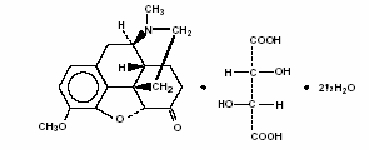
Hydrocodone bitartrate is an opioid analgesic and antitussive and occurs as fine, white crystals or as a crystalline powder. It is affected by light. The chemical name is 4,5α-epoxy-3-methoxy-17-methylmorphinan-6-one tartrate (1:1) hydrate (2:5). It has the following structural formula:
[image: MM1]
C18H21NO3 ● C4H6O6 ● 2 ½ H20
M.W. 494.490
Acetaminophen, 4’-hydroxyacetanilide, a slightly bitter, white, odorless, crystalline powder, is a non-opiate, non-salicylate analgesic and antipyretic. It has the following structural formula:
[image: MM2]
C8H9NO2
MW = 151.16
LORTAB Elixir contains: Per Per
5 mL 15 mL
Hydrocodone Bitartrate.............................2.5 mg 7.5 mg
Acetaminophen.........................................167 mg 500 mg
Alcohol......................................................7% 7%
In addition, the liquid contains the following inactive ingredients: citric acid anhydrous, ethyl maltol, glycerin, methylparaben, propylene glycol, propylparaben, purified water, saccharin sodium, sorbitol solution, sucrose, with D&C Yellow #10 and FD&C Yellow #6 as coloring and natural and artificial flavoring.
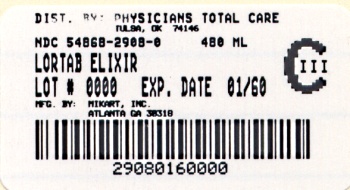
LORTAB Elixir (hydrocodone bitartrate and acetaminophen oral solution)
1 pint / 16 ounces / 473 mL
NDC 54868-2908-0
[image: MM3]
LORTAB Elixir (hydrocodone bitartrate and acetaminophen oral solution) is a yellow-colored tropical fruit punch flavored liquid containing hydrocodone bitartrate 7.5 mg and acetaminophen 500 mg per 15 mL, with 7% alcohol. It is supplied in containers of 1 pint (473 mL) NDC 54868-2908-0.
STORAGEStore at 20 to 25°C (68 to 77°F). [see USP Controlled Room Temperature]
Dispense in a tight, light-resistant container with a child-resistant closure.
For Medical Information
Contact: Medical Affairs Department
Phone: (866) 822-0068
Fax: (770) 970-8859
A Schedule CIII Narcotic
Manufactured for
UCB Pharma,
Inc.
Smyrna, GA 30080
Manufactured by
Mikart
Inc.
Atlanta, GA 30318
Relabeling of "Additional" barcode label by:
Physicians Total Care, Inc.
Tulsa, OK 74146
Photos of the product and/or packaging supplied by the manufacturer.

Rev. 7E 01/2008 Rx only
C I A 70095A 540A00
Hydrocodone is a semisynthetic narcotic analgesic and antitussive with multiple actions qualitatively similar to those of codeine. Most of these involve the central nervous system and smooth muscle. The precise mechanism of action of hydrocodone and other opiates is not known, although it is believed to relate to the existence of opiate receptors in the central nervous system. In addition to analgesia, narcotics may produce drowsiness, changes in mood and mental clouding.
The analgesic action of acetaminophen involves peripheral influences, but the specific mechanism is as yet undetermined. Antipyretic activity is mediated through hypothalamic heat regulating centers. Acetaminophen inhibits prostaglandin synthetase. Therapeutic doses of acetaminophen have negligible effects on the cardiovascular or respiratory systems; however, toxic doses may cause circulatory failure and rapid, shallow breathing.
PharmacokineticsThe behavior of the individual components is described below.
Hydrocodone
Following a 10 mg oral dose of hydrocodone administered to five adult male subjects, the mean peak concentration was 23.6 ± 5.2 ng/mL. Maximum serum levels were achieved at 1.3 ± 0.3 hours and the half-life was determined to be 3.8 ± 0.3 hours. Hydrocodone exhibits a complex pattern of metabolism including O-demethylation, N-demethylation and 6-keto reduction to the corresponding 6-α- and 6-β-hydroxymetabolites.
See OVERDOSAGE for toxicity information.
Acetaminophen
Acetaminophen is rapidly absorbed from the gastrointestinal tract and is distributed throughout most body tissues. The plasma half-life is 1.25 to 3 hours, but may be increased by liver damage and following overdosage. Elimination of acetaminophen is principally by liver metabolism (conjugation) and subsequent renal excretion of metabolites. Approximately 85% of an oral dose appears in the urine within 24 hours of administration, most as the glucuronide conjugate, with small amounts of other conjugates and unchanged drug.
See OVERDOSAGE for toxicity information.
Create a free account to view complete drug information, save medications, and more.
Free forever · No credit card required