 MedLens
Loading…
powder, for suspension · STAT RX USA LLC
Dosage Form
powder, for suspension
Manufacturer
STAT RX USA LLC
This medication contains important usage instructions, warnings, and side effect information that you should review before use.
To reduce the development of drug-resistant bacteria and maintain the
effectiveness of amoxicillin and other antibacterial drugs, amoxicillin should
be used only to treat or prevent infections that are proven or strongly
suspected to be caused by susceptible bacteria. When culture and susceptibility
information are available, they should be considered in selecting or modifying
antibacterial therapy. In the absence of such data, local epidemiology and
susceptibility patterns may contribute to the empiric selection of
therapy.
Amoxicillin is indicated in the treatment of infections due to
susceptible (ONLY β-lactamase–negative) strains of the designated microorganisms
in the conditions listed below:
Infections of the ear,
nose, and throat – due to Streptococcus spp.
(α- and β-hemolytic strains only), S. pneumoniae,
Staphylococcus spp., or H.
influenzae.
Infections of the genitourinary
tract – due to E. coli, P. mirabilis, or E. faecalis.
Infections of the
skin and skin structure – due to Streptococcus
spp. (α- and β-hemolytic strains only), Staphylococcus spp., or E.
coli.
Infections of the lower respiratory
tract – due to Streptococcus spp. (α- and
β-hemolytic strains only), S. pneumoniae,
Staphylococcus spp., or H.
influenzae.
Gonorrhea, acute uncomplicated
(ano-genital and urethral infections) – due to N.
gonorrhoeae (males and females).
Oral suspensions of amoxicillin may be given without regard to meals. The 400 mg suspension has been studied only when administered at the start of a light meal.
A history of allergic reaction to any of the penicillins is a contraindication.
Probenecid decreases the renal tubular secretion of amoxicillin. Concurrent use
of amoxicillin and probenecid may result in increased and prolonged blood levels
of amoxicillin.
Chloramphenicol, macrolides, sulfonamides, and
tetracyclines may interfere with the bactericidal effects of penicillin. This
has been demonstrated in vitro; however, the clinical
significance of this interaction is not well documented.
In common with
other antibiotics, amoxicillin may affect the gut flora, leading to lower
estrogen reabsorption and reduced efficacy of combined oral
estrogen/progesterone contraceptives.
As with other penicillins, it may be expected that untoward reactions will be essentially limited to sensitivity phenomena. They are more likely to occur in individuals who have previously demonstrated hypersensitivity to penicillins and in those with a history of allergy, asthma, hay fever, or urticaria. The following adverse reactions have been reported as associated with the use of penicillins:
Because of incompletely developed renal function in neonates and young infants, the elimination of amoxicillin may be delayed. Dosing of amoxicillin should be modified in pediatric patients 12 weeks or younger (≤3 months). (See DOSAGE AND ADMINISTRATION: Neonates and Infants .)
An analysis of clinical studies of amoxicillin was conducted to determine
whether subjects aged 65 and over respond differently from younger subjects. Of
the 1,811 subjects treated with capsules of amoxicillin, 85% were less than 60 years
old, 15% were ≥61 years old and 7% were ≥71 years old. This analysis and other
reported clinical experience have not identified differences in responses
between the elderly and younger patients, but a greater sensitivity of some
older individuals cannot be ruled out.
This drug is known to be
substantially excreted by the kidney, and the risk of toxic reactions to this
drug may be greater in patients with impaired renal function. Because elderly
patients are more likely to have decreased renal function, care should be taken
in dose selection, and it may be useful to monitor renal function.
In case of overdosage, discontinue medication, treat symptomatically, and
institute supportive measures as required. If the overdosage is very recent and
there is no contraindication, an attempt at emesis or other means of removal of
drug from the stomach may be performed. A prospective study of 51 pediatric
patients at a poison-control center suggested that overdosages of less than 250
mg/kg of amoxicillin are not associated with significant clinical symptoms and
do not require gastric emptying.3
Interstitial
nephritis resulting in oliguric renal failure has been reported in a small
number of patients after overdosage with amoxicillin.
Crystalluria, in
some cases leading to renal failure, has also been reported after amoxicillin
overdosage in adult and pediatric patients. In case of overdosage, adequate
fluid intake and diuresis should be maintained to reduce the risk of amoxicillin
crystalluria.
Renal impairment appears to be reversible with cessation
of drug administration. High blood levels may occur more readily in patients
with impaired renal function because of decreased renal clearance of
amoxicillin. Amoxicillin may be removed from circulation by hemodialysis.
Amoxicillin may be taken every 8 hours or every 12 hours, depending on the
strength of the product prescribed.
Patients should be counseled that
antibacterial drugs, including amoxicillin, should only be used to treat
bacterial infections. They do not treat viral infections (e.g., the common
cold). When amoxicillin is prescribed to treat a bacterial infection, patients
should be told that although it is common to feel better early in the course of
therapy, the medication should be taken exactly as directed. Skipping doses or
not completing the full course of therapy may: (1) decrease the effectiveness of
the immediate treatment, and (2) increase the likelihood that bacteria will
develop resistance and will not be treatable by amoxicillin or other
antibacterial drugs in the future.
Diarrhea is a common problem caused
by antibiotics which usually ends when the antibiotic is discontinued. Sometimes
after starting treatment with antibiotics, patients can develop watery and
bloody stools (with or without stomach cramps and fever) even as late as 2 or
more months after having taken the last dose of the antibiotic. If this occurs,
patients should contact their physician as soon as possible.
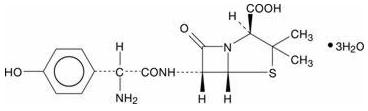
Formulations of amoxicillin for oral suspension, USP contain amoxicillin, a semisynthetic antibiotic, an analog of ampicillin, with a broad spectrum of bactericidal activity against many gram-positive and gram-negative microorganisms. Chemically, it is (2S,5R,6R)-6-[(R)-(-)-2-amino-2-(p-hydroxyphenyl)acetamido]-3,3-dimethyl-7-oxo-4-thia-1-azabicyclo[3.2.0]heptane-2-carboxylic acid trihydrate. It may be represented structurally as:
[image: MM1]
The amoxicillin molecular formula is C16H19N3O5S•3H2O, and the molecular weight is 419.45.AMOXICILLIN POWDER FOR SUSPENSION 400MG / 5mL
[image: MM2]
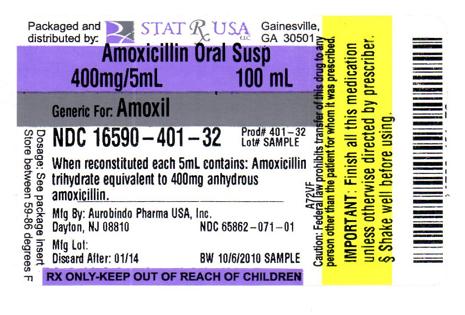
Amoxicillin for Oral Suspension, USP: Each 5 mL of
reconstituted bubble-gum-flavored pink suspension contains 200 or 400 mg
amoxicillin as the trihydrate.
200 mg/5 mL
50 mL bottle
NDC
65862-070-50
75 mL bottle
NDC
65862-070-75
100 mL bottle
NDC 65862-070-01
400 mg/5 mL
50 mL bottle
NDC
65862-071-50
75 mL bottle
NDC
65862-071-75
100 mL
bottle NDC 65862-071-01
Store dry powder at 20° to 25°C (68° to 77°F); excursions
permitted to 15° to 30°C (59° to 86°F) [see USP Controlled Room Temperature].
Photos of the product and/or packaging supplied by the manufacturer.
Amoxicillin is stable in the presence of gastric acid and is rapidly absorbed
after oral administration. The effect of food on the absorption of amoxicillin
from the suspension of amoxicillin has been partially investigated. The 400
mg formulation has been studied only when administered at the start of a light
meal. Amoxicillin diffuses readily into most body tissues and fluids, with the
exception of brain and spinal fluid, except when meninges are inflamed. The
half-life of amoxicillin is 61.3 minutes. Most of the amoxicillin is excreted
unchanged in the urine; its excretion can be delayed by concurrent
administration of probenecid. In blood serum, amoxicillin is approximately 20%
protein-bound.
Orally administered doses of amoxicillin suspension, 125
mg/5 mL and 250 mg/5 mL, result in average peak blood levels 1 to 2 hours after
administration in the range of 1.5 mcg/mL to 3 mcg/mL and 3.5 mcg/mL to 5
mcg/mL, respectively.
Detectable serum levels are observed up to 8 hours
after an orally administered dose of amoxicillin. Following a 1 gram dose and
utilizing a special skin window technique to determine levels of the antibiotic,
it was noted that therapeutic levels were found in the interstitial fluid.
Approximately 60% of an orally administered dose of amoxicillin is excreted in
the urine within 6 to 8 hours.
Long-term studies in animals have not been performed to evaluate carcinogenic potential. Studies to detect mutagenic potential of amoxicillin alone have not been conducted; however, the following information is available from tests on a 4:1 mixture of amoxicillin and potassium clavulanate. Amoxicillin and clavulanic acid mixture was non-mutagenic in the Ames bacterial mutation assay, and the yeast gene conversion assay. Amoxicillin and clavulanic acid mixture was weakly positive in the mouse lymphoma assay, but the trend toward increased mutation frequencies in this assay occurred at doses that were also associated with decreased cell survival. Amoxicillin and clavulanic acid mixture was negative in the mouse micronucleus test, and in the dominant lethal assay in mice. Potassium clavulanate alone was tested in the Ames bacterial mutation assay and in the mouse micronucleus test, and was negative in each of these assays. In a multi-generation reproduction study in rats, no impairment of fertility or other adverse reproductive effects were seen at doses up to 500 mg/kg (approximately 3 times the human dose in mg/m2).
Oral ampicillin-class antibiotics are poorly absorbed during labor. Studies in guinea pigs showed that intravenous administration of ampicillin slightly decreased the uterine tone and frequency of contractions but moderately increased the height and duration of contractions. However, it is not known whether use of amoxicillin in humans during labor or delivery has immediate or delayed adverse effects on the fetus, prolongs the duration of labor, or increases the likelihood that forceps delivery or other obstetrical intervention or resuscitation of the newborn will be necessary.
Mucocutaneous candidiasis.
Nausea, vomiting, diarrhea, black hairy tongue, and hemorrhagic/pseudomembranous
colitis.
Onset of pseudomembranous colitis symptoms may occur during or
after antibiotic treatment. (See
WARNINGS
.)
Anaphylaxis (See
WARNINGS
.)
Serum sickness–like reactions,
erythematous maculopapular rashes, erythema multiforme, Stevens-Johnson
syndrome, exfoliative dermatitis, toxic epidermal necrolysis, acute generalized
exanthematous pustulosis, hypersensitivity vasculitis and urticaria have been
reported.
NOTE: These hypersensitivity
reactions may be controlled with antihistamines and, if necessary, systemic
corticosteroids. Whenever such reactions occur, amoxicillin should be
discontinued unless, in the opinion of the physician, the condition being
treated is life-threatening and amenable only to amoxicillin therapy.
A moderate rise in AST (SGOT) and/or ALT (SGPT) has been noted, but the significance of this finding is unknown. Hepatic dysfunction including cholestatic jaundice, hepatic cholestasis and acute cytolytic hepatitis have been reported.
Crystalluria has also been reported (see OVERDOSAGE ).
Anemia, including hemolytic anemia, thrombocytopenia, thrombocytopenic purpura, eosinophilia, leukopenia, and agranulocytosis have been reported during therapy with penicillins. These reactions are usually reversible on discontinuation of therapy and are believed to be hypersensitivity phenomena.
Reversible hyperactivity, agitation, anxiety, insomnia, confusion, convulsions, behavioral changes, and/or dizziness have been reported rarely.
Tooth discoloration (brown, yellow, or gray staining) has been rarely reported. Most reports occurred in pediatric patients. Discoloration was reduced or eliminated with brushing or dental cleaning in most cases.
In clinical trials using combination therapy with amoxicillin plus clarithromycin and lansoprazole, and amoxicillin plus lansoprazole, no adverse reactions peculiar to these drug combinations were observed. Adverse reactions that have occurred have been limited to those that had been previously reported with amoxicillin, clarithromycin, or lansoprazole.
Triple Therapy Amoxicillin/Clarithromycin/LansoprazoleDue to incompletely developed renal function affecting elimination of amoxicillin in this age group, the recommended upper dose of amoxicillin is 30 mg/kg/day divided q12h.
| Infection | Severity * | Usual Adult Dose | Usual Dose for Children >3 Months+ |
| Ear/Nose/Throat |
Mild/Moderate
|
500 mg every 12 hours | 25 mg/kg/day in divided |
| or 250 mg every 8 hours | doses every 12 hours | ||
|
or
|
|||
| 20 mg/kg/day in divided | |||
| doses every 8 hours | |||
|
Severe
|
875 mg every 12 hours | 45 mg/kg/day in divided | |
| or 500 mg every 8 hours | doses every 12 hours | ||
| or | |||
| 40 mg/kg/day in divided | |||
| doses every 8 hours | |||
|
Lower Respiratory Tract
|
Mild/Moderate or Severe
|
875 mg every 12 hours | 45 mg/kg/day in divided |
| or 500 mg every 8 hours | doses every 12 hours | ||
|
or
|
|||
| 40 mg/kg/day in divided | |||
| doses every 8 hours | |||
|
Skin/Skin Structure
|
Mild/Moderate
|
500 mg every 12 hours | 25 mg/kg/day in divided |
| or 250 mg every 8 hours | doses every 12 hours | ||
|
or
|
|||
| 20 mg/kg/day in divided | |||
| doses every 8 hours | |||
|
Severe
|
875 mg every 12 hours | 45 mg/kg/day in divided | |
| or 500 mg every 8 hours | doses every 12 hours | ||
|
or
|
|||
| 40 mg/kg/day in divided | |||
| doses every 8 hours | |||
|
Genitourinary Tract
|
Mild/Moderate
|
500 mg every 12 hours | 25 mg/kg/day in divided |
| or 250 mg every 8 hours | doses every 12 hours | ||
|
or
|
|||
| 20 mg/kg/day in divided | |||
| doses every 8 hours | |||
|
Severe
|
875 mg every 12 hours | 45 mg/kg/day in divided | |
| or 500 mg every 8 hours | doses every 12 hours | ||
|
or
|
|||
| 40 mg/kg/day in divided | |||
| doses every 8 hours | |||
| Gonorrhea Acute, | 3 grams as single oral | Prepubertal children: 50 | |
| uncomplicated | dose | mg/kg amoxicillin, | |
| ano-genital and | combined with 25 mg/kg | ||
| urethral infections | probenecid as a single dose. | ||
| in males and |
NOTE: SINCE
|
||
| females |
PROBENECID IS
|
||
|
CONTRAINDICATED
|
|||
| IN CHILDREN UNDER | |||
|
2 YEARS, DO NOT USE
|
|||
|
THIS REGIMEN IN
|
|||
| THESE CASES. |
* Dosing for infections caused by less susceptible organisms should follow the recommendations for severe infections.
+The children's dosage is intended for individuals whose weight is less that 40 kg or more should be dosed according to the adult recommendations.
After reconstitution, the required amount of suspension should be placed
directly on the child’s tongue for swallowing. Alternate means of administration
are to add the required amount of suspension to formula, milk, fruit juice,
water, ginger ale, or cold drinks. These preparations should then be taken
immediately. To be certain the child is receiving full dosage, such preparations
should be consumed in entirety.
All patients with gonorrhea should be
evaluated for syphilis. (See
PRECAUTIONS: Laboratory Tests
.)
Larger
doses may be required for stubborn or severe infections.
It should be recognized that in the treatment of chronic urinary tract infections, frequent bacteriological and clinical appraisals are necessary. Smaller doses than those recommended above should not be used. Even higher doses may be needed at times. In stubborn infections, therapy may be required for several weeks. It may be necessary to continue clinical and/or bacteriological follow-up for several months after cessation of therapy. Except for gonorrhea, treatment should be continued for a minimum of 48 to 72 hours beyond the time that the patient becomes asymptomatic or evidence of bacterial eradication has been obtained. It is recommended that there be at least 10 days’ treatment for any infection caused by Streptococcus pyogenes to prevent the occurrence of acute rheumatic fever.
Patients with impaired renal function do not generally require a reduction in
dose unless the impairment is severe. Patients with a glomerular filtration rate
of 10 to 30 mL/min. should receive 500 mg or 250 mg every 12 hours, depending on
the severity of the infection. Patients with a less than 10 mL/min. glomerular
filtration rate should receive 500 mg or 250 mg every 24 hours, depending on
severity of the infection.
Hemodialysis patients should receive 500 mg
or 250 mg every 24 hours, depending on severity of the infection. They should
receive an additional dose both during and at the end of dialysis.
There are currently no dosing recommendations for pediatric
patients with impaired renal function.
Prepare suspension at time of dispensing as follows: Tap bottle until all powder
flows freely. Add approximately 1/3 of the total amount of water for
reconstitution (see table below) and shake vigorously to wet powder. Add
remainder of the water and again shake
vigorously.
200 mg/5 mL
Amount of Water
Bottle
Size
Required for Reconstitution
50
mL
35 mL
75 mL
52 mL
100 mL
69 mL
Each teaspoonful (5 mL) will contain 200 mg
amoxicillin.
400 mg/5 mL
Amount of Water
Bottle
Size Required for Reconstitution
50 mL
35 mL
75 mL
52 mL
100 mL
69
mL
Each teaspoonful (5 mL) will contain 400 mg amoxicillin.
NOTE: SHAKE ORAL SUSPENSION WELL BEFORE USING. Keep bottle
tightly closed. Any unused portion of the reconstituted suspension must be
discarded after 14 days. Refrigeration preferable, but not required.
|
|
Triple Therapy | Triple Therapy |
| Study | Evaluable Analysis* | Intent-to-Treat Analysis† |
|
|
|
|
| Study 1 | 92‡ | 86‡ |
|
|
[80 - 97.7] | [73.3 - 93.5] |
|
|
(n = 48) | (n = 55) |
|
|
|
|
| Study 2 | 86§ | 83§ |
|
|
[75.7 - 93.6] | [72 - 90.8] |
|
|
(n = 66) | (n = 70) |
|
|
Dual Therapy | Dual Therapy |
| Study | Evaluable Analysis* | Intent-to-Treat Analysis† |
|
|
|
|
| Study 1 | 77‡ | 70‡ |
|
|
[62.5 - 87.2] | [56.8 - 81.2] |
|
|
(n = 51) | (n = 60) |
|
|
|
|
| Study 2 | 66§ | 61§ |
|
|
[51.9 - 77.5] | [48.5 - 72.9] |
|
|
(n = 58) | (n = 67) |
Create a free account to view complete drug information, save medications, and more.
Free forever · No credit card required