 MedLens
Loading…
Tablets, USPCII Revised: August 2020 · Zydus Pharmaceuticals (USA) Inc.
Dosage Form
Tablets, USPCII Revised: August 2020
Manufacturer
Zydus Pharmaceuticals (USA) Inc.
This medication contains important usage instructions, warnings, and side effect information that you should review before use.
WARNING: ADDICTION, ABUSE, AND MISUSE; RISK EVALUATION AND MITIGATION STRATEGY (REMS); LIFE-THREATENING RESPIRATORY DEPRESSION; ACCIDENTAL INGESTION; NEONATAL OPIOID WITHDRAWAL SYNDROME, CYTOCHROME P450 3A4 INTERACTION; HEPATOTOXICITY, and RISKS FROM CONCOMITANT USE WITH BENZODIAZEPINES OR OTHER CNS DEPRESSANTS
Addiction, Abuse, and Misuse
Oxycodone Hydrochloride and Acetaminophen Tablets expose patients and other users to the risks of opioid addiction, abuse, and misuse, which can lead to overdose and death. Assess each patient's risk prior to prescribing Oxycodone Hydrochloride and Acetaminophen Tablets, and monitor all patients regularly for the development of these behaviors and conditions [see WARNINGS].
Opioid Analgesic Risk Evaluation and Mitigation Strategy (REMS)
To ensure that the benefits of opioid analgesics outweigh the risks of addiction, abuse, and misuse, the Food and Drug Administration (FDA) has required a REMS for these products [see WARNINGS]. Under the requirements of the REMS, drug companies with approved opioid analgesic products must make REMS-compliant education programs available to healthcare providers. Healthcare providers are strongly encouraged to
- complete a REMS-compliant education program,
- counsel patients and/or their caregivers, with every prescription, on safe use, serious risks, storage, and disposal of these products,
- emphasize to patients and their caregivers the importance of reading the Medication Guide every time it is provided by their pharmacist, and
- consider other tools to improve patient, household, and community safety.
Life-Threatening Respiratory Depression
Serious, life-threatening, or fatal respiratory depression may occur with use of Oxycodone Hydrochloride and Acetaminophen Tablets. Monitor for respiratory depression, especially during initiation of Oxycodone Hydrochloride and Acetaminophen Tablets or following a dose increase [see WARNINGS].
Accidental Ingestion
Accidental ingestion of Oxycodone Hydrochloride and Acetaminophen Tablets, especially by children, can result in a fatal overdose of Oxycodone Hydrochloride and Acetaminophen Tablets [see WARNINGS].
Neonatal Opioid Withdrawal Syndrome
Prolonged use of Oxycodone Hydrochloride and Acetaminophen Tablets during pregnancy can result in neonatal opioid withdrawal syndrome, which may be life-threatening if not recognized and treated, and requires management according to protocols developed by neonatology experts. If opioid use is required for a prolonged period in a pregnant woman, advise the patient of the risk of neonatal opioid withdrawal syndrome and ensure that appropriate treatment will be available [see WARNINGS].
Cytochrome P450 3A4 Interaction
The concomitant use of Oxycodone Hydrochloride and Acetaminophen Tablets with all cytochrome P450 3A4 inhibitors may result in an increase in oxycodone plasma concentrations, which could increase or prolong adverse reactions and may cause potentially fatal respiratory depression. In addition, discontinuation of a concomitantly used cytochrome P450 3A4 inducer may result in an increase in oxycodone plasma concentration. Monitor patients receiving Oxycodone Hydrochloride and Acetaminophen Tablets and any CYP3A4 inhibitor or inducer [see CLINICAL PHARMACOLOGY, WARNINGS, PRECAUTIONS; Drug Interactions].
Hepatoxicity
Acetaminophen has been associated with cases of acute liver failure, at times resulting in liver transplant and death. Most of the cases of liver injury are associated with the use of acetaminophen at doses that exceed 4000 mg per day, and often involve more than one acetaminophen-containing product.
Risks from Concomitant Use With Benzodiazepines Or Other CNS Depressants
Concomitant use of opioids with benzodiazepines or other central nervous system (CNS) depressants, including alcohol, may result in profound sedation, respiratory depression, coma, and death [see WARNINGS, PRECAUTIONS; Drug Interactions].
Oxycodone Hydrochloride and Acetaminophen Tablets are indicated for the management of pain severe enough to require an opioid analgesic and for which alternative treatments are inadequate.
Oxycodone Hydrochloride and Acetaminophen Tablets are contraindicated in patients with:
The following adverse reactions have been identified during post approval use of Oxycodone Hydrochloride and Acetaminophen Tablets. Because these reactions are reported voluntarily from a population of uncertain size, it is not always possible to reliably estimate their frequency or establish a causal relationship to drug exposure.
Serious adverse reactions that may be associated with oxycodone and acetaminophen use include respiratory depression, apnea, respiratory arrest, circulatory depression, hypotension, and shock [see OVERDOSAGE].
The most frequently observed non-serious adverse reactions include lightheadedness, dizziness, drowsiness or sedation, nausea, and vomiting. These effects seem to be more prominent in ambulatory than in nonambulatory patients, and some of these adverse reactions may be alleviated if the patient lies down. Other adverse reactions include euphoria, dysphoria, constipation, and pruritus.
Hypersensitivity reactions may include: Skin eruptions, urticarial, erythematous skin reactions. Hematologic reactions may include: thrombocytopenia, neutropenia, pancytopenia, hemolytic anemia. Rare cases of agranulocytosis has likewise been associated with acetaminophen use. In high doses, the most serious adverse effect is a dose-dependent, potentially fatal hepatic necrosis. Renal tubular necrosis and hypoglycemic coma also may occur.
Other adverse reactions obtained from postmarketing experiences with oxycodone and acetaminophen are listed by organ system and in decreasing order of severity and/or frequency as follows:
Body as a Whole: Anaphylactoid reaction, allergic reaction, malaise, asthenia, fatigue, chest pain, fever, hypothermia, thirst, headache, increased sweating, accidental overdose, nonaccidental overdose
Cardiovascular: Hypotension, hypertension, tachycardia, orthostatic hypotension, bradycardia, palpitations, dysrhythmias
Central and Peripheral Nervous System: Stupor, tremor, paraesthesia, hypoaesthesia, lethargy, seizures, anxiety, mental impairment, agitation, cerebral edema, confusion, dizziness
Fluid and Electrolyte: Dehydration, hyperkalemia, metabolic acidosis, respiratory alkalosis
Gastrointestinal: Dyspepsia, taste disturbances, abdominal pain, abdominal distention, sweating increased, diarrhea, dry mouth, flatulence, gastrointestinal disorder, nausea, vomiting, pancreatitis, intestinal obstruction, ileus
Hepatic: Transient elevations of hepatic enzymes, increase in bilirubin, hepatitis, hepatic failure, jaundice, hepatotoxicity, hepatic disorder
Hearing and Vestibular: Hearing loss, tinnitus
Hematologic: Thrombocytopenia
Hypersensitivity: Acute anaphylaxis, angioedema, asthma, bronchospasm, laryngeal edema, urticaria, anaphylactoid reaction
Metabolic and Nutritional: Hypoglycemia, hyperglycemia, acidosis, alkalosis
Musculoskeletal: Myalgia, rhabdomyolysis
Ocular: Miosis, visual disturbances, red eye
Psychiatric: Drug dependence, drug abuse, insomnia, confusion, anxiety, agitation, depressed level of consciousness, nervousness, hallucination, somnolence, depression, suicide
Respiratory System: Bronchospasm, dyspnea, hyperpnea, pulmonary edema, tachypnea, aspiration, hypoventilation, laryngeal edema
Skin and Appendages: Erythema, urticaria, rash, flushing
Urogenital: Interstitial nephritis, papillary necrosis, proteinuria, renal insufficiency and failure, urinary retention
Following an acute overdosage, toxicity may result from the oxycodone or the acetaminophen.
Clinical Presentation
Acute overdosage with oxycodone can be manifested by respiratory depression, somnolence progressing to stupor or coma, skeletal muscle flaccidity, cold and clammy skin, constricted pupils, and, in some cases, pulmonary edema, bradycardia, hypotension, partial or complete airway obstruction, atypical snoring, and death. Marked mydriasis rather than miosis may be seen with hypoxia in overdose situations.
Acetaminophen
Dose-dependent potentially fatal hepatic necrosis is the most serious adverse effect of acetaminophen overdosage. Renal tubular necrosis, hypoglycemic coma, and coagulation defects may also occur.
Early symptoms following a potentially hepatotoxic overdose may include: nausea, vomiting, diaphoresis, and general malaise. Clinical and laboratory evidence of hepatic toxicity may not be apparent until 48 to 72 hours post-ingestion.
|
Medication Guide
Oxycodone Hydrochloride (ox" i koe' done hye" droe klor' ide) and Acetaminophen (a seet" a min' oh fen) Tablets, CII |
Oxycodone Hydrochloride and Acetaminophen Tablets are:
|
Important information about Oxycodone Hydrochloride and Acetaminophen Tablets:
|
Do not take Oxycodone Hydrochloride and Acetaminophen Tablets if you have:
|
Before taking Oxycodone Hydrochloride and Acetaminophen Tablets tell your healthcare provider if you have a history of:
|
When taking Oxycodone Hydrochloride and Acetaminophen Tablets:
|
While taking Oxycodone Hydrochloride and Acetaminophen Tablets DO NOT:
|
The possible side effects of Oxycodone Hydrochloride and Acetaminophen Tablets:
Get emergency medical help or call 911 right away if you have:
Tablets. Call your doctor for medical advice about side effects. You may report side effects to FDA at 1-800-FDA-1088. For more information go to dailymed.nlm.nih.gov. Manufactured by: Nesher Pharmaceuticals (USA) LLC for Zydus Pharmaceuticals USA, Inc., Pennington, NJ 08534, www.zydus.com or call 1-877-993-8779. |
This Medication Guide has been approved by the U.S. Food and Drug Administration.
Revised 08/2020
Oxycodone Hydrochloride and Acetaminophen is available in tablets for oral administration.
Each tablet for oral administration contains:
Oxycodone Hydrochloride, USP……….2.5 mg*
(*2.5 mg Oxycodone Hydrochloride is equivalent to 2.2409 mg of Oxycodone.)
Acetaminophen, USP…………………..325 mg
Oxycodone Hydrochloride, USP…………5 mg*
(*5 mg Oxycodone Hydrochloride is equivalent to 4.4815 mg of Oxycodone.)
Acetaminophen, USP………………….325 mg
Oxycodone Hydrochloride, USP……….7.5 mg*
(*7.5 mg Oxycodone Hydrochloride is equivalent to 6.7228 mg of Oxycodone.)
Acetaminophen, USP…………………..325 mg
Oxycodone Hydrochloride, USP………..10 mg*
(*10 mg Oxycodone Hydrochloride is equivalent to 8.9637 mg of Oxycodone.)
Acetaminophen, USP…………………..325 mg
Inactive Ingredients
The tablets contain: colloidal silicon dioxide, microcrystalline cellulose, stearic acid, povidone, and croscarmellose sodium.
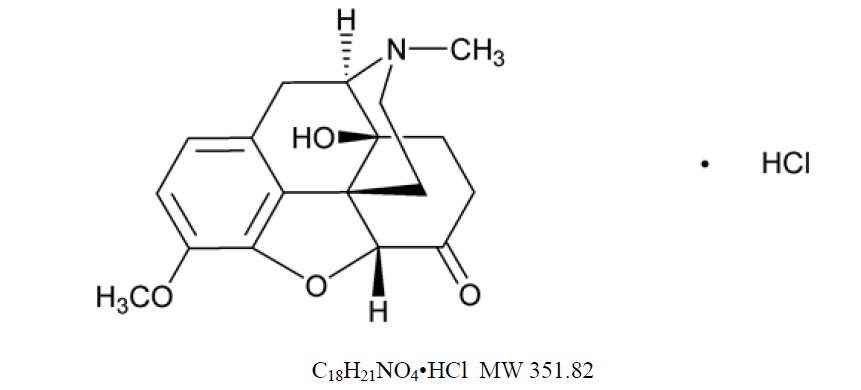
Oxycodone Hydrochloride and Acetaminophen Tablets contain oxycodone, 14-hydroxydihydrocodeinone, a semisynthetic opioid analgesic which occurs as a white to off-white fine crystalline powder. The molecular formula for oxycodone hydrochloride is C18H21NO4•HCl and the molecular weight is 351.82. It is derived from the opium alkaloid thebaine, and may be represented by the following structural formula:
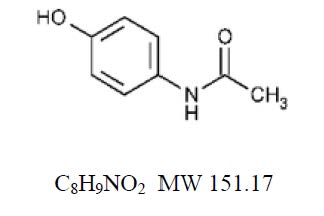
[image: MM1]Oxycodone Hydrochloride and Acetaminophen Tablets contain acetaminophen, 4'-hydroxyacetanilide, a non-opiate, non-salicylate analgesic and antipyretic which occurs as a white, odorless, crystalline powder. The molecular formula for acetaminophen is C8H9NO2 and the molecular weight is 151.17. It may be represented by the following structural formula:
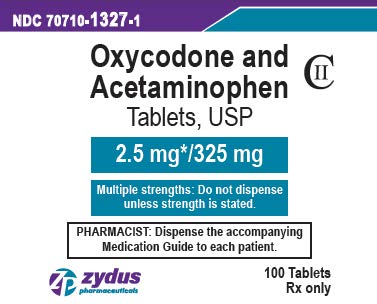
[image: MM2]NDC 70710-1327-1
Oxycodone and Acetaminophen Tablets, USP CII
2.5 mg* / 325 mg
Multiple strengths: Do not dispense unless strength is stated.
Pharmacist: Dispense the accompanying Medication Guide to each patient.
Zydus Pharmaceuticals
100 Tablets
Rx Only
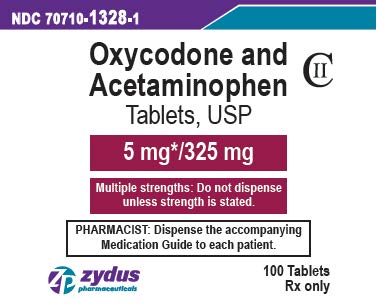
[image: MM3]NDC 70710-1328-1
Oxycodone and Acetaminophen Tablets, USP CII
5 mg* / 325 mg
Multiple strengths: Do not dispense unless strength is stated.
Pharmacist: Dispense the accompanying Medication Guide to each patient.
Zydus Pharmaceuticals
100 Tablets
Rx Only
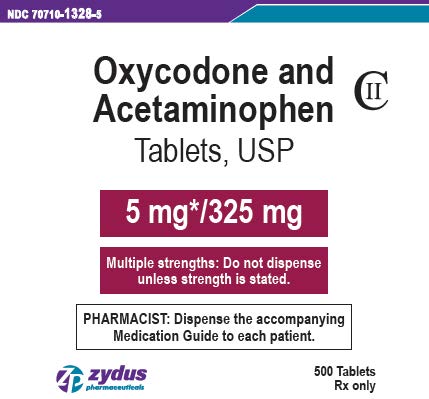
[image: MM4]NDC 70710-1328-5
Oxycodone and Acetaminophen Tablets, USP CII
5 mg* / 325 mg
Multiple strengths: Do not dispense unless strength is stated.
Pharmacist: Dispense the accompanying Medication Guide to each patient.
Zydus Pharmaceuticals
500 Tablets
Rx Only
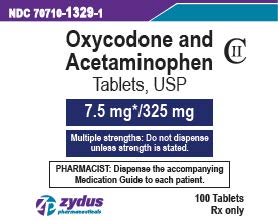
[image: MM5]NDC 70710-1329-1
Oxycodone and Acetaminophen Tablets, USP CII
7.5 mg* / 325 mg
Multiple strengths: Do not dispense unless strength is stated.
Pharmacist: Dispense the accompanying Medication Guide to each patient.
Zydus Pharmaceuticals
100 Tablets
Rx Only
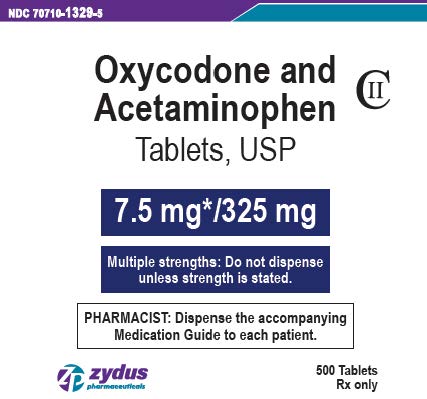
[image: MM6]NDC 70710-1329-5
Oxycodone and Acetaminophen Tablets, USP CII
7.5 mg* / 325 mg
Multiple strengths: Do not dispense unless strength is stated.
Pharmacist: Dispense the accompanying Medication Guide to each patient.
Zydus Pharmaceuticals
500 Tablets
Rx Only
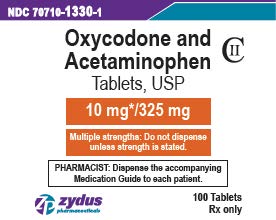
[image: MM7]NDC 70710-1330-1
Oxycodone and Acetaminophen Tablets, USP CII
10 mg* / 325 mg
Multiple strengths: Do not dispense unless strength is stated.
Pharmacist: Dispense the accompanying Medication Guide to each patient.
Zydus Pharmaceuticals
100 Tablets
Rx Only
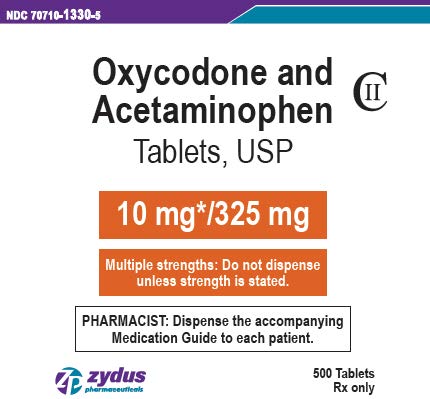
[image: MM8]NDC 70710-1330-5
Oxycodone and Acetaminophen Tablets, USP CII
10 mg* / 325 mg
Multiple strengths: Do not dispense unless strength is stated.
Pharmacist: Dispense the accompanying Medication Guide to each patient.
Zydus Pharmaceuticals
500 Tablets
Rx Only
[image: MM9]Oxycodone Hydrochloride and Acetaminophen Tablets, USP are supplied as follows:
2.5 mg/325 mg
White to off-white, oval tablet, debossed with "1327" on one side and plain on the other.
Bottles of 100……………………..NDC 70710-1327-1
5 mg/325 mg
White to off-white, round tablet, debossed with "1328" on one side and bisect on the other.
Bottles of 100……………………..NDC 70710-1328-1
Bottles of 500……………………..NDC 70710-1328-5
7.5 mg/325 mg
White to off-white, oval shaped tablet, debossed with "1329" on one side and plain on the other.
Bottles of 100……………………..NDC 70710-1329-1
Bottles of 500……………………..NDC 70710-1329-5
10 mg/325 mg
White to off-white, capsule shaped tablet, debossed with "1330" on one side and plain on the other.
Bottles of 100……………………..NDC 70710-1330-1
Bottles of 500……………………..NDC 70710-1330-5
Store Oxycodone Hydrochloride and Acetaminophen Tablets securely and dispose of properly [see PRECAUTIONS/Information for Patients ].
Storage
Store at 20° to 25°C (68° to 77°F) [See USP Controlled Room Temperature]. Protect from moisture.
Dispense in a tight, light-resistant container as defined in the USP, with a child-resistant closure (as required).
DEA Order Form Required.
Keep this and all drugs out of the reach of children.
Manufactured By:
Nesher Pharmaceuticals USA LLC
St. Louis, MO 63044
Distributed by:
Zydus Pharmaceuticals USA Inc. Pennington, NJ 08534
PI-Rasub-7 August 2020
For additional copies of the printed patient information/medication guide, please visit www.zydus.com or call 1-877-993-8779.
Photos of the product and/or packaging supplied by the manufacturer.
Mechanism of Action
Oxycodone is a full opioid agonist with relative selectivity for the mu-opioid receptor, although it can interact with other opioid receptors at higher doses. The principal therapeutic action of oxycodone is analgesia. Like all full opioid agonists, there is no ceiling effect for analgesia with oxycodone.
Clinically, dosage is titrated to provide adequate analgesia and may be limited by adverse reactions, including respiratory and CNS depression.
The precise mechanism of the analgesic action is unknown. However, specific CNS opioid receptors for endogenous compounds with opioid-like activity have been identified throughout the brain and spinal cord and are thought to play a role in the analgesic effects of this drug.
The precise mechanism of the analgesic properties of acetaminophen is not established but is thought to involve central actions.
Pharmacodynamics
Effects on the Central Nervous System
Oxycodone produces respiratory depression by direct action on brain stem respiratory centers. The respiratory depression involves a reduction in the responsiveness of the brain stem respiratory centers to both increases in carbon dioxide tension and electrical stimulation.
Oxycodone causes miosis, even in total darkness. Pinpoint pupils are a sign of opioid overdose but are note pathognomonic (e.g., pontine lesions of hemorrhagic or ischemic origins may produce similar findings). Marked mydriasis rather than miosis may be seen due to hypoxia in overdose situations.
Therapeutic doses of acetaminophen have negligible effects on the cardiovascular or respiratory systems; however, toxic doses may cause circulatory failure and rapid, shallow breathing.
Effects on the Gastrointestinal Tract and Other Smooth Muscle
Oxycodone causes a reduction in motility associated with an increase in smooth muscle tone in the antrum of the stomach and duodenum. Digestion of food in the small intestine is delayed and propulsive contractions are decreased, while tone may be increased to the point of spasm, resulting in constipation. Other opioid-induced effects may include a reduction in biliary and pancreatic secretions, spasm of the sphincter of Oddi, and transient elevations in serum amylase.
Effects on the Cardiovascular System
Oxycodone produces peripheral vasodilation which may result in orthostatic hypotension or syncope. Manifestations of histamine release and/or peripheral vasodilation may include pruritus, flushing, red eyes, sweating, and/or orthostatic hypotension.
Effects on the Endocrine System
Opioids inhibit the secretion of adrenocorticotropic hormone (ACTH), cortisol, and lutenizing hormone (LH) in humans [see ADVERSE REACTIONS]. They also stimulate prolactin, growth hormone (GH) secretion, and pancreatic secretion of insulin and glucagon.
Chronic use of opioids may influence the hypothalamic-pituitary-gonadal axis, leading to androgen deficiency that may manifest as symptoms as low libido, impotence, erectile dysfunction, amenorrhea, or infertility. The causal role of opioids in the syndrome of hypogonadism is unknown because the various medical, physical, lifestyle, and psychological stressors that may influence gonadal hormone levels have not been adequately controlled for in studies conducted to date [see ADVERSE REACTIONS].
Effects on the Immune System
Opioids have been shown to have a variety of effects on components of the immune system. The clinical significance of these findings is unknown. Overall, the effects of opioids appear to be modestly immunosuppressive.
Concentration-Efficacy Relationships
The minimum effective analgesic concentration will vary widely among patients, especially among patients who have been previously treated with potent agonist opioids. The minimum effective analgesic concentration of oxycodone for any individual patient may increase over time due to an increase in pain, the development of a new pain syndrome, and/or the development of analgesic tolerance [see Dosage and Administration].
Concentration-Adverse Reaction Relationships
There is a relationship between increasing oxycodone plasma concentration and increasing frequency of dose-related opioid adverse reactions such as nausea, vomiting, CNS effects, and respiratory depression. In opioid-tolerant patients, the situation may be altered by the development of tolerance to opioid-related adverse reactions [see Dosage and Administration].
Pharmacokinetics
Absorption and Distribution
The mean absolute oral bioavailability of oxycodone in cancer patients was reported to be about 87%. Oxycodone has been shown to be 45% bound to human plasma proteins in vitro. The volume of distribution after intravenous administration is 211.9 ±186.6 L.
Absorption of acetaminophen is rapid and almost complete from the GI tract after oral administration. With overdosage, absorption is complete in 4 hours. Acetaminophen is relatively uniformly distributed throughout most body fluids. Binding of the drug to plasma proteins is variable; only 20% to 50% may be bound at the concentrations encountered during acute intoxication.
Metabolism and Elimination
Oxycodone
In humans, oxycodone is extensively metabolized to noroxycodone by means of CYP3A-mediated N-demethylation, oxymorphone by means of CYP2D6-mediated O-demethylation, and their glucuronides [see PRECAUTIONS; Drug Interactions]
Acetaminophen
Acetaminophen is rapidly absorbed from the gastrointestinal tract and is distributed throughout most body tissues. A small fraction (10-25%) of acetaminophen is bound to plasma proteins. The plasma half-life is 1.25 to 3 hours, but may be increased by liver damage and following overdosage. Elimination of acetaminophen is principally by liver metabolism (conjugation) and subsequent renal excretion of metabolites. Acetaminophen is primarily metabolized in the liver by first-order kinetics and involves three principal separate pathways: conjugation with glucuronide; conjugation with sulfate; and oxidation via the cytochrome, P450-dependent mixed-function oxidase enzyme pathway to form a reactive intermediate metabolite, which conjugates with glutathione and is then further metabolized to form cysteine and mercapturic acid conjugates. The principal cytochrome P450 isoenzyme involved appears to be CPY2E1, with CYP1A2 and CYP3A4 as additional pathways. Approximately 85% of an oral dose appears in the urine within 24 hours of administration, most as the glucuronide conjugate, with small amounts of other conjugates and unchanged drug [see OVERDOSAGE] for toxicity information.
Create a free account to view complete drug information, save medications, and more.
Free forever · No credit card required