 MedLens
Loading…
STAT RX USA LLC
Dosage Form
N/A
Manufacturer
STAT RX USA LLC
This medication contains important usage instructions, warnings, and side effect information that you should review before use.
Amoxicillin is indicated in the treatment of infections due to susceptible (ONLY
β-lactamase–negative) strains of the designated microorganisms in the conditions
listed below:
Infections of the ear, nose, and throat
– due to Streptococcus spp. (α- and
β-hemolytic strains only), S. pneumoniae, Staphylococcus spp., or H.
influenzae.
Infections of the genitourinary tract
– due to E. coli, P. mirabilis, or E. faecalis.
Infections of the skin
and skin structure – due to Streptococcus spp.
(α- and β-hemolytic strains only), Staphylococcus
spp., or E. coli.
Infections
of the lower respiratory tract – due to Streptococcus spp. (α- and β-hemolytic strains only), S. pneumoniae, Staphylococcus spp., or H. influenzae.
Gonorrhea, acute
uncomplicated (ano-genital and urethral infections) – due to N. gonorrhoeae (males and females).
H. pylori
eradication to reduce the risk of duodenal ulcer
recurrence
Triple Therapy
Amoxicillin/clarithromycin/lansoprazole
Amoxicillin,
in combination with clarithromycin plus lansoprazole as triple therapy, is
indicated for the treatment of patients with H.
pylori infection and duodenal ulcer disease (active or 1-year history of
a duodenal ulcer) to eradicate H. pylori. Eradication
of H. pylori has been shown to reduce the risk of
duodenal ulcer recurrence. (See
CLINICAL
STUDIES
and
DOSAGE AND
ADMINISTRATION
.)
Dual Therapy
Amoxicillin/lansoprazole
Amoxicillin, in
combination with lansoprazole delayed-release capsules as dual therapy, is
indicated for the treatment of patients with H.
pylori infection and duodenal ulcer disease (active or 1-year history of
a duodenal ulcer) who are either allergic or intolerant to
clarithromycin or in whom resistance to clarithromycin is known or
suspected. (See the clarithromycin package insert, MICROBIOLOGY.)
Eradication of H. pylori has been shown to reduce the
risk of duodenal ulcer recurrence. (See
CLINICAL STUDIES
and
DOSAGE AND ADMINISTRATION
.)
To reduce the
development of drug-resistant bacteria and maintain the effectiveness of
amoxicillin and other antibacterial drugs, amoxicillin should be used only to
treat or prevent infections that are proven or strongly suspected to be caused
by susceptible bacteria. When culture and susceptibility information are
available, they should be considered in selecting or modifying antibacterial
therapy. In the absence of such data, local epidemiology and susceptibility
patterns may contribute to the empiric selection of therapy.
Indicated
surgical procedures should be performed.
| Infection |
|
Severity * |
|
Usual Adult Dose | Usual Dose for Children |
|
|
|
|
|
|
>3 Months†‡ |
|
|
|
|
|
|
|
| Ear/Nose/Throat |
|
Mild/Moderate |
|
500 mg every 12 hours | 25 mg/kg/day in divided |
|
|
|
|
|
or | doses every 12 hours |
|
|
|
|
|
250 mg every 8 hours | or |
|
|
|
|
|
|
20 mg/kg/day in divided |
|
|
|
|
|
|
doses every 8 hours |
|
|
|
|
|
|
|
|
|
|
Severe |
|
875 mg every 12 hours | 45 mg/kg/day in divided |
|
|
|
|
|
or | doses every 12 hours |
|
|
|
|
|
500 mg every 8 hours | or |
|
|
|
|
|
|
40 mg/kg/day in divided |
|
|
|
|
|
|
doses every 8 hours |
|
|
|
|
|
|
|
| Lower Rispiratory Tract |
|
Mild/Moderate or Severe |
|
875 mg every 12 hours | 45 mg/kg/day in divided |
|
|
|
|
|
or | doses every 12 hours |
|
|
|
|
|
500 mg every 8 hours | or |
|
|
|
|
|
|
40 mg/kg/day in divided |
|
|
|
|
|
|
doses every 8 hours |
|
|
|
|
|
|
|
| Skin/Skin Structure |
|
Mild/Moderate |
|
500 mg every 12 hours | 25 mg/kg/day in divided |
|
|
|
|
|
or | doses every 12 hours |
|
|
|
|
|
250 mg every 8 hours | or |
|
|
|
|
|
|
20 mg/kg/day in divided |
|
|
|
|
|
|
doses every 8 hours |
|
|
|
|
|
|
|
|
|
|
Severe |
|
875 mg every 12 hours | 45 mg/kg/day in divided |
|
|
|
|
|
or | doses every 12 hours |
|
|
|
|
|
500 mg every 8 hours | or |
|
|
|
|
|
|
40 mg/kg/day in divided |
|
|
|
|
|
|
doses every 8 hours |
|
|
|
|
|
|
|
| Genitourinary Tract |
|
Mild/Moderate |
|
500 mg every 12 hours | 25 mg/kg/day in divided |
|
|
|
|
|
or | doses every 12 hours |
|
|
|
|
|
250 mg every 8 hours | or |
|
|
|
|
|
|
20 mg/kg/day in divided |
|
|
|
|
|
|
doses every 8 hours |
|
|
|
|
|
|
|
|
|
|
Severe |
|
875 mg every 12 hours | 45 mg/kg/day in divided |
|
|
|
|
|
or | doses every 12 hours |
|
|
|
|
|
500 mg every 8 hours | or |
|
|
|
|
|
|
40 mg/kg/day in divided |
|
|
|
|
|
|
doses every 8 hours |
|
|
|
|
|
|
|
| Gonorrhea Acute, |
|
|
|
3 grams as single oral | Prepubertal children: |
| uncomplicated |
|
|
|
dose | 50 mg/kg amoxicillin, |
| ano-genital and |
|
|
|
|
combined with 25 mg/kg |
| urethral infections |
|
|
|
|
probenecid as a single |
| in males and females |
|
|
|
|
dose. |
|
|
|
|
|
|
NOTE: SINCE |
|
|
|
|
|
|
PROBENECID IS |
|
|
|
|
|
|
CONTRAINDICATED |
|
|
|
|
|
|
IN CHILDREN UNDER |
|
|
|
|
|
|
2 YEARS, DO NOT USE |
|
|
|
|
|
|
THIS REGIMEN IN |
|
|
|
|
|
|
THESE CASES. |
A history of allergic reaction to any of the penicillins is a contraindication.
As with other penicillins, it may be expected that untoward reactions will be
essentially limited to sensitivity phenomena. They are more likely to occur in
individuals who have previously demonstrated hypersensitivity to penicillins and
in those with a history of allergy, asthma, hay fever, or urticaria. The
following adverse reactions have been reported as associated with the use of
penicillins:
Infections and
Infestations
Mucocutaneous candidiasis.
Gastrointestinal
Nausea, vomiting, diarrhea,
black hairy tongue, and hemorrhagic/pseudomembranous colitis.
Onset of
pseudomembranous colitis symptoms may occur during or after antibiotic
treatment. (See
WARNINGS
.)
Hypersensitivity Reactions
Anaphylaxis (See
WARNINGS
.)
Serum
sickness–like reactions, erythematous maculopapular rashes, erythema multiforme,
Stevens-Johnson syndrome, exfoliative dermatitis, toxic epidermal necrolysis,
acute generalized exanthematous pustulosis, hypersensitivity vasculitis and
urticaria have been reported.
NOTE: These
hypersensitivity reactions may be controlled with antihistamines and, if
necessary, systemic corticosteroids. Whenever such reactions occur, amoxicillin
should be discontinued unless, in the opinion of the physician, the condition
being treated is life-threatening and amenable only to amoxicillin therapy.
Liver
A moderate rise in AST (SGOT) and/or ALT
(SGPT) has been noted, but the significance of this finding is unknown. Hepatic
dysfunction including cholestatic jaundice, hepatic cholestasis and acute
cytolytic hepatitis have been reported.
Renal
Crystalluria has also been reported (see
OVERDOSAGE
).
Hemic and Lymphatic Systems
Anemia, including
hemolytic anemia, thrombocytopenia, thrombocytopenic purpura, eosinophilia,
leukopenia, and agranulocytosis have been reported during therapy with
penicillins. These reactions are usually reversible on discontinuation of
therapy and are believed to be hypersensitivity phenomena.
Central Nervous System
Reversible
hyperactivity, agitation, anxiety, insomnia, confusion, convulsions, behavioral
changes, and/or dizziness have been reported rarely.
Miscellaneous
Tooth discoloration (brown,
yellow, or gray staining) has been rarely reported. Most reports occurred in
pediatric patients. Discoloration was reduced or eliminated with brushing or
dental cleaning in most cases.
Combination Therapy with
Clarithromycin and Lansoprazole
In clinical trials using
combination therapy with amoxicillin plus clarithromycin and lansoprazole, and
amoxicillin plus lansoprazole, no adverse reactions peculiar to these drug
combinations were observed. Adverse reactions that have occurred have been
limited to those that had been previously reported with amoxicillin,
clarithromycin, or lansoprazole.
Triple Therapy
Amoxicillin/Clarithromycin/Lansoprazole
The most
frequently reported adverse events for patients who received triple therapy were
diarrhea (7%), headache (6%), and taste perversion (5%). No treatment-emergent
adverse events were observed at significantly higher rates with triple therapy
than with any dual therapy regimen.
Dual Therapy
Amoxicillin/Lansoprazole
The most frequently
reported adverse events for patients who received amoxicillin three times daily
plus lansoprazole three times daily dual therapy were diarrhea (8%) and headache
(7%). No treatment-emergent adverse events were observed at significantly higher
rates with amoxicillin three times daily plus lansoprazole three times daily
dual therapy than with lansoprazole alone.
For more information on
adverse reactions with clarithromycin or lansoprazole, refer to their package
inserts, ADVERSE REACTIONS.
In case of overdosage, discontinue medication, treat symptomatically, and
institute supportive measures as required. If the overdosage is very recent and
there is no contraindication, an attempt at emesis or other means of removal of
drug from the stomach may be performed. A prospective study of 51 pediatric
patients at a poison-control center suggested that overdosages of less than 250
mg/kg of amoxicillin are not associated with significant clinical symptoms and
do not require gastric emptying.3
Interstitial
nephritis resulting in oliguric renal failure has been reported in a small
number of patients after overdosage with amoxicillin.
Crystalluria, in
some cases leading to renal failure, has also been reported after amoxicillin
overdosage in adult and pediatric patients. In case of overdosage, adequate
fluid intake and diuresis should be maintained to reduce the risk of amoxicillin
crystalluria.
Renal impairment appears to be reversible with cessation
of drug administration. High blood levels may occur more readily in patients
with impaired renal function because of decreased renal clearance of
amoxicillin. Amoxicillin may be removed from circulation by hemodialysis.
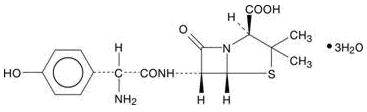
Formulations of amoxicillin tablets, USP contain amoxicillin, a semisynthetic antibiotic, an analog of ampicillin, with a broad spectrum of bactericidal activity against many gram-positive and gram-negative microorganisms. Chemically, it is (2S,5R,6R)-6-[(R)-(-)-2-amino-2-(p-hydroxyphenyl)acetamido]-3,3-dimethyl-7-oxo-4-thia-1-azabicyclo[3.2.0]heptane-2-carboxylic acid trihydrate. It may be represented structural formula as:
[image: MM1]The amoxicillin molecular formula is C16H19N3O5S•3H2O, and the molecular weight is 419.45.[image: MM2]
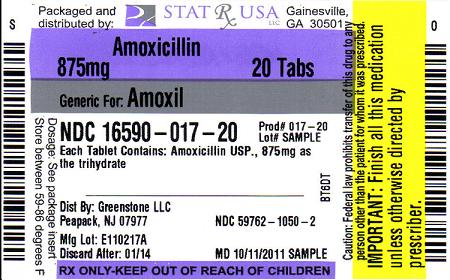
Amoxicillin Tablets, USP contains 875 mg amoxicillin as
the trihydrate.
875 mg Tablet
Pink
colored, capsule shaped, film coated tablets debossed with “A” on one side and
with a score line in between “6” and “7” on the other
side.
Bottles of 20 NDC
59762-1050-2
Bottles of 100 NDC
59762-1050-5
Store at 20° to 25°C (68° to 77°F);
excursions permitted to 15° to 30°C (59° to 86°F) [see USP Controlled Room
Temperature].
Dispense in a tight container.
Photos of the product and/or packaging supplied by the manufacturer.
To reduce the development of drug-resistant bacteria and maintain the effectiveness of amoxicillin and other antibacterial drugs, amoxicillin should be used only to treat or prevent infections that are proven or strongly suspected to be caused by bacteria.
Amoxicillin is stable in the presence of gastric acid and is rapidly absorbed
after oral administration. The effect of food on the absorption of amoxicillin
from the tablets and suspension of amoxicillin has been partially investigated.
The 400 mg and 875 mg formulations have been studied only when administered at
the start of a light meal. However, food effect studies have not been performed
with the 200 mg and 500 mg formulations. Amoxicillin diffuses readily into most
body tissues and fluids, with the exception of brain and spinal fluid, except
when meninges are inflamed. The half-life of amoxicillin is 61.3 minutes. Most
of the amoxicillin is excreted unchanged in the urine; its excretion can be
delayed by concurrent administration of probenecid. In blood serum, amoxicillin
is approximately 20% protein-bound.
Orally administered doses of 250 mg
and 500 mg amoxicillin capsules result in average peak blood levels 1 to 2 hours
after administration in the range of 3.5 mcg/mL to 5 mcg/mL and 5.5 mcg/mL to
7.5 mcg/mL, respectively.
Mean amoxicillin pharmacokinetic parameters
from an open, two-part, single-dose crossover bioequivalence study in 27 adults
comparing 875 mg of amoxicillin with 875 mg of amoxicillin/clavulanate potassium
showed that the 875 mg tablet of amoxicillin produces an AUC0-∞ of 35.4 ± 8.1 mcg•hr/mL and a Cmax
of 13.8 ± 4.1 mcg/mL. Dosing was at the start of a light meal following an
overnight fast.
Orally administered doses of amoxicillin suspension, 125
mg/5 mL and 250 mg/5 mL, result in average peak blood levels 1 to 2 hours after
administration in the range of 1.5 mcg/mL to 3 mcg/mL and 3.5 mcg/mL to 5
mcg/mL, respectively.
Oral administration of single doses of 400 mg
chewable tablets and 400 mg/5 mL suspension of amoxicillin to 24 adult
volunteers yielded comparable pharmacokinetic data:
| Dose * |
|
AUC 0-∞ (mcg•hr/mL) |
|
Cmax (mcg/mL)† |
| Amoxicillin |
|
Amoxicillin |
|
Amoxicillin |
|
|
|
(±S.D.) |
|
(±S.D.) |
|
|
|
|
|
|
| 400 mg (5 mL of suspension) |
|
17.1 (3.1) |
|
5.92 (1.62) |
| 400 mg (1 chewable tablet) |
|
17.9 (2.4) |
|
5.18 (1.64) |
| Study |
|
Triple Therapy | Triple Therapy |
|
|
|
Evaluable Analysis * | Intent-to-Treat Analysis † |
|
|
|
|
|
| Study 1 |
|
92‡ | 86‡ |
|
|
|
[80 - 97.7] | [73.3 - 93.5] |
|
|
|
(n = 48) | (n = 55) |
|
|
|
|
|
| Study 2 |
|
86§ | 83§ |
|
|
|
[75.7 - 93.6] | [72 - 90.8] |
|
|
|
(n = 66) | (n = 70) |
| Study |
|
Dual Therapy | Dual Therapy |
|
|
|
Evaluable Analysis * | Intent-to-Treat Analysis † |
|
|
|
|
|
| Study 1 |
|
77‡ | 70‡ |
|
|
|
[62.5 - 87.2] | [56.8 - 81.2] |
|
|
|
(n = 51) | (n = 60) |
|
|
|
|
|
| Study 2 |
|
66§ | 61§ |
|
|
|
[51.9 - 77.5] | [48.5 - 72.9] |
|
|
|
(n = 58) | (n = 67) |
Create a free account to view complete drug information, save medications, and more.
Free forever · No credit card required