 MedLens
Loading…
Tablets, USP50 mg/325 mg/40 mg Rx Only · Zydus Pharmaceuticals (USA) Inc.
Dosage Form
Tablets, USP50 mg/325 mg/40 mg Rx Only
Manufacturer
Zydus Pharmaceuticals (USA) Inc.
This medication contains important usage instructions, warnings, and side effect information that you should review before use.
Hepatotoxicity
Acetaminophen has been associated with cases of acute liver failure, at times resulting in liver transplant and death. Most of the cases of liver injury are associated with the use of acetaminophen at doses that exceed 4000 milligrams per day, and often involve more than one acetaminophen-containing product.
Butalbital, acetaminophen, and caffeine tablets are indicated for the relief of the symptom complex of tension (or muscle contraction) headache.
Evidence supporting the efficacy and safety of this combination product in the treatment of multiple recurrent headaches is unavailable. Caution in this regard is required because butalbital is habit-forming and potentially abusable.
One or two tablets every 4 hours as needed. Total daily dosage should not exceed six tablets.
Extended and repeated use of this product is not recommended because of the potential for physical dependence.
This product is contraindicated under the following conditions:
The CNS effects of butalbital may be enhanced by monoamine oxidase (MAO) inhibitors.
Butalbital, acetaminophen, and caffeine may enhance the effects of: other narcotic analgesics, alcohol, general anesthetics, tranquilizers such as chlordiazepoxide, sedative-hypnotics, or other CNS depressants, causing increased CNS depression.
Teratogenic Effects
Pregnancy Category C:
Animal reproduction studies have not been conducted with this combination product. It is also not known whether butalbital, acetaminophen, and caffeine can cause fetal harm when administered to a pregnant woman or can affect reproduction capacity. This product should be given to a pregnant woman only when clearly needed.
Nonteratogenic Effects
Withdrawal seizures were reported in a two-day-old male infant whose mother had taken a butalbital-containing drug during the last two months of pregnancy. Butalbital was found in the infant's serum. The infant was given phenobarbital 5 mg/kg, which was tapered without further seizure or other withdrawal symptoms.
Caffeine, barbiturates, and acetaminophen are excreted in breast milk in small amounts, but the significance of their effects on nursing infants is not known. Because of potential for serious adverse reactions in nursing infants from butalbital, acetaminophen, and caffeine, a decision should be made whether to discontinue nursing or to discontinue the drug, taking into account the importance of the drug to the mother.
Safety and effectiveness in pediatric patients below the age of 12 have not been established.
Clinical studies of butalbital, acetaminophen, and caffeine tablets did not include sufficient numbers of subjects aged 65 and over to determine whether they response differently from younger subjects. Other reported clinical experience had not identified differences in responses between the elderly and younger patients. In general, dose selection for an elderly patient should be cautious, usually starting at the low end of the dosing range, reflecting the greater frequency of decreased hepatic, renal, or cardiac function, and of concomitant disease or other drug therapy.
Butalbital is known to be substantially excreted by the kidney, and the risk of toxic reactions to this drug may be greater in patients with impaired renal function. Because elderly patients are more likely to have decreased renal functions, care should be taken in dose selections, and it may be useful to monitor renal function.
Following an acute overdosage of butalbital, acetaminophen, and caffeine, toxicity may result from the barbiturate or the acetaminophen. Toxicity due to caffeine is less likely, due to the relatively small amounts in this formulation.
Butalbital, Acetaminophen, and Caffeine Tablets, USP are supplied in tablet form for oral administration.
Each tablet contains the following active ingredients:
Butalbital, USP 50 mg
Acetaminophen, USP 325 mg
Caffeine, USP 40 mg
Inactive Ingredients: colloidal silicon dioxide, croscarmellose sodium, magnesium stearate, microcrystalline cellulose, and stearic acid.
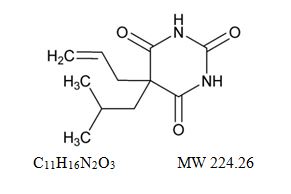
Butalbital (5-allyl-5-isobutylbarbituric acid), is a short- to intermediate-acting barbiturate. It has the following structural formula:
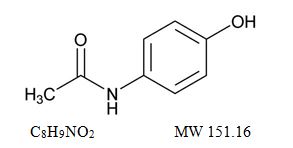
[image: MM1]Acetaminophen (4ʹ-hydroxyacetanilide), is a non-opiate, non-salicylate analgesic and antipyretic. It has the following structural formula:
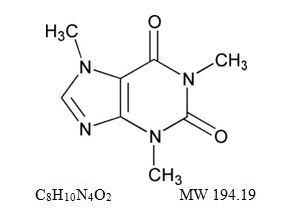
[image: MM2]Caffeine (1,3,7-trimethylxanthine), is a central nervous system stimulant. It has the following structural formula:
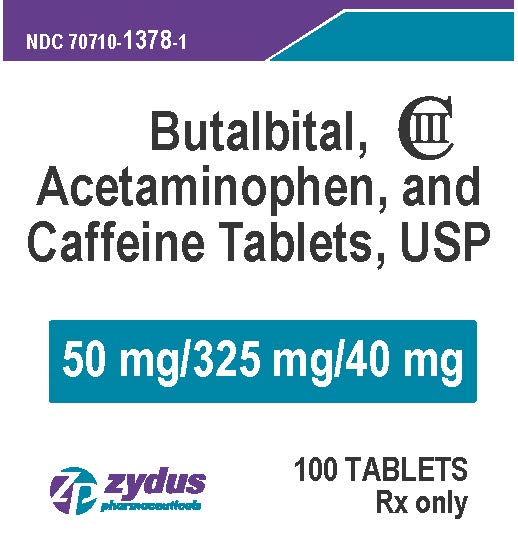
[image: MM3]NDC 70710-1378-1
Butalbital, Acetaminophen, and Caffeine Tablets, USP
50 mg/325 mg/40 mg
Zydus Pharmaceuticals
100 Tablets
Rx only
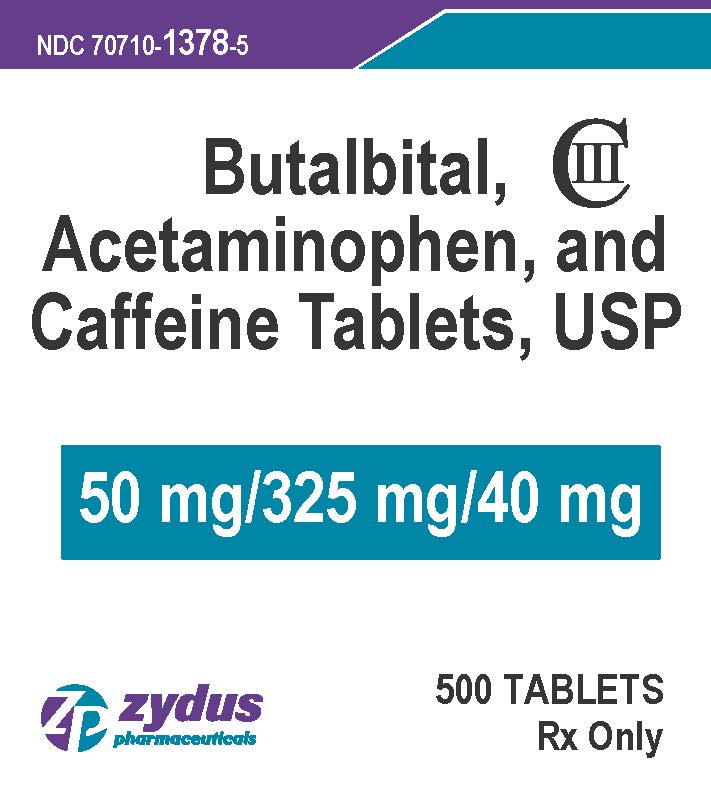
[image: MM4]NDC 70710-1378-5
Butalbital, Acetaminophen, and Caffeine Tablets, USP
50 mg/325 mg/40 mg
Zydus Pharmaceuticals
500 Tablets
Rx only
[image: MM5]Butalbital, Acetaminophen, and Caffeine Tablets, USP
Containing 50 mg butalbital, 325 mg acetaminophen, and 40 mg caffeine. Available as white, round shaped tablets, debossed "1378" on one side and plain on the other side.
Store and Dispense
Store at 20° to 25°C (68° to 77°F) with excursions permitted between 15° to 30°C (59° to 86°F) [see USP Controlled Room Temperature]; dispense in a tight, light-resistant container as defined in the USP with a child-resistant closure.
Manufactured by:
Nesher Pharmaceuticals USA LLC
St. Louis, MO 63044
Distributed by:
Zydus Pharmaceuticals USA Inc.
Pennington, NJ 05534
To request medical information or to report suspected adverse reactions, contact Zydus Pharmaceuticals at 1-877-993-8779.
2073475
Revised 05/20
Photos of the product and/or packaging supplied by the manufacturer.
This combination drug product is intended as a treatment for tension headache.
It consists of a fixed combination of butalbital, acetaminophen, and caffeine. The role each component plays in the relief of the complex of symptoms known as tension headache is incompletely understood.
The behavior of the individual components is described below.
Butalbital
Butalbital is well absorbed from the gastrointestinal tract and is expected to distribute to most tissues in the body. Barbiturates in general may appear in breast milk and readily cross the placental barrier. They are bound to plasma and tissue proteins to a varying degree and binding increases directly as a function of lipid solubility.
Elimination of butalbital is primarily via the kidney (59% to 88% of the dose) as unchanged drug or metabolites. The plasma half-life is about 35 hours. Urinary excretion products include parent drug (about 3.6% of the dose), 5-isobutyl-5-(2,3-dihydroxypropyl) barbituric acid (about 24% of the dose), 5-allyl-5(3-hydroxy-2-methyl-1-propyl) barbituric acid (about 4.8% of the dose), products with the barbituric acid ring hydrolyzed with excretion of urea (about 14% of the dose), as well as unidentified materials. Of the material excreted in the urine, 32% is conjugated.
The in vitro plasma protein binding of butalbital is 45% over the concentration range of 0.5‑20 mcg/mL. This falls within the range of plasma protein binding (20%-45%) reported with other barbiturates such as phenobarbital, pentobarbital, and secobarbital sodium. The plasma-to-blood concentration ratio was almost unity, indicating that there is no preferential distribution of butalbital into either plasma or blood cells.
Create a free account to view complete drug information, save medications, and more.
Free forever · No credit card required