 MedLens
Loading…
Generic name: oxycodone and aspirin
Physicians Total Care, Inc.
Dosage Form
N/A
Manufacturer
Physicians Total Care, Inc.
This medication contains important usage instructions, warnings, and side effect information that you should review before use.
Oxycodone and aspirin tablets are indicated for the management of moderate to moderately severe pain.
Dosage should be adjusted according to the severity of the pain and the response of the patient. It may occasionally be necessary to exceed the usual dosage recommended below in cases of more severe pain or in those patients who have become tolerant to the analgesic effect of opioids. If pain is constant, the opioid analgesic should be given at regular intervals on an around-the-clock schedule. Oxycodone and aspirin tablets are given orally.
The usual dosage is one tablet every 6 hours as needed for pain. The maximum daily dose of aspirin should not exceed 4 grams or 12 tablets.
Cessation of TherapyIn patients treated with oxycodone and aspirin tablets for more than a few weeks who no longer require therapy, doses should be tapered gradually to prevent signs and symptoms of withdrawal in the physically dependent patient.
Oxycodone and aspirin tablets are contraindicated in patients with known hypersensitivity to oxycodone or aspirin, and in any situation where opioids or aspirin are contraindicated. Aspirin is contraindicated for patients with hemophilia.
Reye’s Syndrome: Aspirin should not be used in children or teenagers for viral infections, with or without fever, because of the risk of Reye’s syndrome with concomitant use of aspirin in certain viral illnesses.
Allergy: Aspirin is contraindicated in patients with known allergy to nonsteroidal anti-inflammatory drug products and in patients with the syndrome of asthma, rhinitis, and nasal polyps. Aspirin may cause severe urticaria, angioedema, or bronchospasm (asthma).
Oxycodone is contraindicated in patients with known hypersensitivity to oxycodone. Oxycodone is contraindicated in any situation where opioids are contraindicated including patients with significant respiratory depression (in unmonitored settings or the absence of resuscitative equipment) and patients with acute or severe bronchial asthma or hypercarbia. Oxycodone is contraindicated in the setting of suspected or known paralytic ileus.
Serious adverse reactions that may be associated with oxycodone and aspirin tablet use include respiratory depression, apnea, respiratory arrest, circulatory depression, hypotension, and shock (see OVERDOSAGE).
The most frequently observed non-serious adverse reactions include lightheadedness, dizziness, drowsiness or sedation, nausea, and vomiting. These effects seem to be more prominent in ambulatory than in nonambulatory patients, and some of these adverse reactions may be alleviated if the patient lies down. Other adverse reactions include euphoria, dysphoria, constipation and pruritus.
Aspirin may increase the likelihood of hemorrhage due to its effect on the gastric mucosa and platelet function. Furthermore, aspirin has the potential to cause anaphylaxis in hypersensitive patients as well as angioedema especially in patients with chronic urticaria. Other adverse reactions due to aspirin use include anorexia, reversible hepatotoxicity, leukopenia, thrombocytopenia, purpura, decreased plasma iron concentration, and shortened erythrocyte survival time.
Other adverse reactions obtained from postmarketing experiences with oxycodone and aspirin tablets are listed by organ system and in decreasing order of severity and/or frequency as follows:
Body as a Whole
allergic reaction, malaise, asthenia, headache, anaphylaxis, fever, hypothermia, thirst, increased sweating, accident, accidental overdose, non-accidental overdose.
Cardiovascular
tachycardia, dysrhythmias, hypotension, orthostatic hypotension, bradycardia, palpitations
Central and Peripheral Nervous System
stupor, paresthesia, agitation, cerebral edema, coma, confusion, dizziness, headache, subdural or intracranial hemorrhage, lethargy, seizures, anxiety, mental impairment
Fluid and Electrolyte
dehydration, hyperkalemia, metabolic acidosis, respiratory alkalosis
Gastrointestinal
hemorrhagic gastric/duodenal ulcer, gastric/peptic ulcer, dyspepsia, abdominal pain, diarrhea, eructation, dry mouth, gastrointestinal bleeding, intestinal perforation, nausea, vomiting, transient elevations of hepatic enzymes, hepatitis, Reye’s syndrome, pancreatitis, intestinal obstruction, ileus
Hearing and Vestibular
hearing loss, tinnitus. Patients with high frequency loss may have difficulty perceiving tinnitus. In these patients, tinnitus cannot be used as a clinical indicator of salicylism.
Hematologic
unspecified hemorrhage, purpura, reticulocytosis, prolongation of prothrombin time, disseminated intravascular coagulation, ecchymosis, thrombocytopenia.
Hypersensitivity
acute anaphylaxis, angioedema, asthma, bronchospasm, laryngeal edema, urticaria, anaphylactoid reaction
Metabolic and Nutritional
hypoglycemia, hyperglycemia, acidosis, alkalosis
Musculoskeletal
rhabdomyolysis
Ocular
miosis, visual disturbances, red eye
Psychiatric
drug dependence, drug abuse, somnolence, depression, nervousness, hallucination
Reproductive
prolonged pregnancy and labor, stillbirths, lower birth weight infants, antepartum and postpartum bleeding, closure of patent ductus arteriosis
Respiratory System
bronchospasm, dyspnea, hyperpnea, pulmonary edema, tachypnea, aspiration, hypoventilation, laryngeal edema
Skin and Appendages
urticaria, rash, flushing
Urogenital
interstitial nephritis, papillary necrosis, proteinuria, renal insufficiency and failure, urinary retention
Signs and Symptoms
Serious overdose with oxycodone and aspirin tablets is characterized by signs and symptoms of opioid and salicylate overdose. Oxycodone overdosage can be manifested by respiratory depression (a decrease in respiratory rate and/or tidal volume, Cheyne-Stokes respiration, cyanosis), extreme somnolence progressing to stupor or coma, skeletal muscle flaccidity, cold and clammy skin, pupillary constriction (pupils may be dilated in the setting of hypoxia), and sometimes bradycardia and hypotension. In severe overdosage, apnea, circulatory collapse, cardiac arrest and death may occur. Early signs of acute aspirin (salicylate) overdose including tinnitus occur at plasma concentrations approaching 200 mcg/mL. Plasma concentrations of aspirin above 300 mcg/mL are toxic. Severe toxic effects are associated with levels above 400 mcg/mL. A single lethal dose of aspirin in adults is not known with certainty but death may be expected at 30 g. For real or suspected overdose, a Poison Control Center should be contacted immediately.
In acute salicylate overdose, severe acid-base and electrolyte disturbances may occur and are complicated by hyperthermia and dehydration, and coma. Respiratory alkalosis occurs early while hyperventilation is present, but is quickly followed by metabolic acidosis. Serious symptoms such as depression, coma, and respiratory failure progress rapidly.
Salicylism (chronic salicylate toxicity) may be noted by symptoms such as dizziness, tinnitus, difficulty hearing, nausea, vomiting, diarrhea, and mental confusion. More severe salicylism may result in respiratory alkalosis.
Treatment
Primary attention should be given to the reestablishment of adequate respiratory exchange through provision of a patent airway and the institution of assisted or controlled ventilation. Supportive measures (including oxygen, intravenous fluids, and vasopressors) should be employed in the management of circulatory shock and pulmonary edema accompanying overdose as indicated. Cardiac arrest or arrhythmias may require cardiac massage or defibrillation. Treatment of acid-base disturbances and electrolyte disorders is also important. Because of the concern over salicylate toxicity, acid-base status should be followed closely with serial blood gas and serum pH determinations.
The opioid antagonist naloxone hydrochloride is a specific antidote against respiratory depression which may result from overdosage or unusual sensitivity to opioids including oxycodone. Therefore, an appropriate dose of naloxone hydrochloride should be administered (usual initial adult dose 0.4 mg-2 mg) preferably by the intravenous route, simultaneously with efforts at respiratory resuscitation. Since the duration of action of oxycodone may exceed that of the antagonist, the patient should be kept under continued surveillance and repeated doses of the antagonist should be administered as needed to maintain adequate respiration. Opioid antagonists should not be administered in the absence of clinically significant respiratory of circulatory depression secondary to oxycodone overdose. In patients who are physically dependent on any opioid agonist including oxycodone, an abrupt or complete reversal of opioid effects may precipitate an acute abstinence syndrome. The severity of the withdrawal syndrome produced will depend on the degree of physical dependence and the dose of the antagonist administered. Please see the prescribing information for the specific opioid antagonist for details of their proper use.
Gastric emptying and/or lavage may be useful in removing unabsorbed drug. This procedure is recommended as soon as possible after ingestion, even if the patient has vomited spontaneously. After lavage and/or emesis, administration of activated charcoal, as a slurry, is beneficial, if less than three hours have passed since ingestion. Charcoal adsorption should not be employed prior to lavage and emesis.
In severe cases of salicylate overdose, hyperthermia and hypovolemia are the major immediate threats to life. Children should be sponged with tepid water. Replacement fluid should be administered intravenously and augmented with correction of acidosis. Plasma electrolytes and pH should be monitored to promote alkaline diuresis of salicylate if renal function is normal. Infusion of glucose may be required to control hypoglycemia. With more severe acute toxicity respiratory alkalosis may occur.
Hemodialysis and peritoneal dialysis can be performed to reduce the body content of aspirin. In patients with renal insufficiency or in cases of life-threatening salicylate intoxication dialysis is usually required. Exchange transfusion may be indicated in infants and young children.
In case of real or suspected overdose, a poison control center should be consulted for the treatment of salicylism.
The toxicity of oxycodone and aspirin in combination is unknown.
Oxycodone and Aspirin Tablets, for oral administration, contain:
Oxycodone Hydrochloride USP 4.5 mg*
Oxycodone Terephthalate USP 0.38 mg*
Aspirin USP 325 mg
* The total of 4.5 mg oxycodone HCl and 0.38 mg oxycodone terephthalate is equivalent to 4.33 mg of oxycodone as the free base.
In addition, each tablet also contains the following inactive ingredients: corn starch, D&C Yellow #10 Aluminum-lake and microcrystalline cellulose.
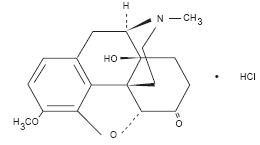
The oxycodone hydrochloride component is Morphinan-6-one, 4,5-epoxy-14-hydroxy-3-methoxy-17-methyl-, hydrochloride, (5α)-, a white to off-white, hygroscopic crystals or powder, odorless, soluble in water; slightly soluble in alcohol. Oxycodone Terephthalate is freely soluble in water and slightly soluble in alcohol. Oxycodone hydrochloride is represented by the following structural formula:
[image: MM1]
Molecular formula: C18H21NO4•HCl Molecular weight: 351.82
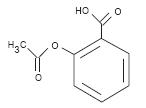
The aspirin component is 2-(acetyloxy)-, Benzoic acid, a white crystal, commonly tabular or needlelike, or white, crystalline powder. Is odorless or has a faint odor. Is stable in dry air; in moist air it gradually hydrolyzes to salicylic and acetic acids. Slightly soluble in water; freely soluble in alcohol; soluble in chloroform and in ether; sparingly soluble in absolute ether and is represented by the following structural formula:
[image: MM2]
Molecular formula: C9H8O4 Molecular weight: 180.16
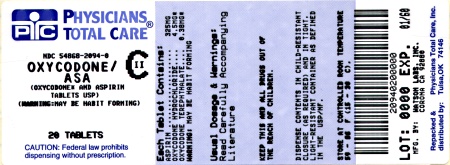
Oxycodone and Aspirin Tablets USP
[image: MM3]
Oxycodone and Aspirin Tablets USP are yellow, round biconvex
tablets, debossed with WATSON and 820 on one side, and plain and scored on the other side,
supplied in
| Bottles of 20 |
NDC 54868-2094-0 |
| Bottles of 30 |
NDC 54868-2094-1 |
Store at controlled room temperature 15°-30°C (59°-86°F). [See USP.]
REPLACE CAP IMMEDIATELY.
PROTECT FROM LIGHT AND MOISTURE.
Dispense in a tight, light-resistant container as defined in the USP.
DEA Order Form Required.
Watson Laboratories, Inc.
Corona, CA 92880
USA
Relabeling and Repackaging by:
Physicians Total Care, Inc.
Tulsa, OK 74146
Photos of the product and/or packaging supplied by the manufacturer.
Central Nervous System
Oxycodone is a semisynthetic pure opioid agonist whose principal therapeutic action is analgesia. Other pharmacological effects of oxycodone include anxiolysis, euphoria and feelings of relaxation. These effects are mediated by receptors (notably μ and κ) in the central nervous system for endogenous opioid-like compounds such as endorphins and enkephalins. Oxycodone produces respiratory depression through direct activity at respiratory centers in the brain stem and depresses the cough reflex by direct effect on the center of the medulla.
Aspirin (acetylsalicylic acid) works by inhibiting the body’s production of prostaglandins, including prostaglandins involved in inflammation. Prostaglandins cause pain sensations by stimulating muscle contractions and dilating blood vessels throughout the body. In the CNS, aspirin works on the hypothalamus heat-regulating center to reduce fever, however, other mechanisms may be involved.
Gastrointestinal Tract and Other Smooth Muscle
Oxycodone reduces motility by increasing smooth muscle tone in the stomach and duodenum. In the small intestine, digestion of food is delayed by decreases in propulsive contractions. Other opioid effects include contraction of biliary tract smooth muscle, spasm of the Sphincter of Oddi, increased ureteral and bladder sphincter tone, and a reduction in uterine tone.
Aspirin can produce gastrointestinal injury (lesions, ulcers) through a mechanism that is not yet completely understood, but may involve a reduction in eicosanoid synthesis by the gastric mucosa. Decreased production of prostaglandins may compromise the defenses of the gastric mucosa and the activity of substances involved in tissue repair and ulcer healing.
Cardiovascular System
Oxycodone may produce a release of histamine and may be associated with orthostatic hypotension, and other symptoms, such as pruritus, flushing, red eyes, and sweating.
Platelet Aggregation
Aspirin affects platelet aggregation by irreversibly inhibiting prostaglandin cyclo-oxygenase. This effect lasts for the life of the platelet and prevents the formation of the platelet aggregating factor thromboxane A2. Nonacetylated salicylates do not inhibit this enzyme and have no effect on platelet aggregation. At somewhat higher doses, aspirin reversibly inhibits the formation of prostaglandin 12 (prostacyclin), which is an arterial vasodilator and inhibits platelet aggregation.
Pharmacokinetics
Absorption and Distribution
The mean absolute oral bioavailability of oxycodone in cancer patients was reported to be about 87%. Oxycodone has been shown to be 45% bound to human plasma proteins in vitro. The volume of distribution after intravenous administration is 211.9 ±186.6 L.
Aspirin is hydrolyzed primarily to salicylic acid in the gut wall and during first-pass metabolism through the liver. Salicylic acid is absorbed rapidly from the stomach, but most of the absorption occurs in the proximal small intestine. Following absorption, salicylate is distributed to most body tissues and fluids, including fetal tissues, breast milk, and the CNS. High concentrations are found in the liver and kidneys. Salicylate is variably bound to serum proteins, particularly albumin.
Metabolism and Elimination
A high portion of oxycodone is N-dealkylated to noroxycodone during first-pass metabolism. Oxymorphone, is formed by the O-demethylation of oxycodone. The metabolism of oxycodone to oxymorphone is catalyzed by CYP2D6. Free and conjugated noroxycodone, free and conjugated oxycodone, and oxymorphone are excreted in human urine following a single oral dose of oxycodone. Approximately 8% to 14% of the dose is excreted as free oxycodone over 24 hours after administration. Following a single, oral dose of oxycodone, the mean ± SD elimination half-life is 3.51 ± 1.43 hours.
The biotransformation of aspirin occurs primarily in the liver by the microsomal enzyme system. With a plasma half-life of approximately 15 minutes, aspirin is rapidly hydrolyzed to salicylate. At low doses, salicylate elimination follows first-order kinetics. The plasma half-life of salicylate is approximately 2 to 3 hours.
Approximately 10% of aspirin is excreted as unchanged salicylate in the urine. The major metabolites excreted in the urine are salicyluric acid (75%), salicyl phenolic glucuronide (10%), salicyl acyl glucuronide (5%), and gentisic and gentisuric acid (less than 1%) each. Eighty to 100% of a single dose is excreted in the urine within 24 to 72 hours.
Create a free account to view complete drug information, save medications, and more.
Free forever · No credit card required