 MedLens
Loading…
Physicians Total Care, Inc.
Dosage Form
N/A
Manufacturer
Physicians Total Care, Inc.
This medication contains important usage instructions, warnings, and side effect information that you should review before use.
Rx Only
Cardiovascular RiskCarefully consider the potential benefits and risks of ibuprofen suspension and other treatment options before deciding to use ibuprofen suspension. Use the lowest effective dose for the shortest duration consistent with individual patient treatment goals (see WARNINGS ).
In Pediatric Patients, ibuprofen suspension is indicated:
In Adults, ibuprofen is indicated:
Since there have been no controlled trials to demonstrate whether there is any beneficial effect or harmful interaction with the use of ibuprofen in conjunction with aspirin, the combination cannot be recommended. (See PRECAUTIONS - Drug Interactions).
Carefully consider the potential benefits and risks of ibuprofen suspension and other treatment options before deciding to use ibuprofen suspension. Use the lowest effective dose for the shortest duration consistent with individual patient treatment goals (see WARNINGS ).
After observing the response to initial therapy with ibuprofen suspension, the dose and frequency should be adjusted to suit an individual patient's needs.
PEDIATRIC PATIENTS Fever reductionFor reduction of fever in children, 6 months up to 2 years of age, the dosage should be adjusted on the basis of the initial temperature level (see CLINICAL PHARMACOLOGY). The recommended dose is 5 mg/kg if the baseline temperature is less than 102.5°F, or 10 mg/kg if the baseline temperature is 102.5°F or greater. The duration of fever reduction is generally 6 to 8 hours. The recommended maximum daily dose is 40 mg/kg.
AnalgesiaFor relief of mild to moderate pain in children 6 months up to 2 years of age, the recommended dosage is 10 mg/kg, every 6 to 8 hours. The recommended maximum daily dose is 40 mg/kg. Doses should be given so as not to disturb the child's sleep pattern.
Juvenile ArthritisThe recommended dose is 30 to 40 mg/kg/day divided into three to four doses (see Individualization of Dosage). Patients with milder disease may be adequately treated with 20 mg/kg/day.
In patients with juvenile arthritis, doses above 50 mg/kg/day are not recommended because they have not been studied and doses exceeding the upper recommended dose of 40 mg/kg/day may increase the risk of causing serious adverse events. The therapeutic response may require from a few days to several weeks to be achieved. Once a clinical effect is obtained, the dosage should be lowered to the smallest dose of ibuprofen needed to maintain adequate control of symptoms.
Pediatric patients receiving doses above 30 mg/kg/day or if abnormal liver function tests have occurred with previous NSAID treatments should be carefully followed for signs and symptoms of early liver dysfunction.
ADULTS Primary DysmenorrheaFor the treatment of primary dysmenorrhea, beginning with the earliest onset of such pain, ibuprofen suspension should be given in a dose of 400 mg every 4 hours, as necessary, for the relief of pain.
Rheumatoid arthritis and osteoarthritisSuggested dosage: 1200-3200 mg daily (300 mg q.i.d. or 400 mg, 600 mg or 800 mg t.i.d. or q.i.d.). Individual patients may show a better response to 3200 mg daily, as compared with 2400 mg, although in well-controlled clinical trials patients on 3200 mg did not show a better mean response in terms of efficacy. Therefore, when treating patients with 3200 mg/day, the physician should observe sufficient increased clinical benefits to offset potential increased risk.
Individualization of DosageThe dose of ibuprofen suspension should be tailored to each patient, and may be lowered or raised from the suggested doses depending on the severity of symptoms either at time of initiating drug therapy or as the patient responds or fails to respond.
One fever study showed that, after the initial dose of ibuprofen suspension, subsequent doses may be lowered and still provide adequate fever control.
In a situation when low fever would require the ibuprofen suspension 5 mg/kg dose in a child with pain, the dose that will effectively treat the predominant symptom should be chosen.
In chronic conditions, a therapeutic response to ibuprofen suspension therapy is sometimes seen in a few days to a week, but most often is observed by two weeks. After a satisfactory response has been achieved, the patient's dose should be reviewed and adjusted as required.
Patients with rheumatoid arthritis seem to require higher doses than do patients with osteoarthritis. The smallest dose of ibuprofen suspension that yields acceptable control should be employed.
Ibuprofen suspension may be used in combination with gold salts and/or corticosteroids.
Ibuprofen suspension is contraindicated in patients with known hypersensitivity to ibuprofen.
Ibuprofen suspension should not be given to patients who have experienced asthma, urticaria, or allergic-type reactions after taking aspirin or other NSAIDs. Severe, rarely fatal, anaphylactic-like reactions to NSAIDS have been reported in such patients (see WARNINGS - Anaphylactoid Reactions and PRECAUTIONS - Preexisting Asthma ).
Ibuprofen suspension is contraindicated for the treatment of peri-operative pain in the setting of coronary artery bypass graft (CABG) surgery (see WARNINGS ).
Enter section text here
In patients taking ibuprofen or other NSAIDs, the most frequently reported adverse experiences occurring in approximately 1-10% of patients are: Abnormal renal function, anemia, dizziness, edema, elevated liver enzymes, fluid retention, gastrointestinal experiences (including abdominal pain, bloating, constipation, diarrhea, dyspepsia, epigastric pain, flatulence, heartburn, nausea, vomiting), headaches, increased bleeding time, nervousness, pruritus, rashes (including maculopapular) and tinnitus.
Additional adverse experiences reported occasionally include:
| Body as a whole - | fever, infection, sepsis |
| Cardiovascular system - | congestive heart failure in patients with marginal cardiac function, hypertension, tachycardia, syncope |
| Digestive system - | dry mouth, duodenitits, esophagitis, gastric or duodenal ulcer with bleeding and/or perforation, gastritis, gastrointestinal bleeding, glossitis, hematemesis, hepatitis, jaundice, melena, rectal bleeding |
| Hemic and lymphatic system - | ecchymosis, eosinophilia, leukopenia, purpura, stomatitis, thrombocytopenia |
| Metabolic and nutritional - | weight changes |
| Nervous system - | anxiety, asthenia, confusion, depression, dream abnormalities, drowsiness, insomnia, malaise, paresthesia, somnolence, tremors, vertigo |
| Respiratory system - | asthma, dyspnea |
| Skin and appendages - | alopecia, photosensitivity, sweat |
| Special senses - | blurred vision |
| Urogenital system - | cystitis, dysuria, hematuria, interstitial nephritis, oliguria/polyuria, proteinuria, acute renal failure in patients with pre-existing significantly impaired renal function |
Other adverse reactions, which occur rarely are:
| Body as a whole - | anaphylactic reactions, anaphylactoid reactions, appetite changes |
| Cardiovascular system - | arrhythmia, cerebrovascular accident, hypotension, myocardial infarction, palpitations, vasculitis |
| Digestive system - | eructation, gingival ulcer, hepatorenal syndrome, liver necrosis, liver failure, pancreatitis |
| Hemic and lymphatic system - | agranulocystosis, hemolytic anemia, aplastic anemia, lymphadenopathy, neutropenia, pancytopenia |
| Metabolic and nutritional - | hyperglycemia |
| Nervous system - | convulsions, coma, emotional lability, hallucinations, aseptic meningitis |
| Respiratory - | apnea, respiratory depression, pneumonia, rhinitis |
| Skin and appendages - | angioedema, toxic epidermal necrosis, erythema multiforme, exfoliative dermatitis, Stevens Johnson syndrome, urticaria, vesiculobullous eruptions |
| Special senses - | amblyopia (blurred and/or diminished vision, scotomata and/or changes in color vision), conjunctivitis, dry eyes, hearing impairment |
| Urogenital - | azotemia, decreased creatinine clearance, glomerulitis, renal papillary necrosis, tubular necrosis |
The toxicity of ibuprofen overdose is dependent upon the amount of drug ingested and the time elapsed since ingestion, though individual response may vary, which makes it necessary to evaluate each case individually. Although uncommon, serious toxicity and death have been reported in the medical literature with ibuprofen overdosage. The most frequently reported symptoms of ibuprofen overdose include abdominal pain, nausea, vomiting, lethargy and drowsiness. Other central nervous system symptoms include headache, tinnitus, CNS depression and seizures. Metabolic acidosis, coma, acute renal failure and apnea (primarily in very young children) may rarely occur. Cardiovascular toxicity, including hypotension, bradycardia, tachycardia and atrial fibrillation, also have been reported.
The treatment of acute ibuprofen overdose is primarily supportive. Management of hypotension, acidosis and gastrointestinal bleeding may be necessary. In cases of acute overdose, the stomach should be emptied through ipecac-induced emesis or lavage. Emesis is most effective if initiated within 30 minutes of ingestion. Orally administered activated charcoal may help in reducing the absorption and reabsorption of ibuprofen.
In children, the estimated amount of ibuprofen ingested per body weight may be helpful to predict the potential for development of toxicity although each case must be evaluated. Ingestion of less than 100 mg/kg is unlikely to produce toxicity. Children ingesting 100 to 200 mg/kg may be managed with induced emesis and a minimal observation time of four hours. Children ingesting 200 to 400 mg/kg of ibuprofen should have immediate gastric emptying and at least four hours observation in a health care facility. Children ingesting greater than 400 mg/kg require immediate medical referral, careful observation and appropriate supportive therapy. Ipecac-induced emesis is not recommended in overdoses greater than 400 mg/kg because of the risk for convulsions and the potential for aspiration of gastric contents.
In adult patients the history of the dose reportedly ingested does not appear to be predictive of toxicity. The need for referral and follow-up must be judged by the circumstances at the time of the overdose ingestion. Symptomatic adults should be carefully evaluated, observed and supported.
(See the end of this Medication Guide for a list of prescription NSAID medicines.)
What is the most important information I should know about medicines called Non-Steroidal Anti-Inflammatory Drugs (NSAIDs)?
NSAID medicines may increase the chance of a heart attack or stroke that can lead to death. This chance increases:
NSAID medicines should never be used right before or after a heart surgery called a "coronary artery bypass graft (CABG)."
NSAID medicines can cause ulcers and bleeding in the stomach and intestines at any time during treatment. Ulcers and bleeding:
The chance of a person getting an ulcer or bleeding increases with:
NSAID medicines should only be used:
What are Non-Steroidal Anti-Inflammatory Drugs (NSAIDs)?
NSAID medicines are used to treat pain and redness, swelling, and heat (inflammation) from medical conditions such as:
Who should not take a Non-Steroidal Anti-Inflammatory Drug (NSAID)?
Do not take an NSAID medicine:
Tell your healthcare provider:
What are the possible side effects of Non-Steroidal Anti-Inflammatory Drugs (NSAIDs)?
| Serious side effects include: | Other side effects include: |
|---|---|
|
|
Get emergency help right away if you have any of the following symptoms:
Stop your NSAID medicine and call your healthcare provider right away if you have any of the following symptoms:
These are not all the side effects with NSAID medicines. Talk to your healthcare provider or pharmacist for more information about NSAID medicines.
Other information about Non-Steroidal Anti-Inflammatory Drugs (NSAIDs)
NSAID medicines that need a prescription
| Generic Name | Tradename |
|---|---|
| Celecoxib | Celebrex |
| Diclofenac | Cataflam, Voltaren, Arthrotec (combined with misoprostol) |
| Diflunisal | Dolobid |
| Etodolac | Lodine, Lodine XL |
| Fenoprofen | Nalfon, Nalfon 200 |
| Flurbiprofen | Ansaid |
| Ibuprofen | Motrin, Tab-Profen, Vicoprofen* (combined with hydrocodone), Combunox (combined with oxycodone) |
| Indomethacin | Indocin, Indocin SR, Indo-Lemmon, Indomethagan |
| Ketoprofen | Oruvail |
| Ketorolac | Toradol |
| Mefenamic Acid | Ponstel |
| Meloxicam | Mobic |
| Nabumetone | Relafen |
| Naproxen | Naprosyn, Anaprox, Anaprox DS, EC-Naprosyn, Naprelan, NapraPAC (copackaged with lansoprazole) |
| Oxaprozin | Daypro |
| Piroxicam | Feldene |
| Sulindac | Clinoril |
| Tolmetin | Tolectin, Tolectin DS, Tolectin 600 |
Call your doctor for medical advice about side
effects.
You may report side effects to FDA at 1-800-FDA-1088.
This Medication Guide has been approved by the U.S. Food and Drug Administration.
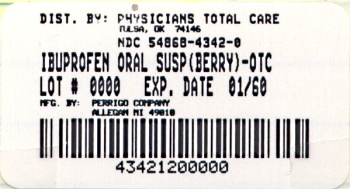
Ibuprofen Suspension, 100 mg/5 mL
120 mL
[image: MM2]
Ibuprofen Suspension, 100 mg/5 mL is available as
follows:
Orange-colored, berry-flavored suspension
Bottles of 120 mL - NDC 54868-4342-0
Shake well before using. Store at 20° - 25°C (68° - 77°F)
[see USP
Controlled Room Temperature].
MANUFACTURED AND DISTRIBUTED BY
PERRIGO®
ALLEGAN, MI 49010
Revised 07/08
Relabeling of "Additional Barcode Label" by:
Physicians Total Care, Inc.
Tulsa, OK 74146
Photos of the product and/or packaging supplied by the manufacturer.
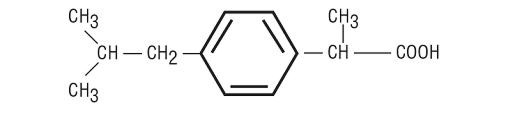
Ibuprofen is a nonsteroidal anti-inflammatory drug (NSAID) that possesses anti-inflammatory, analgesic and antipyretic activity. Its mode of action, like that of other NSAIDs, is not completely understood, but may be related to prostaglandin synthetase inhibition. After absorption of the racemic ibuprofen, the [-]R-enantiomer undergoes interconversion to the [+]S-form. The biological activities of ibuprofen are associated with the [+]S-enantiomer.
PharmacokineticsIbuprofen is a racemic mixture of [-]R-and [+]S-isomers. In vivo and in vitro studies indicate that the [+]S-isomer is responsible for clinical activity. The [-]R-form, while thought to be pharmacologically inactive, is slowly and incompletely (~60%) interconverted into the active [+]S species in adults. The degree of interconversion in children is unknown, but is thought to be similar. The [-]R-isomer serves as a circulating reservoir to maintain levels of active drug. Ibuprofen is well absorbed orally, with less than 1% being excreted in the urine unchanged. It has a biphasic elimination time curve with a plasma half-life of approximately 2 hours. Studies in febrile children have established the dose-proportionality of 5 and 10 mg/kg doses of ibuprofen. Studies in adults have established the dose-proportionality of ibuprofen as a single oral dose from 50 to 600 mg for total drug and up to 1200 mg for free drug.
AbsorptionIn vivo studies indicate that ibuprofen is well absorbed orally from the suspension formulation, with peak plasma levels usually occurring within 1 to 2 hours (see Table 1).
| Dose | 200mg (2.8mg/kg) in Adults |
10mg/kg in
Febrile Children |
|---|---|---|
| Formulation | Suspension | Suspension |
| Number of Patients | 24 | 18 |
| AUCinf (µg•h/mL) | 64 (27%) |
155 (24%) |
| Cmax (µg/mL) | 19 (22%) |
55 (23%) |
| Tmax (h) | 0.79 (69%) |
0.97 (57%) |
| CI/F(mL/h/kg) | 45.6 (22%) |
68.6 (22%) |
A bioavailability study in adults has shown that there was no interference with the absorption of ibuprofen when given in conjunction with an antacid containing both aluminum hydroxide and magnesium hydroxide.
H-2 AntagonistsIn studies with human volunteers, coadministration of cimetidine or ranitidine with ibuprofen had no substantive effect on ibuprofen serum concentrations.
Food EffectsAbsorption is most rapid when ibuprofen is given under fasting conditions. Administration of ibuprofen suspension with food affects the rate but not the extent of absorption. When taken with food, Tmax is delayed by approximately 30 to 60 minutes, and peak levels are reduced by approximately 30 to 50%.
DistributionIbuprofen, like most drugs of its class, is highly protein bound (>99% bound at 20 µg/mL). Protein binding is saturable and at concentrations >20 µg/mL binding is non-linear. Based on oral dosing data there is an age- or fever-related change in volume of distribution for ibuprofen. Febrile children <11 years old have a volume of approximately 0.2 L/kg while adults have a volume of approximately 0.12 L/kg. The clinical significance of these findings is unknown.
MetabolismFollowing oral administration, the majority of the dose was recovered in the urine within 24 hours as the hydroxy-(25%) and carboxypropyl-(37%) phenylpropionic acid metabolites. The percentages of free and conjugated ibuprofen found in the urine were approximately 1% and 14%, respectively. The remainder of the drug was found in the stool as both metabolites and unabsorbed drug.
EliminationIbuprofen is rapidly metabolized and eliminated in the urine. The excretion of ibuprofen is virtually complete 24 hours after the last dose. It has a biphasic plasma elimination time curve with a half-life of approximately 2.0 hours. There is no difference in the observed terminal elimination rate or half-life between children and adults, however, there is an age-or fever-related change in total clearance. This suggests that the observed change in clearance is due to changes in the volume of distribution of ibuprofen (see Table 1 for CI/F values).
Clinical StudiesControlled clinical trials comparing doses of 5 and 10 mg/kg ibuprofen suspension and 10-15 mg/kg of acetaminophen elixir have been conducted in children 6 months to 12 years of age with fever primarily due to viral illnesses. In these studies there were no differences between treatments in fever reduction for the first hour and maximum fever reduction occurred between 2 and 4 hours. Response after 1 hour was dependent on both the level of temperature elevation as well as the treatment. In children with baseline temperatures at or below 102.5°F both ibuprofen doses and acetaminophen were equally effective in their maximum effect. In children with temperatures above 102.5°F, the ibuprofen 10 mg/kg dose was more effective. By 6 hours, children treated with ibuprofen 5mg/kg tended to have recurrence of fever, whereas children treated with ibuprofen 10 mg/kg still had significant fever reduction at 8 hours. In control groups treated with 10 mg/kg acetaminophen, fever reduction resembled that seen in children treated with 5 mg/kg of ibuprofen, with the exception that temperature elevation tended to return 1-2 hours earlier.
In patients with primary dysmenorrhea, ibuprofen has been shown to reduce elevated levels of prostaglandin activity in the menstrual fluid and to reduce testing and active intrauterine pressure, as well as the frequency of uterine contractions. The probable mechanism of action is to inhibit prostaglandin synthesis rather than simply to provide analgesia.
Create a free account to view complete drug information, save medications, and more.
Free forever · No credit card required