 MedLens
Loading…
Physicians Total Care, Inc.
Dosage Form
N/A
Manufacturer
Physicians Total Care, Inc.
This medication contains important usage instructions, warnings, and side effect information that you should review before use.
Butalbital, Aspirin, Caffeine, and Codeine Phosphate Capsules, USP is indicated for the relief of the symptom complex of tension (or muscle contraction) headache.
Evidence supporting the efficacy of butalbital, aspirin, caffeine, and codeine phosphate capsules is derived from 2 multi-clinic trials that compared patients with tension headache randomly assigned to 4 parallel treatments: butalbital, aspirin, caffeine, and codeine phosphate capsules; codeine; Butalbital, Aspirin, and Caffeine Capsules, USP; and placebo. Response was assessed over the course of the first 4 hours of each of 2 distinct headaches, separated by at least 24 hours. Butalbital, aspirin, caffeine, and codeine phosphate capsules proved statistically significantly superior to each of its components (Butalbital, Aspirin, and Caffeine Capsules, USP and codeine) and to placebo on measures of pain relief.
Evidence supporting the efficacy and safety of Butalbital, Aspirin, Caffeine, and Codeine Phosphate Capsules, USP in the treatment of multiple recurrent headaches is unavailable. Caution in this regard is required because codeine and butalbital are habit-forming and potentially abusable.
One or 2 capsules every 4 hours. Total daily dosage should not exceed 6 capsules.
Extended and repeated use of this product is not recommended because of the potential for physical dependence.
Butalbital, Aspirin, Caffeine, and Codeine Phosphate Capsules, USP is contraindicated under the following conditions:
Hypersensitivity or intolerance to aspirin, caffeine, butalbital or codeine.
Patients with a hemorrhagic diathesis (e.g., hemophilia, hypoprothrombinemia, von Willebrand’s disease, the thrombocytopenias, thrombasthenia and other ill-defined hereditary platelet dysfunctions, severe vitamin K deficiency and severe liver damage).
Patients with the syndrome of nasal polyps, angioedema and bronchospastic reactivity to aspirin or other nonsteroidal anti-inflammatory drugs. Anaphylactoid reactions have occurred in such patients.
Peptic ulcer or other serious gastrointestinal lesions.
Patients with porphyria.
The most commonly reported adverse events associated with the use of butalbital, aspirin, caffeine, and codeine phosphate capsules and not reported at an equivalent incidence by placebo-treated patients were nausea and/or abdominal pain, drowsiness, and dizziness.
Associated with Treatment DiscontinuationOf the 382 patients treated with butalbital, aspirin, caffeine, and codeine phosphate capsules in controlled clinical trials, three (0.8%) discontinued treatment with butalbital, aspirin, caffeine, and codeine phosphate capsules because of adverse events. One patient each discontinued treatment for the following reasons: gastrointestinal upset; lightheadedness and heavy eyelids; and drowsiness and generalized tingling.
Incidence in Controlled Clinical TrialsThe following table summarizes the incidence rates of the adverse events reported by at least 1% of the butalbital, aspirin, caffeine, and codeine phosphate capsules treated patients in controlled clinical trials comparing butalbital, aspirin, caffeine, and codeine phosphate capsules to placebo, and provides a comparison to the incidence rates reported by the placebo-treated patients.
The prescriber should be aware that these figures cannot be used to predict the incidence of side effects in the course of usual medical practice where patient characteristics and other factors differ from those that prevailed in the clinical trials. Similarly, the cited frequencies cannot be compared with figures obtained from other clinical investigations involving different treatments, uses, and investigators.
|
Body System/ Adverse Event |
Butalbital, Aspirin, Caffeine, and Codeine Phosphate Capsules (N = 382) |
Placebo (N = 377) |
|
Central Nervous Drowsiness |
2.4% |
0.5% |
| Dizziness/Lightheadedness |
2.6% |
0.5% |
| Intoxicated Feeling |
1.0% |
0% |
|
Gastrointestinal Nausea/Abdominal Pain |
3.7% |
0.8% |
The listing that follows represents the proportion of the 382 patients exposed to butalbital, aspirin, caffeine, and codeine phosphate capsules while participating in the controlled clinical trials who reported, on at least one occasion, an adverse event of the type cited. All reported adverse events, except those already presented in the previous table, are included. It is important to emphasize that, although the adverse events reported did occur while the patient was receiving butalbital, aspirin, caffeine, and codeine phosphate capsules, the adverse events were not necessarily caused by butalbital, aspirin, caffeine, and codeine phosphate capsules.
Adverse events are classified by body system and frequency. “Frequent” is defined as an adverse event which occurred in at least 1/100 (1%) of the patients; all adverse events listed in the previous table are frequent. “Infrequent” is defined as an adverse event that occurred in less than 1/100 patients but at least 1/1000 patients. All adverse events tabulated below are classified as infrequent.
Central Nervous: headache, shaky feeling, tingling, agitation, fainting, fatigue, heavy eyelids, high energy, hot spells, numbness, and sluggishness.
Autonomic Nervous: dry mouth and hyperhidrosis.
Gastrointestinal: vomiting, difficulty swallowing, and heartburn.
Cardiovascular: tachycardia.
Musculoskeletal: leg pain and muscle fatigue.
Genitourinary: diuresis.
Miscellaneous: pruritus, fever, earache, nasal congestion, and tinnitus.
Voluntary reports of adverse drug events, temporally associated with butalbital, aspirin, caffeine, and codeine phosphate capsules, that have been received since market introduction and that were not reported in clinical trials by the patients treated with butalbital, aspirin, caffeine, and codeine phosphate capsules, are listed below. Many or most of these events may have no causal relationship with the drug and are listed according to body system.
Central Nervous: Abuse, addiction, anxiety, depression, disorientation, hallucination, hyperactivity, insomnia, libido decrease, nervousness, neuropathy, psychosis, sedation, sexual activity increase, slurred speech, twitching, unconsciousness, vertigo.
Autonomic Nervous: epistaxis, flushing, miosis, salivation.
Gastrointestinal: anorexia, appetite increased, constipation, diarrhea, esophagitis, gastroenteritis, gastrointestinal spasm, hiccup, mouth burning, pyloric ulcer.
Cardiovascular: chest pain, hypotensive reaction, palpitations, syncope.
Skin: erythema, erythema multiforme, exfoliative dermatitis, hives, rash, toxic epidermal necrolysis.
Urinary: kidney impairment, urinary difficulty.
Miscellaneous: allergic reaction, anaphylactic shock, cholangiocarcinoma, drug interaction with erythromycin (stomach upset), edema.
The following adverse drug events may be borne in mind as potential effects of the components of Butalbital, Aspirin, Caffeine, and Codeine Phosphate Capsules, USP. Potential effects of high dosage are listed in the OVERDOSAGE section of this insert.
Aspirin: occult blood loss, hemolytic anemia, iron deficiency anemia, gastric distress, heartburn, nausea, peptic ulcer, prolonged bleeding time, acute airway obstruction, renal toxicity when taken in high doses for prolonged periods, impaired urate excretion, hepatitis.
Caffeine: cardiac stimulation, irritability, tremor, dependence, nephrotoxicity, hyperglycemia.
Codeine: nausea, vomiting, drowsiness, lightheadedness, constipation, pruritus.
The toxic effects of acute overdosage of Butalbital, Aspirin, Caffeine, and Codeine Phosphate Capsules, USP are attributable mainly to the barbiturate and codeine components, and, to a lesser extent, aspirin. Because toxic effects of caffeine occur in very high dosages only, the possibility of significant caffeine toxicity from Butalbital, Aspirin, Caffeine, and Codeine Phosphate Capsules, USP overdosage is unlikely.
Signs and SymptomsSymptoms attributable to acute barbiturate poisoning include drowsiness, confusion, and coma; respiratory depression; hypotension; hypovolemic shock. Symptoms attributable to acute aspirin poisoning include hyperpnea; acid-base disturbances with development of metabolic acidosis; vomiting and abdominal pain; tinnitus, hyperthermia; hypoprothrombinemia; restlessness; delirium; convulsions. Acute caffeine poisoning may cause insomnia, restlessness, tremor, and delirium; tachycardia and extrasystoles. Symptoms of acute codeine poisoning include the opioid triad of: pinpoint pupils, marked depression of respiration, and loss of consciousness. Convulsions may occur.
TreatmentThe following paragraphs describe one approach to the treatment of overdose with Butalbital, Aspirin, Caffeine, and Codeine Phosphate Capsules, USP. However, because strategies for the management of an overdose continually evolve, consultation with a regional poison control center is strongly encouraged.
Treatment consists primarily of management of barbiturate intoxication, reversal of the effects of codeine, and the correction of the acid-base imbalance due to salicylism. Vomiting should be induced mechanically or with emetics in the conscious patient. Gastric lavage may be used if the pharyngeal and laryngeal reflexes are present and if less than 4 hours have elapsed since ingestion. A cuffed endotracheal tube should be inserted before gastric lavage of the unconscious patient and when necessary to provide assisted respiration. Diuresis, alkalinization of the urine, and correction of electrolyte disturbances should be accomplished through administration of intravenous fluids such as 1% sodium bicarbonate and 5% dextrose in water.
Meticulous attention should be given to maintaining adequate pulmonary ventilation. The value of vasopressor agents such as Norepinephrine or Phenylephrine Hydrochloride in treating hypotension is questionable since they increase vasoconstriction and decrease blood flow. However, if prolonged support of blood pressure is required, Norepinephrine Bitartrate (Levophed®) may be given I.V. with the usual precautions and serial blood pressure monitoring. In severe cases of intoxication, peritoneal dialysis, hemodialysis, or exchange transfusion may be lifesaving. Hypoprothrombinemia should be treated with vitamin K, intravenously.
Methemoglobinemia over 30% should be treated with methylene blue by slow intravenous administration.
Naloxone, a narcotic antagonist, can reverse respiratory depression and coma associated with opioid overdose. Typically, a dose of 0.4-2 mg is given parenterally and may be repeated if an adequate response is not achieved. Since the duration of action of codeine may exceed that of the antagonist, the patient should be kept under continued surveillance and repeated doses of the antagonist should be administered as needed to maintain adequate respiration. A narcotic antagonist should not be administered in the absence of clinically significant respiratory or cardiovascular depression.
Up-to-date information about the treatment of overdose can be obtained from a Certified Regional Poison Control Center. Telephone numbers of Certified Regional Poison Control Centers are listed in the Physicians’ Desk Reference®.
Toxic and Lethal Doses (for adults)
Butalbital: toxic dose 1
g (20 capsules); lethal dose 2-5 g
Aspirin: toxic blood level greater than
30 mg/100 mL; lethal dose 10-30 g
Caffeine: toxic dose greater than 1 g; (25
capsules); lethal dose unknown
Codeine: toxic dose 240 mg (8 capsules);
lethal dose 0.5-1 g
Butalbital, Aspirin, Caffeine, and Codeine Phosphate Capsules, USP is supplied in capsule form for oral administration.
Each capsule contains the following active ingredients:
butalbital, USP
……………………..50 mg
aspirin, USP ……………………....325 mg
caffeine, USP ………………………40
mg
codeine phosphate, USP …………30 mg
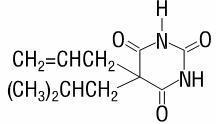
Butalbital (5-allyl-5-isobutylbarbituric acid) is a short- to intermediate-acting barbiturate. It has the following structural formula:
[image: MM3]C11H16N2O3 molecular weight 224.26
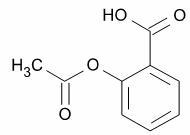
Aspirin (benzoic acid, 2-(acetyloxy)-) is an analgesic, antipyretic, and anti-inflammatory. It has the following structural formula:
[image: MM4]C9H8O4 molecular weight 180.16
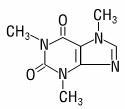
Caffeine (1,3,7-trimethylxanthine) is a central nervous system stimulant. It has the following structural formula:
[image: MM5]C8H10N4O2 molecular weight 194.19
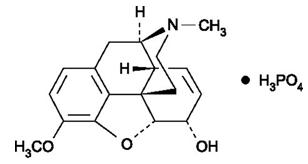
Codeine phosphate (7,8-Didehydro-4,5α-epoxy-3-methoxy-17-methylmorphinan-6α-ol phosphate (1:1) (salt) hemihydrate) is a narcotic analgesic and antitussive. It has the following structural formula:
[image: MM6]C18H24NO7P anhydrous molecular weight 397.37
Inactive Ingredients: microcrystalline cellulose, pregelatinized starch, talc. Gelatin capsules contain D&C Yellow No.10, FD&C Blue No.1, FD&C Red No. 3, FD&C Yellow No. 6, gelatin, titanium dioxide. The capsules are printed with edible ink containing red iron oxide.
Butalbital, Aspirin, Caffeine, and Codeine Phosphate Capsules,
USP
50 mg/325 mg/40 mg/30 mg
[image: MM2]
Butalbital, Aspirin, Caffeine, and Codeine
Phosphate Capsules, USP
Blue cap with a yellow body. Cap is imprinted
with “WATSON” in red. Body is imprinted with “3546” in red. Supplied in:
bottles of 20 NDC 54868-1037-1
bottles of 30 NDC 54868-1037-3
bottles of 60 NDC 54868-1037-5
bottles of 120 NDC 54868-1037-4
which are supplied with child-resistant closures.
Below 25°C (77°F); tight container. Protect from moisture.
Rx only
Watson Laboratories, Inc.
Corona, CA 92880 USA
Revised: January 2007
BASPCC01/07
S0107
Relabeling and Repackaging by:
Physicians Total Care, Inc.
Tulsa, OK 74146
Photos of the product and/or packaging supplied by the manufacturer.
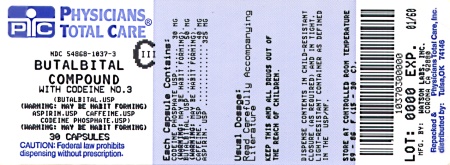
Butalbital, Aspirin, Caffeine, and Codeine Phosphate Capsules, USP is a combination drug product intended as a treatment for tension headache.
Butalbital, Aspirin, and Caffeine Capsules, USP consists of a fixed combination of caffeine 40 mg, butalbital 50 mg, and aspirin 325 mg. The role each component plays in the relief of the complex of symptoms known as tension headache is incompletely understood.
PharmacokineticsBioavailability: The bioavailability of the components of the fixed combination of Butalbital, Aspirin, Caffeine, and Codeine Phosphate Capsules, USP is identical to their bioavailability when Butalbital, Aspirin, and Caffeine Capsules, USP and codeine are administered separately in equivalent molar doses.
The behavior of the individual components is described below.
AspirinThe systemic availability of aspirin after an oral dose is highly dependent on the dosage form, the presence of food, the gastric emptying time, gastric pH, antacids, buffering agents, and particle size. These factors affect not necessarily the extent of absorption of total salicylates but more the stability of aspirin prior to absorption.
During the absorption process and after absorption, aspirin is mainly hydrolyzed to salicylic acid and distributed to all body tissues and fluids, including fetal tissues, breast milk, and the central nervous system (CNS). Highest concentrations are found in plasma, liver, renal cortex, heart, and lung. In plasma, about 50%-80% of the salicylic acid and its metabolites are loosely bound to plasma proteins.
The clearance of total salicylates is subject to saturable kinetics; however, first-order elimination kinetics are still a good approximation for doses up to 650 mg. The plasma half-life for aspirin is about 12 minutes and for salicylic acid and/or total salicylates is about 3 hours.
The elimination of therapeutic doses is through the kidneys either as salicylic acid or other biotransformation products. The renal clearance is greatly augmented by an alkaline urine as is produced by concurrent administration of sodium bicarbonate or potassium citrate.
The biotransformation of aspirin occurs primarily in the hepatocytes. The major metabolites are salicyluric acid (75%), the phenolic and acyl glucuronides of salicylate (15%), and gentisic and gentisuric acid (1%). The bioavailability of the aspirin component of Butalbital, Aspirin, Caffeine, and Codeine Phosphate Capsules, USP is equivalent to that of a solution except for a slower rate of absorption. A peak concentration of 8.8 mcg/mL was obtained at 40 minutes after a 650 mg dose.
See OVERDOSAGE for toxicity information.
CodeineCodeine is readily absorbed from the gastrointestinal tract. It is rapidly distributed from the intravascular spaces to the various body tissues, with preferential uptake by parenchymatous organs such as the liver, spleen, and kidney. Codeine crosses the blood-brain barrier, and is found in fetal tissue and breast milk. The plasma concentration does not correlate with brain concentration or relief of pain, however, codeine is not bound to plasma proteins and does not accumulate in body tissues.
The plasma half-life is about 2.9 hours. The elimination of codeine is primarily via the kidneys, and about 90% of an oral dose is excreted by the kidneys within 24 hours of dosing. The urinary secretion products consist of free and glucuronide-conjugated codeine (about 70%), free and conjugated norcodeine (about 10%), free and conjugated morphine (about 10%), normorphine (4%), and hydrocodone (1%). The remainder of the dose is excreted in the feces.
At therapeutic doses, the analgesic effect reaches a peak within 2 hours and persists between 4 and 6 hours.
The bioavailability of the codeine component of Butalbital, Aspirin, Caffeine, and Codeine Phosphate Capsules, USP is equivalent to that of a solution. Peak concentrations of 198 ng/mL were obtained at 1 hour after a 60 mg dose.
See OVERDOSAGE for toxicity information.
ButalbitalButalbital is well absorbed from the gastrointestinal tract and is expected to distribute to most of the tissues in the body. Barbiturates, in general, may appear in breast milk and readily cross the placental barrier. They are bound to plasma and tissue proteins to a varying degree and binding increases directly as a function of lipid solubility.
Elimination of butalbital is primarily via the kidney (59%-88% of the dose) as unchanged drug or metabolites. The plasma half-life is about 35 hours. Urinary excretion products included parent drug (about 3.6% of the dose), 5-isobutyl-5-(2,3-dihydroxypropyl) barbituric acid (about 24% of the dose), 5-allyl-5(3-hydroxy-2-methyl-1-propyl) barbituric acid (about 4.8% of the dose), products with the barbituric acid ring hydrolyzed with excretion of urea (about 14% of the dose), as well as unidentified materials. Of the material excreted in the urine, 32% was conjugated.
The bioavailability of the butalbital component of Butalbital, Aspirin, Caffeine, and Codeine Phosphate Capsules, USP is equivalent to that of a solution except for a decrease in the rate of absorption. A peak concentration of 2,020 ng/mL is obtained at about 1.5 hours after a 100 mg dose.
The in vitro plasma protein binding of butalbital is 45% over the concentration range of 0.5-20 mcg/mL. This falls within the range of plasma protein binding (20%-45%) reported with other barbiturates such as phenobarbital, pentobarbital, and secobarbital sodium. The plasma-to-blood concentration ratio was almost unity indicating that there is no preferential distribution of butalbital into either plasma or blood cells.
See OVERDOSAGE for toxicity information.
CaffeineLike most xanthines, caffeine is rapidly absorbed and distributed in all body tissues and fluids, including the CNS, fetal tissues, and breast milk.
Caffeine is cleared rapidly through metabolism and excretion in the urine. The plasma half-life is about 3 hours. Hepatic biotransformation prior to excretion results in about equal amounts of 1-methylxanthine and 1-methyluric acid. Of the 70% of the dose that has been recovered in the urine, only 3% was unchanged drug.
The bioavailability of the caffeine component Butalbital, Aspirin, Caffeine, and Codeine Phosphate Capsules, USP is equivalent to that of a solution except for a slightly longer time to peak. A peak concentration of 1,660 ng/mL was obtained in less than an hour for an 80 mg dose.
See OVERDOSAGE for toxicity information.
Create a free account to view complete drug information, save medications, and more.
Free forever · No credit card required