 MedLens
Loading…
Tablets · GAVIS Pharmaceuticals, LLC
Dosage Form
Tablets
Manufacturer
GAVIS Pharmaceuticals, LLC
This medication contains important usage instructions, warnings, and side effect information that you should review before use.
Pentazocine Hydrochloride and Acetaminophen Tablets are indicated for the relief of mild to moderate pain.
Adult
The usual adult dose is 1 caplet every 4 hours as needed for pain relief, up to a maximum of 6 caplets per day.
Discontinuation
Due to the potential for withdrawal symptoms associated with abrupt discontinuation, consideration should be given to tapering patients off pentazocine hydrochloride and acetaminophen tablets after prolonged periods of treatment with pentazocine hydrochloride and acetaminophen tablets (See PRECAUTIONS, Drug Abuse and Dependence).
Pentazocine hydrochloride and acetaminophen tablets are contraindicated in patients who are hypersensitive to either pentazocine or acetaminophen.
CNS Depressants
Other central nervous system (CNS) depressants including sedatives, hypnotics, general anesthetics, antiemetics, phenothiazines, or other tranquilizers or alcohol increases the risk of respiratory depression, hypotension, profound sedation, or coma. Use morphine sulfate with caution and in reduced dosages in patients taking these agents.
Opioid Agonist Analgesics
Pentazocine hydrochloride and acetaminophen tablets can antagonize the effects of a pure opioid agonist analgesic and/or may precipitate withdrawal symptoms.
Monoamine Oxidase Inhibitors (MAOIs)
Concomitant use of monoamine oxidase inhibitors (MAOIs) with pentazocine hydrochloride and acetaminophen tablets may cause CNS excitation and hypertension through their respective effects on catecholamines. Caution should therefore be observed in administering pentazocine hydrochloride and acetaminophen tablets to patients who are currently receiving MAOIs or who have received them within the preceding 14 days.
Anticholinergics
Anticholinergics or other medications with anticholinergic activity when used concurrently with opioid analgesics may result in increased risk of urinary retention and/or severe constipation, which may lead to paralytic ileus.
Tobacco
Smoking tobacco could enhance the metabolic clearance rate of pentazocine reducing the clinical effectiveness of a standard dose of pentazocine.
Clinical experience with pentazocine hydrochloride and acetaminophen tablets have been insufficient to define all possible adverse reactions with this combination. However, reactions reported after oral administration of pentazocine hydrochloride in 50 mg dosage include the following:
Cardiovascular: hypertension, hypotension, circulatory depression, tachycardia.
Respiratory: rarely respiratory depression,
Acute CNS Manifestations: Hallucinations (usually visual), disorientation, and confusion
Other CNS effects: grand mal convulsions, increase in intracranial pressure, dizziness, lightheadedness, hallucinations, sedation, euphoria, headache, confusion, disorientation; infrequently weakness, disturbed dreams, insomnia, syncope, and depression; and rarely tremor, irritability, excitement, tinnitus.
Autonomic: sweating; infrequently flushing; and rarely chills.
Gastrointestinal: nausea, vomiting, constipation; diarrhea, anorexia, dry mouth, Biliary tract spasm, and rarely abdominal distress.
Allergic: edema of the face, anaphylactic shock, dermatitis including pruritus, flushed skin including plethora, infrequently rash; and rarely urticaria.
Ophthalmic: visual blurring and focusing difficulty, miosis.
Hematologic: depression of white blood cells (especially granulocytes) with rare cases of agranulocytosis, which is usually reversible, moderate transient eosinophilia.
Dependence and Withdrawal Symptoms: (See WARNINGS, PRECAUTIONS, and DRUG ABUSE AND DEPENDENCE Sections).
Other: urinary retention, paresthesia, serious skin reactions, including erythema multiforme, Stevens-Johnson Syndrome, toxic epidermal necrolysis, and alterations in rate or strength of uterine contractions during labor.
A few cases of hypersensitivity to acetaminophen have been reported, as manifested by anaphylaxis, angioneurotic edema, thrombocytopenic purpura, skin rashes, and rarely hemolytic anemia and agranulocytosis. Occasionally individuals respond to ordinary doses with nausea and vomiting and diarrhea.
Pentazocine and acetaminophen are excreted in human milk. Caution should be exercised when pentazocine hydrochloride and acetaminophen tablets are administered to a nursing woman.
Safety and effectiveness in pediatric patients below the age of 12 have not been established.
Clinical studies of pentazocine hydrochloride and acetaminophen tablets did not include sufficient numbers of subjects aged 65 and over to determine whether they respond differently from younger subjects. Other reported clinical experience has not identified differences in responses between the elderly and younger patients. In general, dose selection for an elderly patient should be cautious, usually starting at the low end of the dosing range, reflecting the greater frequency of decreased hepatic, renal, or cardiac function, and of concomitant disease or other drug therapy.
Patients receiving pentazocine hydrochloride and acetaminophen tablets should be given the following instructions by the physician:
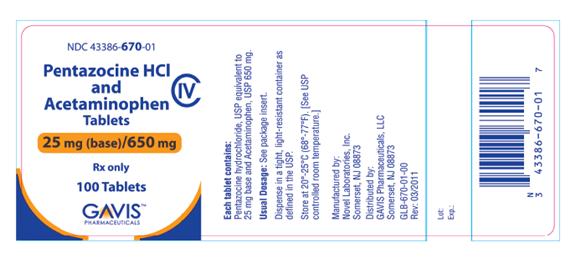
Pentazocine Hydrochloride and Acetaminophen Tablets are a combination of pentazocine hydrochloride, USP, equivalent to 25 mg base and acetaminophen, USP, 650 mg.
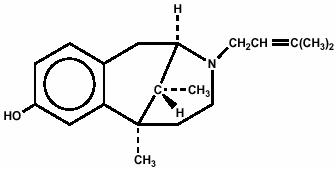
Pentazocine is a member of the benzazocine series (also known as the benzomorphan series). Chemically, pentazocine is (2R*,6R*,11R*)1,2,3,4,5,6-hexahydro-6,11-dimethyl-3-(3-methyl-2-butenyl)-2,6-methano-3-benzazocin-8-ol, a white, crystalline substance soluble in acidic aqueous solutions, and has the following structural formula:
[image: MM1]C19H27NO HCl M.W. 321.88
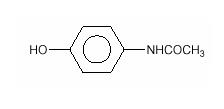
Chemically, acetaminophen is Acetamide, N-(4-hydroxyphenyl)-, and has the following structural formula:
[image: MM2]C8H9NO2 M.W. 151.16
Pentazocine is an analgesic and acetaminophen is an analgesic and antipyretic.
Inactive ingredients: colloidal silicon dioxide, FD&C Blue # 1 aluminum lake, microcrystalline cellulose, sodium lauryl sulfate, sodium starch glycolate, and stearic acid.
Pentazocine Hydrochloride and Acetaminophen Tablets are light blue capsule shaped, tablets debossed “NL” on left side and “670” on right side of bisect and plain on the other side.
Bottles of 100 (NDC 43386-670-01).
Bottles of 100 (NDC 43386-670-05)
Store at 25°C (77°F); excursions permitted between 15°-30°C (59°-86°F). [See USP.]
Dispense in a tight, light-resistant container as defined in the USP.
DEA Order Form Required.
Manufactured by:
Novel Laboratories, Inc.
Somerset, NJ 08873
Distributed by:
GAVIS Pharmaceuticals, LLC
Somerset, NJ 08873
GIN-670-02
Rev: 06/2011
Photos of the product and/or packaging supplied by the manufacturer.
Hepatotoxicity
Pentazocine Hydrochloride and Acetaminophen Tablets contain acetaminophen and pentazocine hydrochloride. Acetaminophen has been associated with cases of acute liver failure, at times resulting in liver transplant and death. Most of the cases of liver injury are associated with the use of acetaminophen at doses that exceed 4000 milligrams per day, and often involve more than one acetaminophen-containing product.
Pentazocine is a Schedule IV opioid analgesic with agonist/antagonist action which when administered orally is approximately equivalent on a mg for mg basis in analgesic effect to codeine.
Acetaminophen is an analgesic and antipyretic.
Pentazocine weakly antagonizes the analgesic effects of morphine, meperidine, and phenazocine; in addition, it produces incomplete reversal of cardiovascular, respiratory, and behavioral depression induced by morphine and meperidine. Pentazocine has about 1/50 the antagonistic activity of nalorphine. It also has sedative activity.
Onset of significant analgesia with pentazocine usually occurs between 15 and 30 minutes after oral administration, and duration of action is usually three hours or longer.
Pentazocine is well absorbed from the gastrointestinal tract. Plasma levels closely correspond to the onset, duration, and intensity of analgesia. The time to mean peak concentration in 24 normal volunteers was 1.7 hours (range 0.5 to 4 hours) after oral administration and the mean plasma elimination half-life was 3.6 hours (range 1.5 to 10 hours).
The action of pentazocine is terminated for the most part by biotransformation in the liver with some free pentazocine excreted in the urine. The products of the oxidation of the terminal methyl groups and glucuronide conjugates are excreted by the kidney. Elimination of approximately 60% of the total dose occurs within 24 hours. Pentazocine passes into fetal circulation.
Onset of significant analgesic and antipyretic activity of acetaminophen when administered orally occurs within 30 minutes and is maximal at approximately 2 1/2 hours. The pharmacological mode of action of acetaminophen is unknown at this time.
Acetaminophen is rapidly and almost completely absorbed from the gastrointestinal tract. In 24 normal volunteers the time to mean peak plasma concentration was 1 hour (range 0.25 to 3 hours) after oral administration and the mean plasma elimination half-life was 2.8 hours (range 2 to 4 hours).
The effect of pentazocine on acetaminophen plasma protein binding or vice versa has not been established. For acetaminophen there is little or no plasma protein binding at normal therapeutic doses. When toxic doses of acetaminophen are ingested and drug plasma levels exceed 90 mcg/mL, plasma binding may vary from 8% to 43%.
Acetaminophen is conjugated in the liver with glucuronic acid and to a lesser extent with sulfuric acid. Approximately 80% of acetaminophen is excreted in the urine after conjugation and about 3% is excreted unchanged. The drug is also conjugated to a lesser extent with cysteine and additionally metabolized by hydroxylation.
If pentazocine hydrochloride and acetaminophen tablets are taken every 4 hours over an extended period of time, accumulation of pentazocine and to a lesser extent, acetaminophen, may occur.
Carcinogenesis, mutagenesis, and impairment of fertility studies have not been done with this combination product.
Studies to evaluate the mutagenic potential of the components of pentazocine hydrochloride and acetaminophen tablets have not been conducted.
Pentazocine, when administered orally or parenterally, had no adverse effect on either the reproductive capabilities or the course of pregnancy in rabbits and rats. Embryotoxic effects on the fetuses were not shown.
The daily administration of 4 mg/kg to 20 mg/kg pentazocine subcutaneously to female rats during a 14 day pre-mating period and until the 13th day of pregnancy did not have any adverse effects on the fertility rate.
Patients receiving pentazocine during labor have experienced no adverse effects other than those that occur with commonly used analgesics. However, pentazocine can cross the placental barrier and cause central nervous system depression in the newborn and, if used regularly throughout pregnancy, may lead to symptoms of withdrawal in the newborn. Pentazocine hydrochloride and acetaminophen tablets should be used with caution in women delivering premature infants. The effect of pentazocine hydrochloride and acetaminophen tablets on the mother and fetus, the duration of labor or delivery, the possibility that forceps delivery or other intervention or resuscitation of the newborn may be necessary, or the effect of pentazocine hydrochloride and acetaminophen tablets, on the later growth, development, and functional maturation of the child are unknown at the present time.
Create a free account to view complete drug information, save medications, and more.
Free forever · No credit card required