 MedLens
Loading…
CARACO PHARMACEUTICAL LABORATORIES, LTD.
Dosage Form
N/A
Manufacturer
CARACO PHARMACEUTICAL LABORATORIES, LTD.
This medication contains important usage instructions, warnings, and side effect information that you should review before use.
Metformin hydrochloride tablets, USP are indicated as an adjunct to diet and exercise to improve glycemic control in adults and children with type 2 diabetes mellitus.
There is no fixed dosage regimen for the management of hyperglycemia in patients with type 2 diabetes with metformin or any other pharmacologic agent. Dosage of metformin must be individualized on the basis of both effectiveness and tolerance, while not exceeding the maximum recommended daily dose. The maximum recommended daily dose of metformin hydrochloride tablets, USP is 2550 mg in adults and 2000 mg in pediatric patients (10-16 years of age).
Metformin should be given in divided doses with meals and should be started at a low dose, with gradual dose escalation, both to reduce gastrointestinal side effects and to permit identification of the minimum dose required for adequate glycemic control of the patient.
During treatment initiation and dose titration (see Recommended Dosing Schedule), fasting plasma glucose should be used to determine the therapeutic response to metformin and identify the minimum effective dose for the patient. Thereafter, glycosylated hemoglobin should be measured at intervals of approximately three months. The therapeutic goal should be to decrease both fasting plasma glucose and glycosylated hemoglobin levels to normal or near normal by using the lowest effective dose of metformin hydrochloride tablets, USP either when used as monotherapy or in combination with sulfonylureas or insulin.
Monitoring of blood glucose and glycosylated hemoglobin will also permit detection of primary failure, i.e., inadequate lowering of blood glucose at the maximum recommended dose of medication, and secondary failure, i.e., loss of an adequate blood glucose lowering response after an initial period of effectiveness.
Short-term administration of metformin may be sufficient during periods of transient loss of control in patients usually well-controlled on diet alone.
Metformin hydrochloride tablets are contraindicated in patients with:
Metformin should be temporarily discontinued in patients undergoing radiologic studies involving intravascular administration of iodinated contrast materials, because use of such products may result in acute alteration of renal function. (See also PRECAUTIONS.)
In a U.S. double-blind clinical study of metformin in patients with type 2 diabetes, a total of 141 patients received metformin therapy (up to 2550 mg per day) and 145 patients received placebo.
Adverse reactions reported in greater than 5% of the metformin patients, and that were more common in metformin than placebo-treated patients, are listed in Table 7.
| Table 7. Most Common Adverse Reactions (>5.0%) in a Placebo-Controlled Clinical Study of Metformin Monotherapy* | ||
|---|---|---|
| Metformin Monotherapy n=141 | Placebo n=145 | |
| Adverse Reaction | % of Patients | |
| * Reactions that were more common in metformin- than placebo-treated patients | ||
| Diarrhea | 53.2 | 11.7 |
| Nausea/Vomiting | 25.5 | 8.3 |
| Flatulence | 12.1 | 5.5 |
| Asthenia | 9.2 | 5.5 |
| Indigestion | 7.1 | 4.1 |
| Abdominal Discomfort | 6.4 | 4.8 |
| Headache | 5.7 | 4.8 |
Diarrhea led to discontinuation of study medication in 6% of patients treated with metformin.
Additionally, the following adverse reactions were reported in ≥1.0-≤ 5.0% of metformin patients and were more commonly reported with metformin than placebo: abnormal stools, hypoglycemia, myalgia, lightheaded, dyspnea, nail disorder, rash, sweating increased, taste disorder, chest discomfort, chills, flu syndrome, flushing, palpitation.
Studies in lactating rats show that metformin is excreted into milk and reaches levels comparable to those in plasma. Similar studies have not been conducted in nursing mothers. Because the potential for hypoglycemia in nursing infants may exist, a decision should be made whether to discontinue nursing or to discontinue the drug, taking into account the importance of the drug to the mother. If metformin is discontinued, and if diet alone is inadequate for controlling blood glucose, insulin therapy should be considered.
The safety and effectiveness of metformin hydrochloride tablets, USP for treatment of type 2 diabetes have been established in pediatric patients ages 10 to 16 years (studies have not been conducted in pediatric patients below the age of 10 years). Use of metformin hydrochloride tablets, USP in this age group is supported by evidence from adequate and well-controlled studies of Metformin in adults with additional data from a controlled clinical study in pediatric patients ages 10-16 years with type 2 diabetes, which demonstrated a similar response in glycemic control to that seen in adults. (See CLINICAL PHARMACOLOGY: Pediatric Clinical Studies.) In this study, adverse effects were similar to those described in adults. (See ADVERSE REACTIONS: Pediatric Patients.) A maximum daily dose of 2000 mg is recommended. (See DOSAGE AND ADMINISTRATION: Recommended Dosing Schedule: Pediatrics.)
Overdose of metformin hydrochloride has occurred, including ingestion of amounts greater than 50 grams. Hypoglycemia was reported in approximately 10% of cases, but no causal association with metformin hydrochloride has been established. Lactic acidosis has been reported in approximately 32% of metformin overdose cases (see WARNINGS). Metformin is dialyzable with a clearance of up to 170 mL/min under good hemodynamic conditions. Therefore, hemodialysis may be useful for removal of accumulated drug from patients in whom metformin overdosage is suspected.
Store at controlled room temperature 15°-30° C (59°-86°F).
Dispense in tight, light resistant container as defined in the USP.
Patients should be informed of the potential risks and benefits of metformin and of alternative modes of therapy. They should also be informed about the importance of adherence to dietary instructions, of a regular exercise program, and of regular testing of blood glucose, glycosylated hemoglobin, renal function and hematologic parameters.
The risks of lactic acidosis, its symptoms, and conditions that predispose to its development, as noted in the WARNINGS and PRECAUTIONS sections should be explained to patients. Patients should be advised to discontinue metformin immediately and to promptly notify their health practitioner if unexplained hyperventilation, myalgia, malaise, unusual somnolence or other nonspecific symptoms occur. Once a patient is stabilized on any dose level of metformin, gastrointestinal symptoms, which are common during initiation of therapy, are unlikely to be drug related. Later occurrence of gastrointestinal symptoms could be due to lactic acidosis or other serious disease.
Patients should be counseled against excessive alcohol intake, either acute or chronic, while receiving metformin.
Metformin hydrochloride tablets, USP alone does not usually cause hypoglycemia, although it may occur when metformin is used in conjunction with oral sulfonylureas and insulin. When initiating combination therapy, the risks of hypoglycemia, its symptoms and treatment, and conditions that predispose to its development should be explained to patients and responsible family members.
(See Patient Information Printed Below.)
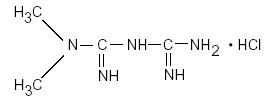
Metformin hydrochloride, USP is an oral antihyperglycemic drug used in the management of type 2 diabetes. Metformin hydrochloride ( N,N-dimethylimidodicarbonimidic diamide hydrochloride) is not chemically or pharmacologically related to any other classes of oral antihyperglycemic agents. The structural formula is as shown:
[image: MM1]Metformin hydrochloride, USP is a white to off-white crystalline compound with a molecular formula of C4H11N5•HCl and a molecular weight of 165.63. Metformin hydrochloride, USP is freely soluble in water and is practically insoluble in acetone, ether and chloroform. The pKa of metformin is 12.4. The pH of a 1% aqueous solution of metformin hydrochloride, USP is 6.68.
Metformin hydrochloride tablets, USP contain 500 mg, 850 mg, and 1000 mg of metformin hydrochloride, USP. Each tablet contains the inactive ingredients povidone, croscarmellose sodium, microcrystalline cellulose, polyethylene glycol and magnesium stearate. In addition, the coating for 500 mg, 850 mg and 1000 mg contains: Polyvinyl alcohol, titanium dioxide, polyethylene glycol, and talc.
Metformin hydrochloride tablets, USP
500 mg Bottles of 90                           NDC 57664-997-99
500 mg Bottles of 100                         NDC 57664-997-88
500 mg Bottles of 500                         NDC 57664-997-13
500 mg Bottles of 1000                       NDC 57664-997-18
850 mg Bottles of 90                           NDC 57664-998-99
850 mg Bottles of 100                         NDC 57664-998-88
850 mg Bottles of 500                         NDC 57664-998-13
850 mg Bottles of 1000                       NDC 57664-998-18
1000 mg Bottles of 90                         NDC 57664-999-99
1000 mg Bottles of 100                       NDC 57664-999-88
1000 mg Bottles of 500                       NDC 57664-999-13
1000 mg Bottles of 1000                     NDC 57664-999-18
Metformin hydrochloride 500 mg tablets, USP are round, white to off-white, film coated tablets debossed with “397” on one side and plain on the other side.
Metformin hydrochloride 850 mg tablets, USP are round, white to off-white, film coated tablets debossed with “435” on one side and plain on the other side.
Metformin hydrochloride 1000 mg tablets, USP are white to off-white colored, oval shaped, film coated tablets debossed with “C” & “474” on one side and scored on both sides.
Photos of the product and/or packaging supplied by the manufacturer.
In a double-blind placebo-controlled, multicenter U.S. clinical trial involving obese patients with type 2 diabetes whose hyperglycemia was not adequately controlled with dietary management alone (baseline fasting plasma glucose [FPG] of approximately 240 mg/dL), treatment with metformin hydrochloride tablets, USP (up to 2550 mg/day) for 29 weeks resulted in significant mean net reductions in fasting and postprandial plasma glucose (PPG) and hemoglobin A1c (HbA1c) of 59 mg/dL, 83 mg/dL, and 1.8%, respectively, compared to placebo group (see Table 2).
| Table 2. Metformin Hydrochloride Tablets, USP vs Placebo Summary of Mean Changes from Baseline* in Fasting Plasma Glucose HbA1c and Body Weight, at Final Visit (29-week study) | |||
|---|---|---|---|
| Metformin hydrochloride tablets, USP (n = 141) | Placebo (n = 145) | P-value | |
| * All patients on diet therapy at baseline ** Not statistically significant | |||
| FPG (mg/dL) | |||
| Baseline | 241.5 | 237.7 | NS** |
| Change at FINAL VISIT | -53 | 6.3 | 0.001 |
| Hemoglobin A1c (%) | |||
| Baseline | 8.4 | 8.2 | NS** |
| Change at FINAL VISIT | -1.4 | 0.4 | 0.001 |
| Body Weight (lbs) |   |   | |
| Baseline | 201 | 206.0  | NS** |
| Change at FINAL VISIT | -1.4 | -2.4 | NS** |
A 29-week, double-blind, placebo-controlled study of metformin and glyburide, alone and in combination, was conducted in obese patients with type 2 diabetes patients who had failed to achieve adequate glycemic control while on maximum doses of glyburide (baseline FPG of approximately 250 mg/dL) (see Table 3). Patients randomized to the combination arm started therapy with metformin hydrochloride 500 mg and glyburide 20 mg. At the end of each week of the first four weeks of the trial, these patients had their dosages of metformin hydrochloride increased by 500 mg if they had failed to reach target fasting plasma glucose. After week four, such dosage adjustments were made monthly, although no patient was allowed to exceed metformin hydrochloride 2500 mg. Patients in the metformin hydrochloride only arm (metformin plus placebo) followed the same titration schedule. At the end of the trial, approximately 70% of the patients in the combination group were taking metformin hydrochloride 2000 mg/glyburide 20 mg or metformin hydrochloride 2500 mg/glyburide 20 mg. Patients randomized to continue on glyburide experienced worsening of glycemic control, with mean increases in FPG, PPG and HbA1c of 14 mg/dL, 3 mg/dL and 0.2%, respectively. In contrast, those randomized to metformin (up to 2500 mg/day) experienced a slight improvement, with mean reductions in FPG, PPG and HbA1c of 1 mg/dL, 6 mg/dL and 0.4%, respectively. The combination of metformin and glyburide was effective in reducing FPG, PPG and HbA1c levels by 63 mg/dL, 65 mg/dL, and 1.7%, respectively. Compared to results of glyburide treatment alone, the net differences with combination treatment were -77 mg/dL, -68 mg/dL and -1.9%, respectively (see Table 3).
| Table 3. Combined Metformin Hydrochloride Tablets, USP / Glyburide (Comb) vs Glyburide (Glyb) or Metformin Hydrochloride Tablets, USP (Met) Monotherapy: Summary of Mean Changes from Baseline* in Fasting Plasma Glucose, HBA1c and Body Weight at Final Visit (29-week study) | ||||||
|---|---|---|---|---|---|---|
| p-values | ||||||
| Comb (n = 213) | Glyb (n = 209) | Met (n = 210) | Glyb Vs Comb | Met Vs comb | Met Vs Glyb | |
| *All patients on glyburide, 20 mg/day, at Baseline ** Not statistically significant | ||||||
| Fasting Plasma Glucose (mg/dL) | ||||||
| Baseline | 250.5 | 247.5 | 253.9 | NS** | NS** | NS** |
| Change at FINAL VISIT | -63.5 | 13.7 | -0.9 | 0.001 | 0.001 | 0.025 |
| Hemoglobin A1c (%) | ||||||
| Baseline | 8.8 | 8.5 | 8.9 | NS** | NS** | 0.007 |
| Change at FINAL VISIT | -1.7 | 0.2 | -0.4 | 0.001 | 0.001 | 0.001 |
| Body Weight (lbs) | ||||||
| Baseline | 202.2 | 203 | 204 | NS** | NS** | NS** |
| Change at FINAL VISIT | 0.9 | -0.7 | -8.4 | 0.011 | 0.001 | 0.001 |
The magnitude of the decline in fasting blood glucose concentration following the institution of metformin hydrochloride tablets, USP therapy is proportional to the level of fasting hyperglycemia. Patients with type 2 diabetes with higher fasting glucose concentrations experienced greater declines in plasma glucose and glycosylated hemoglobin.
In clinical studies, metformin, alone or in combination with a sulfonylurea, lowered mean fasting serum triglycerides, total cholesterol and LDL cholesterol levels and had no adverse effects on other lipid levels (see Table 4).
| Table 4. Summary of Mean Percent Change from Baseline of Major Serum Lipid Variables at Final Visit (29-week studies) | |||||
|---|---|---|---|---|---|
| Metformin Vs Placebo | Combined Metformin/Glyburide Vs Monotherapy | ||||
| Metformin (N = 141) | Placebo (N = 145) | Metformin (n = 210) | Metformin/Glyburide (n = 213) | Glyburide (n = 209) | |
| Total Cholestrol (mg/dL) | |||||
| Baseline | 211 | 212.3 | 213.1 | 215.6 | 219.6 |
| Mean % change at FINAL VISIT | -5% | 1% | -2% | -4% | 1% |
| Total Triglycerides (mg/dL) | |||||
| Baseline | 236.1 | 203.5 | 242.5 | 215 | 266.1 |
| Mean % change at FINAL VISIT | -16% | 1% | -3% | -8% | 4% |
| LDL-Cholestrol (mg/dL) | |||||
| Baseline | 135.4 | 138.5 | 134.3 | 136 | 137.5 |
| Mean % change at FINAL VISIT | -8% | 1% | -4% | -6% | 3% |
| HDL-Cholestrol (mg/dL) | |||||
| Baseline | 39 | 40.5 | 37.2 | 39 | 37 |
| Mean % change at FINAL VISIT | 2% | -1% | 5% | 3% | 1% |
In contrast to sulfonylureas, body weight of individuals on metformin tended to remain stable or even decrease somewhat (see Tables 2 and 3).
A 24-week, double blind, placebo-controlled study of metformin hydrochloride tablets, USP plus insulin versus insulin plus placebo was conducted in patients with type 2 diabetes who failed to achieve adequate glycemic control on insulin alone (see Table 5). Patients randomized to receive metformin hydrochloride plus insulin achieved a reduction in HbA1C of 2.10%, compared to a 1.56% reduction in HbA1c achieved by insulin plus placebo. The improvement in glycemic control was achieved at the final study visit with 16% less insulin, 93.0 U/day vs 110.6 U/day, metformin hydrochloride tablets, USP plus insulin versus insulin plus placebo, respectively, p=0.04.
| Table 5. Combined Metformin Hydrochloride Tablets, USP/Insulin vs Placebo/Insulin Summary of Mean Changes from Baseline in HbA1c and Daily Insulin Dose | |||
|---|---|---|---|
| Metformin Hydrochloride tablets, USP/Insulin n=26 | Placebo/Insulin n=28 | Treatment difference Mean ± SE | |
| a Statistically significant using analysis of covariance with baseline as covariate (p=0.04) Not significant using analysis of variance (values shown in table) b Statistically significant for insulin (p=0.04) | |||
| Hemoglobin A1c (%) | |||
| Baseline | 8.95 | 9.32 | |
| Change at FINAL VISIT | - 2.10 | - 1.56 | - 0.54 ± 0.43a |
| Insulin Dose (U/day) | |||
| Baseline | 93.12 | 94.64 | |
| Change at FINAL VISIT | - 0.15 | 15.93 | - 16.08 ± 7.77b |
A second double-blind, placebo-controlled study (n=51), with 16 weeks of randomized treatment, demonstrated that in patients with type 2 diabetes controlled on insulin for 8 weeks with an average HbA1c of 7.46 ± 0.97%, the addition of metformin hydrochloride tablets, USP maintained similar glycemic control (HbA1C 7.15 ± 0.61 versus 6.97 ± 0.62 for metformin hydrochloride tablets, USP plus insulin and placebo plus insulin, respectively) with 19% less insulin versus baseline (reduction of 23.68 ± 30.22 versus an increase of 0.43 ± 25.20 units for metformin hydrochloride tablets, USP plus insulin and placebo plus insulin, p<0.01). In addition, this study demonstrated that the combination of metformin hydrochloride tablets, USP plus insulin resulted in reduction in body weight of 3.11 ± 4.30 lbs, compared to an increase of 1.30 ± 6.08 lbs for placebo plus insulin, p=0.01.
Long-term carcinogenicity studies have been performed in rats (dosing duration of 104 weeks) and mice (dosing duration of 91 weeks) at doses up to and including 900 mg/kg/day and 1500 mg/kg/day, respectively. These doses are both approximately four times the maximum recommended human daily dose of 2000 mg based on body surface area comparisons. No evidence of carcinogenicity with metformin was found in either male or female mice. Similarly, there was no tumorigenic potential observed with metformin in male rats. There was, however, an increased incidence of benign stromal uterine polyps in female rats treated with 900 mg/kg/day.
There was no evidence of a mutagenic potential of metformin in the following in vitro tests: Ames test (S. typhimurium), gene mutation test (mouse lymphoma cells), or chromosomal aberrations test (human lymphocytes). Results in the in vivo mouse micronucleus test were also negative.
Fertility of male or female rats was unaffected by metformin when administered at doses as high as 600 mg/kg/day, which is approximately three times the maximum recommended human daily dose based on body surface area comparisons.
Create a free account to view complete drug information, save medications, and more.
Free forever · No credit card required