 MedLens
Loading…
Tablets, USP · NuCare Pharmaceuticals, Inc.
Dosage Form
Tablets, USP
Manufacturer
NuCare Pharmaceuticals, Inc.
This medication contains important usage instructions, warnings, and side effect information that you should review before use.
Full Prescribing Information
HEPATOTOXICITY
Tramadol hydrochloride and acetaminophen tablets, USP contains tramadol HCl and acetaminophen. Acetaminophen has been associated with cases of acute liver failure, at times resulting in liver transplant and death. Most of the cases of liver injury are associated with the use of acetaminophen at doses that exceed 4,000 milligrams per day, and often involve more than one acetaminophen-containing product (see WARNINGS).
Tramadol hydrochloride and acetaminophen tablets, USP are indicated for the short-term (five days or less) management of acute pain.
For the short-term (five days or less) management of acute pain, the recommended dose of tramadol hydrochloride and acetaminophen tablets is 2 tablets every 4 to 6 hours as needed for pain relief, up to a maximum of 8 tablets per day.
Tramadol hydrochloride and acetaminophen tablets should not be administered to patients who have previously demonstrated hypersensitivity to tramadol, acetaminophen, any other component of this product, or opioids. Tramadol hydrochloride and acetaminophen tablets are contraindicated in any situation where opioids are contraindicated, including acute intoxication with any of the following: alcohol, hypnotics, narcotics, centrally acting analgesics, opioids, or psychotropic drugs. Tramadol hydrochloride and acetaminophen tablets may worsen central nervous system and respiratory depression in these patients.
CYP2D6 and CYP3A4 Inhibitors :
Concomitant administration of CYP2D6 and/or CYP3A4 inhibitors (see CLINICAL PHARMACOLOGY, Pharmacokinetics ), such as quinidine, fluoxetine, paroxetine and amitriptyline (CYP2D6 inhibitors), and ketoconazole and erythromycin (CYP3A4 inhibitors), may reduce metabolic clearance of tramadol, increasing the risk for serious adverse events including seizures and serotonin syndrome.
Serotonergic Drugs :
There have been postmarketing reports of serotonin syndrome with use of tramadol and SSRIs/SNRIs or MAOIs and α2-adrenergic blockers. Caution is advised when tramadol hydrochloride and acetaminophen tablets are coadministered with other drugs that may affect the serotonergic neurotransmitter systems, such as SSRIs, MAOIs, triptans, linezolid (an antibiotic which is a reversible non-selective MAOI), lithium, or St. John's Wort. If concomitant treatment of tramadol hydrochloride and acetaminophen tablets with a drug affecting the serotonergic neurotransmitter system is clinically warranted, careful observation of the patient is advised, particularly during treatment initiation and dose increases (see WARNINGS, Serotonin Syndrome ).
Triptans
Based on the mechanism of action of tramadol and the potential for serotonin syndrome, caution is advised when tramadol hydrochloride and acetaminophen tablets are coadministered with a triptan. If concomitant treatment of tramadol hydrochloride and acetaminophen tablets with a triptan is clinically warranted, careful observation of the patient is advised, particularly during treatment initiation and dose increases (see WARNINGS, Serotonin Syndrome ).
Table 2 reports the incidence rate of treatment-emergent adverse events over five days of tramadol hydrochloride and acetaminophen tablets use in clinical trials (subjects took an average of at least 6 tablets per day).
|
|
Tramadol
Hydrochloride
and
Acetaminophen
Tablets
(
N
=
142
)
|
|
Body
System
|
|
| Preferred Term
|
(%)
|
|
Gastrointestinal
System
Disorders
|
|
| Constipation
|
6
|
| Diarrhea
|
3
|
| Nausea
|
3
|
| Dry Mouth
|
2
|
|
Psychiatric
Disorders
|
|
| Somnolence
|
6
|
| Anorexia
|
3
|
| Insomnia
|
2
|
|
Central
&
Peripheral
Nervous
System
|
|
| Dizziness
|
3
|
|
Skin
and
Appendages
|
|
| Sweating Increased
|
4
|
| Pruritus
|
2
|
|
Reproductive
Disorders
,
Male
|
|
| Prostatic Disorder
|
2
|
Tramadol hydrochloride and acetaminophen tablets are not recommended for obstetrical preoperative medication or for post-delivery analgesia in nursing mothers because its safety in infants and newborns has not been studied.
Following a single IV 100 mg dose of tramadol, the cumulative excretion in breast milk within 16 hours post-dose was 100 mcg of tramadol (0.1% of the maternal dose) and 27 mcg of M1.
The safety and effectiveness of tramadol hydrochloride and acetaminophen tablets has not been studied in the pediatric population.
In general, dose selection for an elderly patient should be cautious, reflecting the greater frequency of decreased hepatic, renal, or cardiac function; of concomitant disease; and multiple drug therapy.
Tramadol hydrochloride and acetaminophen tablets is a combination product. The clinical presentation of overdose may include the signs and symptoms of tramadol toxicity, acetaminophen toxicity or both. The initial symptoms of tramadol overdosage may include respiratory depression and/or seizures. The initial symptoms seen within the first 24 hours following an acetaminophen overdose are: anorexia, nausea, vomiting, malaise, pallor and diaphoresis. An overdosage of tramadol hydrochloride and acetaminophen tablets may be a potentially lethal polydrug overdose, and consultation with a regional poison control center is recommended.
Tramadol:
Acute overdosage with tramadol can be manifested by respiratory depression, somnolence progressing to stupor or coma, skeletal muscle flaccidity, cold and clammy skin, constricted pupils, seizures, bradycardia, hypotension, cardiac arrest, and death.
Deaths due to overdose have been reported with abuse and misuse of tramadol (see WARNINGS, Misuse, Abuse, and Diversion ). Review of case reports has indicated that the risk of fatal overdose is further increased when tramadol is abused concurrently with alcohol or other CNS depressants, including other opioids.
In the treatment of tramadol overdosage, primary attention should be given to the re-establishment of a patent airway and institution of assisted or controlled ventilation. Supportive measures (including oxygen and vasopressors) should be employed in the management of circulatory shock and pulmonary edema accompanying overdose as indicated. Cardiac arrest or arrhythmias may require cardiac massage or defibrillation.
While naloxone will reverse some, but not all, symptoms caused by overdosage with tramadol, the risk of seizures is also increased with naloxone administration. In animals, convulsions following the administration of toxic doses of tramadol hydrochloride and acetaminophen tablets could be suppressed with barbiturates or benzodiazepines but were increased with naloxone. Naloxone administration did not change the lethality of an overdose in mice. Hemodialysis is not expected to be helpful in an overdose because it removes less than 7% of the administered dose in a 4-hour dialysis period.
Store at 20° to 25°C (68° to 77°F) [See USP Controlled Room Temperature].
Dispense in a tight container.
Call your doctor for medical advice about side effects. You may report side effects to FDA at 1-800-FDA-1088.
Tramadol hydrochloride and acetaminophen tablet, USP combines two analgesics, tramadol 37.5 mg and acetaminophen 325 mg.
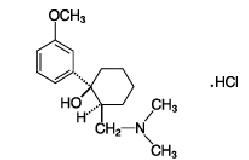
The chemical name for tramadol hydrochloride is (±) cis-2-[(dimethylamino)methyl]-1-(3-methoxyphenyl) cyclohexanol hydrochloride. Its structural formula is:
[image: MM1]The molecular weight of tramadol hydrochloride is 299.84. Tramadol hydrochloride, USP is a white, crystalline powder.
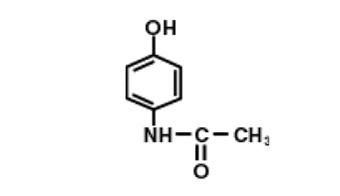
The chemical name for acetaminophen is N-acetyl- p-aminophenol. Its structural formula is:
[image: MM2]The molecular weight of acetaminophen is 151.16. Acetaminophen, USP is an analgesic and antipyretic agent which occurs as a white, odorless, crystalline powder, possessing a slightly bitter taste.
Each tramadol hydrochloride and acetaminophen tablets, USP intended for oral administration contains tramadol hydrochloride, 37.5 mg and acetaminophen, 325 mg. In addition, each tablet contains the following inactive ingredients: corn starch, hypromellose, magnesium stearate, microcrystalline cellulose, polyethylene glycol, pregelatinized starch, sodium starch glycolate, talc and titanium dioxide.
[image: img_8634d978-d164-2bb3-e053-2a91aa0a77cf]
Tramadol Hydrochloride and Acetaminophen Tablets USP, 37.5 mg/325 mg are white, capsule-shaped, beveled-edge, biconvex, film-coated tablets, debossed "334" on one side and plain on other side and are supplied as follows:
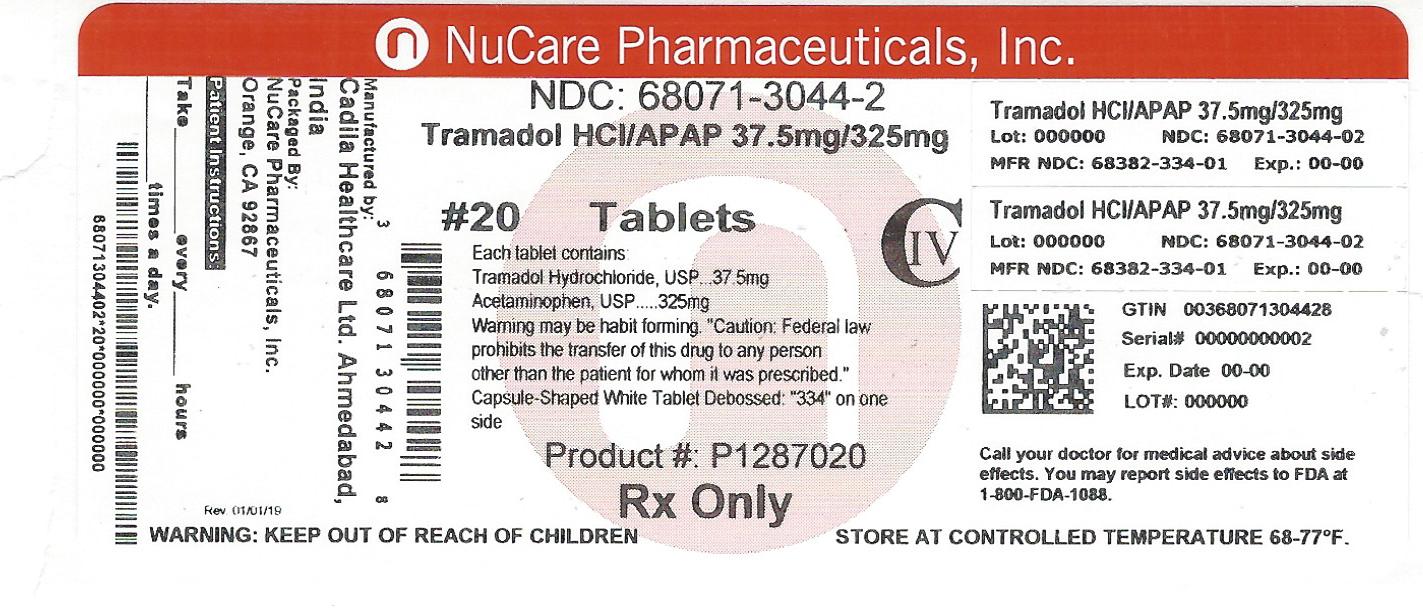
NDC 68071-3044-2 bottle of 20
NDC 68071-3044-3 bottle of 30
NDC 68071-3044-6 bottle of 60
Photos of the product and/or packaging supplied by the manufacturer.
The following information is based on studies of tramadol alone or acetaminophen alone, except where otherwise noted:
Tramadol hydrochloride and acetaminophen tablets contain tramadol and acetaminophen. Tramadol is a centrally acting synthetic opioid analgesic. Although its mode of action is not completely understood, from animal tests, at least two complementary mechanisms appear applicable: binding of parent and M1 metabolite to µ-opioid receptors and weak inhibition of reuptake of norepinephrine and serotonin.
Opioid activity is due to both low affinity binding of the parent compound and higher affinity binding of the O-demethylated metabolite M1 to µ-opioid receptors. In animal models, M1 is up to 6 times more potent than tramadol in producing analgesia and 200 times more potent in µ-opioid binding. Tramadol-induced analgesia is only partially antagonized by the opiate antagonist naloxone in several animal tests. The relative contribution of both tramadol and M1 to human analgesia is dependent upon the plasma concentrations of each compound (see CLINICAL PHARMACOLOGY, Pharmacokinetics ).
Tramadol has been shown to inhibit reuptake of norepinephrine and serotonin in vitro, as have some other opioid analgesics. These mechanisms may contribute independently to the overall analgesic profile of tramadol.
Apart from analgesia, tramadol administration may produce a constellation of symptoms (including dizziness, somnolence, nausea, constipation, sweating, and pruritus) similar to that of other opioids.
Acetaminophen is a non-opiate, non-salicylate analgesic.
Tramadol is administered as a racemate and both the [-] and [+] forms of both tramadol and M1 are detected in the circulation. The pharmacokinetics of plasma tramadol and acetaminophen following oral administration of one tramadol hydrochloride and acetaminophen tablet are shown in Table 1. Tramadol has a slower absorption and longer half-life when compared to acetaminophen.
|
Parameter
|
(+)-
Tramadol
|
(-)-
Tramadol
|
(+)-
M1
|
(-)-
M1
|
acetaminophen
|
|||||
| Cmax (ng/mL)
|
64.3
|
(9.3)
|
55.5
|
(8.1)
|
10.9
|
(5.7)
|
12.8
|
(4.2)
|
4.2
|
(0.8)
|
| tmax (h)
|
1.8
|
(0.6)
|
1.8
|
(0.7)
|
2.1
|
(0.7)
|
2.2
|
(0.7)
|
0.9
|
(0.7)
|
| CL/F (mL/min)
|
588
|
(226)
|
736
|
(244)
|
-
|
-
|
-
|
-
|
365
|
(84)
|
| t1/2 (h)
|
5.1
|
(1.4)
|
4.7
|
(1.2)
|
7.8
|
(3.0)
|
6.2
|
(1.6)
|
2.5
|
(0.6)
|
A single-dose pharmacokinetic study of tramadol hydrochloride and acetaminophen tablet in volunteers showed no drug interactions between tramadol and acetaminophen. Upon multiple oral dosing to steady state, however, the bioavailability of tramadol and metabolite M1 was lower for the combination tablets compared to tramadol administered alone. The decrease in AUC was 14% for (+)-tramadol, 10.4% for (-)-tramadol, 11.9% for (+)-M1 and 24.2% for (-)-M1. The cause of this reduced bioavailability is not clear. Following single- or multiple-dose administration of tramadol hydrochloride and acetaminophen tablets, no significant change in acetaminophen pharmacokinetics was observed when compared to acetaminophen given alone.
Tramadol hydrochloride and acetaminophen tablets should not be used in pregnant women prior to or during labor unless the potential benefits outweigh the risks. Safe use in pregnancy has not been established. Chronic use during pregnancy may lead to physical dependence and post-partum withdrawal symptoms in the newborn (see DRUG ABUSE AND DEPENDENCE ). Tramadol has been shown to cross the placenta. The mean ratio of serum tramadol in the umbilical veins compared to maternal veins was 0.83 for 40 women given tramadol during labor.
The effect of tramadol hydrochloride and acetaminophen tablets, if any, on the later growth, development, and functional maturation of the child is unknown.
Manufactured by:
Cadila Healthcare Ltd.
Ahmedabad, India
Distributed by:
Zydus Pharmaceuticals USA Inc.
Pennington, NJ 08534
Rev.: 08/16
Create a free account to view complete drug information, save medications, and more.
Free forever · No credit card required