 MedLens
Loading…
Quality Care products LLC
Dosage Form
N/A
Manufacturer
Quality Care products LLC
This medication contains important usage instructions, warnings, and side effect information that you should review before use.
INDICATIONS AND USAGE
Oxycodone and acetaminophen tablets USP are indicated for the relief of moderate to moderately severe pain.
DOSAGE AND ADMINISTRATION
Dosage should be adjusted according to the severity of the pain and the response of the patient. It may occasionally be necessary to exceed the usual dosage recommended below in cases of more severe pain or in those patients who have become tolerant to the analgesic effect of opioids. If pain is constant, the opioid analgesic should be given at regular intervals on an around-the-clock schedule. Oxycodone and acetaminophen tablets are given orally.
The total daily dose of acetaminophen should not exceed 4 grams.
| Strength |
Usual Adult Dosage |
Maximal Daily Dose |
| Oxycodone and acetaminophen tablets 5 mg/325 mg |
1 tablet every 6 hours as needed for pain |
12 Tablets |
| Oxycodone and acetaminophen tablets 7.5 mg/325 mg |
1 tablet every 6 hours as needed for pain |
8 Tablets |
| Oxycodone and acetaminophen tablets 7.5 mg/500 mg |
1 tablet every 6 hours as needed for pain |
8 Tablets |
| Oxycodone and acetaminophen tablets 10 mg/325 mg |
1 tablet every 6 hours as needed for pain |
6 Tablets |
Cessation of Therapy
In patients treated with oxycodone and acetaminophen tablets for more than a few weeks who no longer require therapy, doses should be tapered gradually to prevent signs and symptoms of withdrawal in the physically dependent patient.
CONTRAINDICATIONS
Oxycodone and acetaminophen tablets should not be administered to patients with known hypersensitivity to oxycodone, acetaminophen, or any other component of this product.
Oxycodone is contraindicated in any situation where opioids are contraindicated including patients with significant respiratory depression (in unmonitored settings or the absence of resuscitative equipment) and patients with acute or severe bronchial asthma or hypercarbia. Oxycodone is contraindicated in the setting of suspected or known paralytic ileus.
ADVERSE REACTIONS
Serious adverse reactions that may be associated with oxycodone and acetaminophen tablet use include respiratory depression, apnea, respiratory arrest, circulatory depression, hypotension, and shock (see
OVERDOSAGE
).
The most frequently observed non-serious adverse reactions include lightheadedness, dizziness, drowsiness or sedation, nausea, and vomiting. These effects seem to be more prominent in ambulatory than in nonambulatory patients, and some of these adverse reactions may be alleviated if the patient lies down. Other adverse reactions include euphoria, dysphoria, constipation, and pruritus.
Hypersensitivity reactions may include: Skin eruptions, urticarial, erythematous skin reactions. Hematologic reactions may include: Thrombocytopenia, neutropenia, pancytopenia, hemolytic anemia. Rare cases of agranulocytosis have likewise been associated with acetaminophen use. In high doses, the most serious adverse effect is a dose-dependent, potentially fatal hepatic necrosis. Renal tubular necrosis and hypoglycemic coma also may occur.
Other adverse reactions obtained from postmarketing experiences with oxycodone and acetaminophen tablets are listed by organ system and in decreasing order of severity and/or frequency as follows:
Body as a Whole
Anaphylactoid reaction, allergic reaction, malaise, asthenia, fatigue, chest pain, fever, hypothermia, thirst, headache, increased sweating, accidental overdose, non-accidental overdose
Cardiovascular
Hypotension, hypertension, tachycardia, orthostatic hypotension, bradycardia, palpitations, dysrhythmias
Central and Peripheral Nervous System
Stupor, tremor, paraesthesia, hypoaesthesia, lethargy, seizures, anxiety, mental impairment, agitation, cerebral edema, confusion, dizziness
Fluid and Electrolyte
Dehydration, hyperkalemia, metabolic acidosis, respiratory alkalosis
Gastrointestinal
Dyspepsia, taste disturbances, abdominal pain, abdominal distention, sweating increased, diarrhea, dry mouth, flatulence, gastro-intestinal disorder, nausea, vomiting, pancreatitis, intestinal obstruction, ileus
Hepatic
Transient elevations of hepatic enzymes, increase in bilirubin, hepatitis, hepatic failure, jaundice, hepatotoxicity, hepatic disorder
Hearing and Vestibular
Hearing loss, tinnitus
Hematologic
Thrombocytopenia
Hypersensitivity
Acute anaphylaxis, angioedema, asthma, bronchospasm, laryngeal edema, urticaria, anaphylactoid reaction
Metabolic and Nutritional
Hypoglycemia, hyperglycemia, acidosis, alkalosis
Musculoskeletal
Myalgia, rhabdomyolysis
Ocular
Miosis, visual disturbances, red eye
Psychiatric
Drug dependence, drug abuse, insomnia, confusion, anxiety, agitation, depressed level of consciousness, nervousness, hallucination, somnolence, depression, suicide
Respiratory System
Bronchospasm, dyspnea, hyperpnea, pulmonary edema, tachypnea, aspiration, hypoventilation, laryngeal edema
Skin and Appendages
Erythema, urticaria, rash, flushing
Urogenital
Interstitial nephritis, papillary necrosis, proteinuria, renal insufficiency and failure, urinary retention
Enter section text here
DESCRIPTION
Each tablet, for oral administration, contains oxycodone hydrochloride and acetaminophen in the following strengths:
Oxycodone Hydrochloride USP ..........................................................................5 mg* Acetaminophen USP ........................................................................................325 mg *5 mg oxycodone HCl is equivalent to 4.4815 mg of oxycodone. Oxycodone Hydrochloride USP .......................................................................7.5 mg* Acetaminophen USP ........................................................................................325 mg *7.5 mg oxycodone HCl is equivalent to 6.7228 mg of oxycodone. Oxycodone Hydrochloride USP .......................................................................7.5 mg* Acetaminophen USP ........................................................................................500 mg *7.5 mg oxycodone HCl is equivalent to 6.7228 mg of oxycodone. Oxycodone Hydrochloride USP .........................................................................10 mg* Acetaminophen USP .........................................................................................325 mg *10 mg oxycodone HCl is equivalent to 8.9637 mg of oxycodone.All strengths of oxycodone and acetaminophen tablets USP also contain the following inactive ingredients: crospovidone, microcrystalline cellulose, povidone, pregelatinized starch, silicon dioxide and stearic acid.
Oxycodone, 4,5α-epoxy-14-hydroxy-3-methoxy-17-methylmorphinan-6-one hydrochloride, is a semisynthetic opioid analgesic which occurs as a white, odorless, crystalline powder having a saline, bitter taste. It is derived from the opium alkaloid thebaine. Oxycodone hydrochloride may be represented by the following structural formula:
Acetaminophen, 4'-hydroxyacetanilide, is a non-opiate, non-salicylate analgesic and antipyretic which occurs as a white, odorless, crystalline powder, possessing a slightly bitter taste. It may be represented by the following structural formula:
[image: L78b9a692-0121-4864-b195-5406f3c4c2f8]
HOW SUPPLIED
Each oxycodone and acetaminophen tablet USP 5 mg/325 mg contains oxycodone hydrochloride 5 mg (equivalent to 4.4815 mg oxycodone) and acetaminophen 325 mg. It is available as a round, white scored tablet debossed with a 512 identification number.
49999-852-14
49999-852-30
49999-852-60
49999-852-90
Each oxycodone and acetaminophen tablet USP 7.5 mg/325 mg contains oxycodone hydrochloride 7.5 mg (equivalent to 6.7228 mg oxycodone) and acetaminophen 325 mg. It is available as a white to off-white caplet shaped tablet debossed with “M522” on one side and “7.5/325” on the other side.
Each oxycodone and acetaminophen tablet USP 7.5 mg/500 mg contains oxycodone hydrochloride 7.5 mg (equivalent to 6.7228 mg oxycodone) and acetaminophen 500 mg. It is available as a white to off-white oval shaped tablet debossed with “M582” on one side and the other side is plain.
Each oxycodone and acetaminophen tablet USP 10 mg/325 mg contains oxycodone hydrochloride 10 mg (equivalent to 8.9637 mg oxycodone) and acetaminophen 325 mg. It is available as a white to off-white caplet shaped tablet debossed with “M523” on one side and “10/325” on the other side.
Store at 20° to 25°C (68° to 77°F) [see USP Controlled Room Temperature].
Dispense in a tight, light-resistant container as defined in the USP, with a child-resistant closure (as required).
DEA Order Form Required.
Mallinckrodt Inc.,
Hazelwood, MO 63042 USA.
Printed in U.S.A.
COVIDIEN™
Mallinckrodt
Rev 05/2009
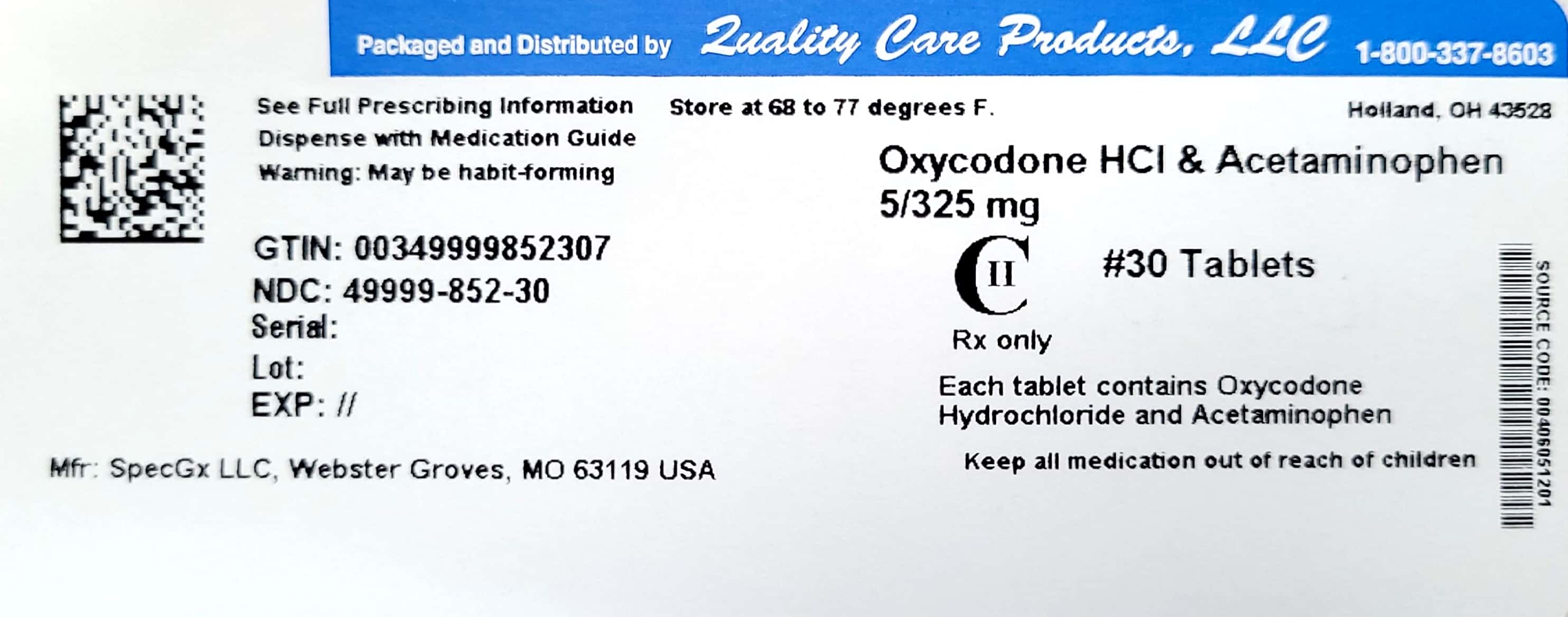
PACKAGE LABEL - PRINCIPAL DISPLAY PANEL - 5 mg*/325 mg Bottle
Multiple strengths. Do not dispense unless strength is stated.
NDC 0406-0512-05
500 TABLETS
OXYCODONE AND ACETAMINOPHEN TABLETS USP
CII
5 mg*/325 mg
Each tablet contains:
Oxycodone Hydrochloride USP. . . . . . . 5 mg*
Acetaminophen USP . . . . . . . . . . . . . .325 mg
Rx only
Mallinckrodt
Photos of the product and/or packaging supplied by the manufacturer.
CLINICAL PHARMACOLOGY
Central Nervous System
Oxycodone is a semisynthetic pure opioid agonist whose principal therapeutic action is analgesia. Other pharmacological effects of oxycodone include anxiolysis, euphoria and feelings of relaxation. These effects are mediated by receptors (notably μ and κ) in the central nervous system for endogenous opioid-like compounds such as endorphins and enkephalins. Oxycodone produces respiratory depression through direct activity at respiratory centers in the brain stem and depresses the cough reflex by direct effect on the center of the medulla.
Acetaminophen is a non-opiate, non-salicylate analgesic and antipyretic. The site and mechanism for the analgesic effect of acetaminophen has not been determined. The antipyretic effect of acetaminophen is accomplished through the inhibition of endogenous pyrogen action on the hypothalamic heat-regulating centers.
Gastrointestinal Tract and Other Smooth Muscle
Oxycodone reduces motility by increasing smooth muscle tone in the stomach and duodenum. In the small intestine, digestion of food is delayed by decreases in propulsive contractions. Other opioid effects include contraction of biliary tract smooth muscle, spasm of the Sphincter of Oddi, increased ureteral and bladder sphincter tone, and a reduction in uterine tone.
Cardiovascular System
Oxycodone may produce a release of histamine and may be associated with orthostatic hypotension, and other symptoms, such as pruritus, flushing, red eyes, and sweating.
Pharmacokinetics
Absorption and Distribution – The mean absolute oral bioavailability of oxycodone in cancer patients was reported to be about 87%. Oxycodone has been shown to be 45% bound to human plasma proteins in vitro. The volume of distribution after intravenous administration is 211.9 ± 186.6 L.
Absorption of acetaminophen is rapid and almost complete from the GI tract after oral administration. With overdosage, absorption is complete in 4 hours. Acetaminophen is relatively uniformly distributed throughout most body fluids. Binding of the drug to plasma proteins is variable; only 20% to 50% may be bound at the concentrations encountered during acute intoxication.
Metabolism and Elimination
A high portion of oxycodone is N-dealkylated to noroxycodone during first-pass metabolism. Oxymorphone, is formed by the O-demethylation of oxycodone. The metabolism of oxycodone to oxymorphone is catalyzed by CYP2D6. Free and conjugated noroxycodone, free and conjugated oxycodone, and oxymorphone are excreted in human urine following a single oral dose of oxycodone. Approximately 8% to 14% of the dose is excreted as free oxycodone over 24 hours after administration. Following a single, oral dose of oxycodone, the mean ± SD elimination half-life is 3.51 ± 1.43 hours.
Acetaminophen is metabolized in the liver via cytochrome P450 microsomal enzyme. About 80% to 85% of the acetaminophen in the body is conjugated principally with glucuronic acid and to a lesser extent with sulfuric acid and cysteine. After hepatic conjugation, 90% to 100% of the drug is recovered in the urine within the first day.
About 4% of acetaminophen is metabolized via cytochrome P450 oxidase to a toxic metabolite which is further detoxified by conjugation with glutathione, present in a fixed amount. It is believed that the toxic metabolite NAPQI (N acetyl-p-benzoquinoneimine, N-acetylimidoquinone) is responsible for liver necrosis. High doses of acetaminophen may deplete the glutathione stores so that inactivation of the toxic metabolite is decreased. At high doses, the capacity of metabolic pathways for conjugation with glucuronic acid and sulfuric acid may be exceeded, resulting in increased metabolism of acetaminophen by alternate pathways.
Create a free account to view complete drug information, save medications, and more.
Free forever · No credit card required