 MedLens
Loading…
Tablets, USP CIV · AvPAK
Dosage Form
Tablets, USP CIV
Manufacturer
AvPAK
This medication contains important usage instructions, warnings, and side effect information that you should review before use.
Tramadol hydrochloride and acetaminophen tablets, USP are indicated for the short-term (five days or less) management of acute pain.
For the short-term (five days or less) management of acute pain, the recommended dose of tramadol hydrochloride and acetaminophen tablets, USP is 2 tablets every 4 to 6 hours as needed for pain relief, up to a maximum of 8 tablets per day.
Individualization of Dose
In patients with creatinine clearances of less than 30 mL/min, it is recommended that the dosing interval of tramadol hydrochloride and acetaminophen tablets, USP be increased not to exceed 2 tablets every 12 hours. Dose selection for an elderly patient should be cautious, in view of the potential for greater sensitivity to adverse events.
Tramadol hydrochloride and acetaminophen tablets, USP should not be administered to patients who have previously demonstrated hypersensitivity to tramadol, USP, acetaminophen, USP, any other component of this product, or opioids. Tramadol hydrochloride and acetaminophen tablets, USP are contraindicated in any situation where opioids are contraindicated, including acute intoxication with any of the following: alcohol, hypnotics, narcotics, centrally acting analgesics, opioids, or psychotropic drugs. Tramadol hydrochloride and acetaminophen tablets, USP may worsen central nervous system and respiratory depression in these patients.
Table 2 reports the incidence rate of treatment-emergent adverse events over five days of tramadol hydrochloride and acetaminophen tablets use in clinical trials (subjects took an average of at least 6 tablets per day).
| Table 2: Incidence of Treatment-Emergent Adverse Events (≥2%) | |
|
Body System
Preferred Term |
Tramadol Hydrochloride and
Acetaminophen Tablets (N=142) % |
| Gastrointestinal System Disorders | |
| Constipation | 6 |
| Diarrhea | 3 |
| Nausea | 3 |
| Dry Mouth | 2 |
| Psychiatric Disorders | |
| Somnolence | 6 |
| Anorexia | 3 |
| Insomnia | 2 |
| Central & Peripheral Nervous System | |
| Dizziness | 3 |
| Skin and Appendages | |
| Sweating Increased | 4 |
| Pruritus | 2 |
| Reproductive Disorders, Male * | |
| Prostatic Disorder | 2 |
* Number of males = 62
Incidence at least 1%, causal relationship at least possible or greater: the following lists adverse reactions that occurred with an incidence of at least 1% in single-dose or repeated-dose clinical trials of tramadol hydrochloride and acetaminophen tablets.
Body as a Whole – Asthenia, fatigue, hot flushes
Central and Peripheral Nervous System – Dizziness, headache, tremor
Gastrointestinal System – Abdominal pain, constipation, diarrhea, dyspepsia, flatulence, dry mouth, nausea, vomiting
Psychiatric Disorders – Anorexia, anxiety, confusion, euphoria, insomnia, nervousness, somnolence
Skin and Appendages – Pruritus, rash, increased sweating.
Selected Adverse events occurring at less than 1%: the following lists clinically relevant adverse reactions that occurred with an incidence of less than 1% in tramadol hydrochloride and acetaminophen tablets clinical trials.
Body as a Whole – Chest pain, rigors, syncope, withdrawal syndrome
Cardiovascular Disorders – Hypertension, aggravated hypertension, hypotension
Central and Peripheral Nervous System – Ataxia, convulsions, hypertonia, migraine, aggravated migraine, involuntary muscle contractions, paresthesias, stupor, vertigo
Gastrointestinal System – Dysphagia, melena, tongue edema
Hearing and Vestibular Disorders – Tinnitus
Heart Rate and Rhythm Disorders – Arrhythmia, palpitation, tachycardia
Liver and Biliary System – Hepatic function abnormal
Metabolic and Nutritional Disorders – Weight decrease
Psychiatric Disorders – Amnesia, depersonalization, depression, drug abuse, emotional lability, hallucination, impotence, paroniria, abnormal thinking
Red Blood Cell Disorders – Anemia
Respiratory System – Dyspnea
Urinary System – Albuminuria, micturition disorder, oliguria, urinary retention
Vision Disorders – Abnormal vision
Other clinically significant adverse experiences previously reported with tramadol hydrochloride:
Other events which have been reported with the use of tramadol products and for which a causal association has not been determined include: vasodilation, orthostatic hypotension, myocardial ischemia, pulmonary edema, allergic reactions (including anaphylaxis and urticaria, Stevens-Johnson syndrome/TENS), cognitive dysfunction, difficulty concentrating, depression, suicidal tendency, hepatitis, liver failure and gastrointestinal bleeding. Reported laboratory abnormalities included elevated creatinine and liver function tests. Serotonin syndrome (whose symptoms may include mental status change, hyperreflexia, fever, shivering, tremor, agitation, diaphoresis, seizures and coma) has been reported with tramadol when used concomitantly with other serotonergic agents such as SSRIs and MAOIs.
Other clinically significant adverse experiences previously reported with acetaminophen:
Allergic reactions (primarily skin rash) or reports of hypersensitivity secondary to acetaminophen are rare and generally controlled by discontinuation of the drug and, when necessary, symptomatic treatment.
Tramadol hydrochloride and acetaminophen tablets are a combination product. The clinical presentation of overdose may include the signs and symptoms of tramadol toxicity, acetaminophen toxicity or both. The initial symptoms of tramadol overdosage may include respiratory depression and/or seizures. The initial symptoms seen within the first 24 hours following an acetaminophen overdose are: anorexia, nausea, vomiting, malaise, pallor and diaphoresis. An overdosage of tramadol hydrochloride and acetaminophen tablets may be a potentially lethal polydrug overdose, and consultation with a regional poison control center is recommended.
Tramadol
Acute overdosage with tramadol can be manifested by respiratory depression, somnolence progressing to stupor or coma, skeletal muscle flaccidity, cold and clammy skin, constricted pupils, seizures, bradycardia, hypotension, cardiac arrest, and death.
Deaths due to overdose have been reported with abuse and misuse of tramadol (see WARNINGS, Misuse, Abuse, and Diversion). Review of case reports has indicated that the risk of fatal overdose is further increased when tramadol is abused concurrently with alcohol or other CNS depressants, including other opioids.
In the treatment of tramadol overdosage, primary attention should be given to the re-establishment of a patent airway and institution of assisted or controlled ventilation. Supportive measures (including oxygen and vasopressors) should be employed in the management of circulatory shock and pulmonary edema accompanying overdose as indicated. Cardiac arrest or arrhythmias may require cardiac massage or defibrillation.
While naloxone will reverse some, but not all, symptoms caused by overdosage with tramadol, the risk of seizures is also increased with naloxone administration. In animals, convulsions following the administration of toxic doses of tramadol hydrochloride and acetaminophen tablets could be suppressed with barbiturates or benzodiazepines but were increased with naloxone. Naloxone administration did not change the lethality of an overdose in mice. Hemodialysis is not expected to be helpful in an overdose because it removes less than 7% of the administered dose in a 4-hour dialysis period.
Acetaminophen
In
acetaminophen
overdosage, dose-dependent, potentially fatal hepatic necrosis is the most serious adverse effect. Renal tubular necrosis, hypoglycemic coma, and coagulation defects also may occur. Early symptoms following a potentially hepatotoxic overdose may include: nausea, vomiting, diaphoresis and general malaise. Clinical and laboratory evidence of hepatic toxicity may not be apparent until 48 to 72 hours post ingestion.
In the treatment of acetaminophen overdosage, gastric decontamination with activated charcoal should be administered just prior to N-acetylcysteine (NAC) to decrease systemic absorption if acetaminophen ingestion is known or suspected to have occurred within a few hours of presentation. Serum acetaminophen levels should be obtained immediately if the patient presents 4 or more hours after ingestion to assess potential risk of hepatotoxicity; acetaminophen levels drawn less than 4 hours post-ingestion may be misleading. To obtain the best possible outcome, NAC should be administered as soon as possible where impending or evolving liver injury is suspected. Intravenous NAC may be administered when circumstances preclude oral administration.
Vigorous supportive therapy is required in severe intoxication. Procedures to limit the continuing absorption of the drug must be readily performed since the hepatic injury is dose-dependent and occurs early in the course of intoxication.
Tramadol hydrochloride and acetaminophen tablets, USP combine two analgesics, tramadol, USP 37.5 mg and acetaminophen, USP 325 mg.
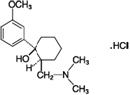
The chemical name for tramadol hydrochloride, USP is (±) cis-2-[(dimethylamino)methyl]-1-(3-methoxyphenyl) cyclohexanol hydrochloride. Its structural formula is:
[image: SPLSERV-b9644bc7-7a14-2870-b824-ad097f9b7927]
The molecular weight of tramadol hydrochloride, USP is 299.84. Tramadol hydrochloride, USP is a white, bitter, crystalline and odorless powder.
The chemical name for acetaminophen, USP is N-acetyl- p-aminophenol. Its structural formula is:
[image: SPLSERV-51f9b09f-06e8-9294-4f93-161b20c86976]
The molecular weight of acetaminophen, USP is 151.17. Acetaminophen, USP is an analgesic and antipyretic agent which occurs as a white, odorless, crystalline powder, possessing a slightly bitter taste.
Tramadol hydrochloride and acetaminophen tablets, USP contain 37.5 mg tramadol hydrochloride, USP and 325 mg acetaminophen, USP and are beige in color. Inactive ingredients in the tablets are carnauba wax, crospovidone, iron oxide black, iron oxide red, iron oxide yellow, microcrystalline cellulose, pregelatinized starch, polyethylene glycol, polyvinyl alcohol, povidone, sodium starch glycolate, stearic acid, talc and titanium dioxide.
[image: MM38978]
Tramadol hydrochloride and acetaminophen tablets, USP are beige colored, film-coated, biconvex capsule shaped tablets with “AN 617” debossed on one side and plain on the other side and are available as follows:
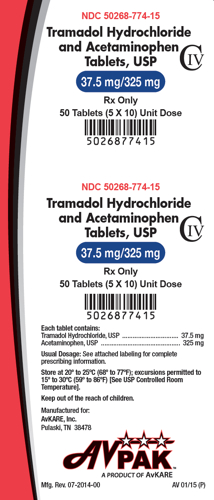
NDC 50268-774-15 (10 tablets per card, 5 cards per carton)
Dispensed in Unit Dose package. For Institutional Use Only.
Store at 20° to 25°C (68° to 77°F); excursions permitted to 15° to 30°C (59° to 86°F) [See USP Controlled Room Temperature].
Rx only
Manufactured for:
AvKARE, Inc.
Pulaski, TN 38478
Mfg. Rev. 07-2014-01
AV 01/15 (P)
AvPAK
Photos of the product and/or packaging supplied by the manufacturer.

The following information is based on studies of tramadol alone or acetaminophen alone, except where otherwise noted:
Pharmacodynamics
Tramadol hydrochloride and acetaminophen tablets contain tramadol hydrochloride and acetaminophen. Tramadol is a centrally acting synthetic opioid analgesic. Although its mode of action is not completely understood, from animal tests, at least two complementary mechanisms appear applicable: binding of parent and M1 metabolite to µ-opioid receptors and weak inhibition of reuptake of norepinephrine and serotonin.
Opioid activity is due to both low affinity binding of the parent compound and higher affinity binding of the O-demethylated metabolite M1 to µ-opioid receptors. In animal models, M1 is up to 6 times more potent than tramadol in producing analgesia and 200 times more potent in µ-opioid binding. Tramadol-induced analgesia is only partially antagonized by the opiate antagonist naloxone in several animal tests. The relative contribution of both tramadol and M1 to human analgesia is dependent upon the plasma concentrations of each compound (see CLINICAL PHARMACOLOGY, Pharmacokinetics ).
Tramadol has been shown to inhibit reuptake of norepinephrine and serotonin in vitro, as have some other opioid analgesics. These mechanisms may contribute independently to the overall analgesic profile of tramadol.
Apart from analgesia, tramadol administration may produce a constellation of symptoms (including dizziness, somnolence, nausea, constipation, sweating and pruritus) similar to that of other opioids.
Acetaminophen is a non-opiate, non-salicylate analgesic.
Pharmacokinetics
Tramadol is administered as a racemate and both the [-] and [+] forms of both tramadol and M1 are detected in the circulation. The pharmacokinetics of plasma tramadol and acetaminophen following oral administration of one tramadol hydrochloride and acetaminophen tablet are shown in Table 1. Tramadol has a slower absorption and longer half-life when compared to acetaminophen.
| Table 1: Summary of Mean (±SD) Pharmacokinetic Parameters of the (+)- and (-)
Enantiomers of Tramadol and M1 and Acetaminophen Following A Single Oral Dose Of One Tramadol Hydrochloride and Acetaminophen Combination Tablet (37.5 mg/325 mg) in Volunteers. |
||||||||||
| Parameter a | (+)-Tramadol | (-)-Tramadol | (+)-M1 | (-)-M1 | acetaminophen | |||||
| C max (ng/mL) | 64.3 | (9.3) | 55.5 | (8.1) | 10.9 | (5.7) | 12.8 | (4.2) | 4.2 | (0.8) |
| t max (h) | 1.8 | (0.6) | 1.8 | (0.7) | 2.1 | (0.7) | 2.2 | (0.7) | 0.9 | (0.7) |
| CL/F (mL/min) | 588 | (226) | 736 | (244) | - | - | - | - | 365 | (84) |
| t ½ (h) | 5.1 | (1.4) | 4.7 | (1.2) | 7.8 | (3) | 6.2 | (1.6) | 2.5 | (0.6) |
a For acetaminophen, C max was measured as mcg/mL.
A single-dose pharmacokinetic study of tramadol hydrochloride and acetaminophen tablets in volunteers showed no drug interactions between tramadol and acetaminophen. Upon multiple oral dosing to steady-state, however, the bioavailability of tramadol and metabolite M1 was lower for the combination tablets compared to tramadol administered alone. The decrease in AUC was 14% for (+)-tramadol, 10.4% for (-)-tramadol, 11.9% for (+)-M1 and 24.2% for (-)-M1. The cause of this reduced bioavailability is not clear. Following single- or multiple-dose administration of tramadol hydrochloride and acetaminophen tablets, no significant change in acetaminophen pharmacokinetics was observed when compared to acetaminophen given alone.
Absorption
The absolute bioavailability of tramadol from tramadol hydrochloride and acetaminophen tablets has not been determined. Tramadol hydrochloride has a mean absolute bioavailability of approximately 75% following administration of a single 100 mg oral dose of tramadol hydrochloride tablets. The mean peak plasma concentration of racemic tramadol and M1 after administration of two tramadol hydrochloride and acetaminophen tablets occurs at approximately two and three hours, respectively, post-dose.
Peak plasma concentrations of acetaminophen occur within one hour and are not affected by co-administration with tramadol. Oral absorption of acetaminophen following administration of tramadol hydrochloride and acetaminophen tablets occurs primarily in the small intestine.
Food Effects
When tramadol hydrochloride and acetaminophen tablets were administered with food, the time to peak plasma concentration was delayed for approximately 35 minutes for tramadol and almost one hour for acetaminophen. However, peak plasma concentrations, and the extents of absorption, of tramadol and acetaminophen were not affected. The clinical significance of this difference is unknown.
Distribution
The volume of distribution of tramadol was 2.6 and 2.9 L/kg in male and female subjects, respectively, following a 100 mg intravenous dose. The binding of tramadol to human plasma proteins is approximately 20% and binding also appears to be independent of concentration up to 10 mcg/mL. Saturation of plasma protein binding occurs only at concentrations outside the clinically relevant range.
Acetaminophen appears to be widely distributed throughout most body tissues except fat. Its apparent volume of distribution is about 0.9 L/kg. A relative small portion (~20%) of acetaminophen is bound to plasma protein.
Metabolism
Following oral administration, tramadol is extensively metabolized by a number of pathways, including CYP2D6 and CYP3A4, as well as by conjugation of parent and metabolites. Approximately 30% of the dose is excreted in the urine as unchanged drug, whereas 60% of the dose is excreted as metabolites. The major metabolic pathways appear to be N- and O- demethylation and glucuronidation or sulfation in the liver. Metabolite M1 ( O-desmethyltramadol) is pharmacologically active in animal models. Formation of M1 is dependent on CYP2D6 and as such is subject to inhibition, which may affect the therapeutic response (see PRECAUTIONS, Drug Interactions).
Approximately 7% of the population has reduced activity of the CYP2D6 isoenzyme of cytochrome P450. These individuals are “poor metabolizers” of debrisoquine, dextromethorphan, tricyclic antidepressants, among other drugs. Based on a population PK analysis of Phase 1 studies in healthy subjects, concentrations of tramadol were approximately 20% higher in “poor metabolizers” versus “extensive metabolizers”, while M1 concentrations were 40% lower. In vitro drug interaction studies in human liver microsomes indicate that inhibitors of CYP2D6 such as fluoxetine and its metabolite norfluoxetine, amitriptyline, and quinidine inhibit the metabolism of tramadol to various degrees. The full pharmacological impact of these alterations in terms of either efficacy or safety is unknown. Concomitant use of SEROTONIN re-uptake INHIBITORS and MAO INHIBITORS may enhance the risk of adverse events, including seizure (see WARNINGS) and serotonin syndrome.
Acetaminophen is primarily metabolized in the liver by first-order kinetics and involves three principal separate pathways:
a) conjugation with glucuronide;
b) conjugation with sulfate; and
c) oxidation via the cytochrome, P450-dependent, mixed-function oxidase enzyme pathway to form a reactive intermediate metabolite, which conjugates with glutathione and is then further metabolized to form cysteine and mercapturic acid conjugates. The principal cytochrome P450 isoenzyme involved appears to be CYP2E1, with CYP1A2 and CYP3A4 as additional pathways.
In adults, the majority of acetaminophen is conjugated with glucuronic acid and, to a lesser extent, with sulfate. These glucuronide-, sulfate-, and glutathione-derived metabolites lack biologic activity. In premature infants, newborns, and young infants, the sulfate conjugate predominates.
Elimination
Tramadol is eliminated primarily through metabolism by the liver and the metabolites are eliminated primarily by the kidneys. The plasma elimination half-lives of racemic tramadol and M1 are approximately 5 to 6 and 7 hours, respectively, after administration of tramadol hydrochloride and acetaminophen tablets. The apparent plasma elimination half-life of racemic tramadol increased to 7 to 9 hours upon multiple dosing of tramadol hydrochloride and acetaminophen tablets.
The half-life of acetaminophen is about 2 to 3 hours in adults. It is somewhat shorter in children and somewhat longer in neonates and in cirrhotic patients. Acetaminophen is eliminated from the body primarily by formation of glucuronide and sulfate conjugates in a dose-dependent manner. Less than 9% of acetaminophen is excreted unchanged in the urine.
Special Populations
Renal
The pharmacokinetics of tramadol hydrochloride and acetaminophen in patients with renal impairment has not been studied. Based on studies using tramadol alone, excretion of tramadol and metabolite M1 is reduced in patients with creatinine clearance of less than 30 mL/min. Adjustment of dosing regimen in this patient population is recommended (see DOSAGE AND ADMINISTRATION). The total amount of tramadol and M1 removed during a 4-hour dialysis period is less than 7% of the administered dose based on studies using tramadol alone.
Hepatic
The pharmacokinetics and tolerability of tramadol hydrochloride and acetaminophen in patients with impaired hepatic function have not been studied. Since tramadol and acetaminophen are both extensively metabolized by the liver, the use of tramadol hydrochloride and acetaminophen in patients with hepatic impairment is not recommended (see PRECAUTIONS and DOSAGE AND ADMINISTRATION).
Geriatric
A population pharmacokinetic analysis of data obtained from a clinical trial in patients with chronic pain treated with tramadol hydrochloride and acetaminophen, which included 55 patients between 65 and 75 years of age and 19 patients over 75 years of age, showed no significant changes in the pharmacokinetics of tramadol and acetaminophen in elderly patients with normal renal and hepatic function (see PRECAUTIONS, Geriatric Use).
Gender
Tramadol clearance was 20% higher in female subjects compared to males on four phase I studies of tramadol hydrochloride and acetaminophen in 50 male and 34 female healthy subjects. The clinical significance of this difference is unknown.
Pediatric
The pharmacokinetics of tramadol hydrochloride and acetaminophen tablets has not been studied in pediatric patients below 16 years of age.
Clinical Studies
Single-Dose Studies for Treatment of Acute Pain
In pivotal single-dose studies in acute pain, two tablets of tramadol hydrochloride and acetaminophen administered to patients with pain following oral surgical procedures provided greater relief than placebo or either of the individual components given at the same dose. The onset of pain relief after tramadol hydrochloride and acetaminophen was faster than tramadol alone. Onset of analgesia occurred in less than one hour. The duration of pain relief after tramadol hydrochloride and acetaminophen tablets was longer than acetaminophen alone. Analgesia was generally comparable to that of the comparator, ibuprofen.
Create a free account to view complete drug information, save medications, and more.
Free forever · No credit card required