 MedLens
Loading…
Tablets · QUAGEN PHARMACEUTICALS LLC
Dosage Form
Tablets
Manufacturer
QUAGEN PHARMACEUTICALS LLC
This medication contains important usage instructions, warnings, and side effect information that you should review before use.
HEPATOTOXICITY
Acetaminophen has been associated with cases of acute liver failure, at times resulting in liver transplant and death. Most of the cases of liver injury are associated with the use of acetaminophen at doses that exceed 4000 milligrams per day, and often involve more than one acetaminophen containing product.
Butalbital and Acetaminophen Tablets are indicated for the relief of the symptom complex of tension (or muscle contraction) headache.
Evidence supporting the efficacy and safety of this combination product in the treatment of multiple recurrent headaches is unavailable. Caution in this regard is required because butalbital is habit-forming and potentially abusable.
Butalbital and Acetaminophen Tablets 50 mg/300 mg: One or two tablets every four hours. Total daily dosage should not exceed 6 tablets.
Extended and repeated use of these products is not recommended because of the potential for physical dependence.
This product is contraindicated under the following conditions:
The CNS effects of butalbital may be enhanced by monoamine oxidase (MAO) inhibitors.
Butalbital and acetaminophen may enhance the effects of: other narcotic analgesics, alcohol, general anesthetics, tranquilizers such as chlordiazepoxide, sedative-hypnotics, or other CNS depressants, causing increased CNS depression.
Frequently Observed: The most frequently reported adverse reactions are drowsiness, lightheadedness, dizziness, sedation, shortness of breath, nausea, vomiting, abdominal pain, and intoxicated feeling.
Infrequently Observed: All adverse events tabulated below are classified as infrequent.
Central Nervous: headache, shaky feeling, tingling, agitation, fainting, fatigue, heavy eyelids, high energy, hot spells, numbness, sluggishness, seizure. Mental confusion, excitement or depression can also occur due to intolerance, particularly in elderly or debilitated patients, or due to overdosage of butalbital.
Autonomic Nervous: dry mouth, hyperhidrosis.
Gastrointestinal: difficulty swallowing, heartburn, flatulence, constipation.
Cardiovascular: tachycardia.
Musculoskeletal: leg pain, muscle fatigue.
Genitourinary: diuresis.
Miscellaneous: pruritus, fever, earache, nasal congestion, tinnitus, euphoria, allergic reactions.
Several cases of dermatological reactions, including toxic epidermal necrolysis and erythema multiforme, have been reported.
The following adverse drug events may be borne in mind as potential effects of the components of this product. Potential effects of high dosage are listed in the OVERDOSAGE section.
Acetaminophen: allergic reactions, rash, thrombocytopenia, agranulocytosis.
To report SUSPECTED ADVERSE REACTIONS, contact Quagen Pharmaceuticals LLC at1-888-344-9603 or www.quagenpharma.com, or FDA at 1-800-FDA-1088 or www.fda.gov/medwatch.
Teratogenic Effects
Animal reproduction studies have not been conducted with this combination product. It is also not known whether butalbital and acetaminophen can cause fetal harm when administered to a pregnant woman or can affect reproduction capacity. These products should be given to a pregnant woman only when clearly needed.
Nonteratogenic effects
Withdrawal seizures were reported in a two-day-old male infant whose mother had taken a butalbital-containing drug during the last two months of pregnancy. Butalbital was found in the infant's serum. The infant was given phenobarbital 5 mg/kg, which was tapered without further seizure or other withdrawal symptoms.
Barbiturates and acetaminophen are excreted in breast milk in small amounts, but the significance of their effects on nursing infants is not known. Because of potential for serious adverse reactions in nursing infants from butalbital and acetaminophen, a decision should be made whether to discontinue nursing or to discontinue the drug, taking into account the importance of the drug to the mother.
Safety and effectiveness in children below the age of 12 have not been established.
Following an acute overdosage of butalbital and acetaminophen, toxicity may result from the barbiturate or the acetaminophen.
Signs and Symptoms
Toxicity from barbiturate poisoning include drowsiness, confusion, and coma; respiratory depression; hypotension; and hypovolemic shock.
In acetaminophen overdosage: dose-dependent, potentially fatal hepatic necrosis is the most serious adverse effect. Renal tubular necroses, hypoglycemic coma and coagulation defects may also occur. Early symptoms following a potentially hepatotoxic overdose may include: nausea, vomiting, diaphoresis and general malaise. Clinical and laboratory evidence of hepatic toxicity may not be apparent until 48 to 72 hours post-ingestion.
Treatment
A single or multiple drug overdose with this combination product is a potentially lethal polydrug overdose, and consultation with a regional poison control center is recommended. Immediate treatment includes support of cardiorespiratory function and measures to reduce drug absorption.
Oxygen, intravenous fluids, vasopressors, and other supportive measures should be employed as indicated. Assisted or controlled ventilation should also be considered.
Gastric decontamination with activated charcoal should be administered just prior to N-acetylcysteine (NAC) to decrease systemic absorption if acetaminophen ingestion is known or suspected to have occurred within a few hours of presentation. Serum acetaminophen levels should be obtained immediately if the patient presents 4 hours or more after ingestion to assess potential risk of hepatotoxicity; acetaminophen levels drawn less than 4 hours post-ingestion may be misleading. To obtain the best possible outcome, NAC should be administered as soon as possible where impending or evolving liver injury is suspected. Intravenous NAC may be administered when circumstances preclude oral administration.
Vigorous supportive therapy is required in severe intoxication. Procedures to limit the continuing absorption of the drug must be readily performed since the hepatic injury is dose dependent and occurs early in the course of intoxication.
This product may impair mental and/or physical abilities required for the performance of potentially hazardous tasks such as driving a car or operating machinery. Such tasks should be avoided while taking this product.
Alcohol and other Central Nervous System (CNS) depressants may produce an additive CNS depression, when taken with this combination product, and should be avoided.
Butalbital may be habit-forming. Patients should take the drug only for as long as it is prescribed, in the amounts prescribed, and no more frequently than prescribed.
Each Butalbital and Acetaminophen Tablet for oral administration, contains Butalbital, USP 50 mg, Acetaminophen, USP 300 mg.
In addition, each Butalbital and Acetaminophen Tablet contains the following inactive ingredients: Colloidal Silicon Dioxide, Crospovidone, Croscarmellose Sodium, Povidone, Microcrystalline Cellulose, Pregelatinized Starch, D&C Yellow #10 Lake, FD&C Red #40 Lake and Stearic Acid.
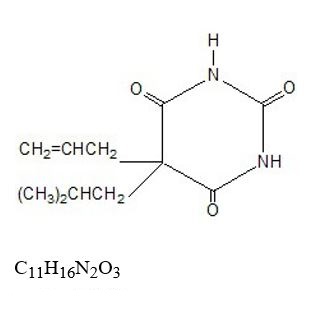
Butalbital (5-allyl-5-isobutylbarbituric acid), a slightly bitter, white, odorless, crystalline powder, is a short to intermediate-acting barbiturate. It has the following structural formula:
[image: Le5277e37-79d3-48ec-9770-d4989784971b]
MOLECULAR WEIGHT = 224.26
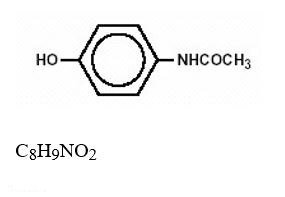
Acetaminophen (4'-hydroxyacetanilide), a slightly bitter, white, odorless, crystalline powder, is a non-opiate, non-salicylate analgesic and antipyretic. It has the following structural formula:
[image: Ldc3be0df-70e3-4aab-97c4-7c5af6152454]
MOLECULAR WEIGHT = 151.16
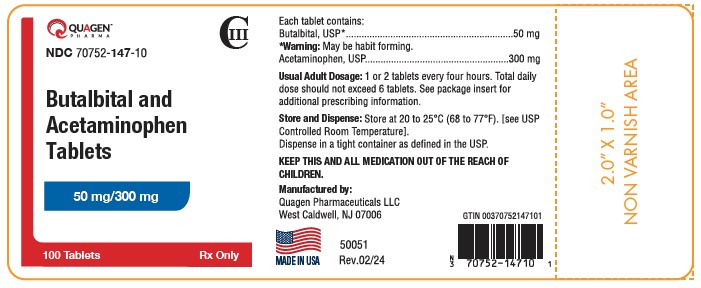
PRINCIPAL DISPLAY PANEL
NDC 70752-147-10
Butalbital and
Acetaminophen
Tablets
100 Tablets
Rx only
[image: Le1f0feed-2e76-479b-935e-cfca22bcb713]
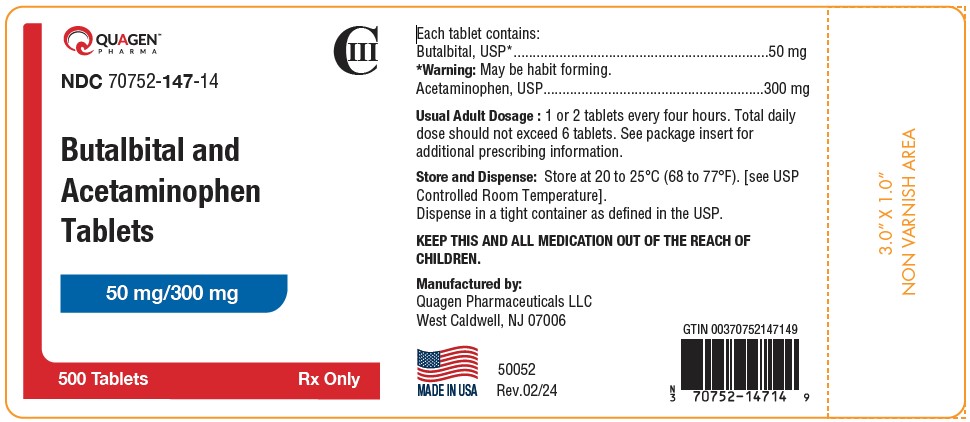
PRINCIPAL DISPLAY PANEL
NDC 70752-147-14
Butalbital and
Acetaminophen
Tablets
500 Tablets
Rx only
[image: L4378a19a-47a2-4782-a9a5-695fb7a287d7]
Yellow, round, biconvex unscored tablets debossed " T abov e 2 8 " on one side and plain on the other side, in bottles of 100 (NDC 70752-147-10) and bottles of 500 (NDC 70752-147-14). Each tablet contains butalbital, USP 50 mg and acetaminophen, USP 300 mg.
Store at 20°C to 25°C (68°F to 77°F) [see USP Controlled Room Temperature].
Dispense in a tight container as defined in the USP.
Photos of the product and/or packaging supplied by the manufacturer.
This combination drug product is intended as a treatment for tension headache.
It consists of a fixed combination of butalbital and acetaminophen. The role each component plays in the relief of the complex of symptoms known as tension headache is incompletely understood.
Pharmacokinetics: The behavior of the individual components is described below.
Butalbital: Butalbital is well absorbed from the gastrointestinal tract and is expected to distribute to most tissues in the body. Barbiturates in general may appear in breast milk and readily cross the placental barrier. They are bound to plasma and tissue proteins to a varying degree and binding increases directly as a function of lipid solubility.
Elimination of butalbital is primarily via the kidney (59% to 88% of the dose) as unchanged drug or metabolites. The plasma half-life is about 35 hours. Urinary excretion products include parent drug (about 3.6% of the dose), 5-isobutyl-5-(2,3-dihydroxy-propyl) barbituric acid (about 24% of the dose), 5-allyl-5(3-hydroxy-2-methyl-1-propyl) barbituric acid (about 4.8% of the dose), products with the barbituric acid ring hydrolyzed with excretion of urea (about 14% of the dose), as well as unidentified materials. Of the material excreted in the urine, 32% is conjugated.
See OVERDOSAGE for toxicity information.
Acetaminophen: Acetaminophen is rapidly absorbed from the gastrointestinal tract and is distributed throughout most body tissues. The plasma half-life is 1.25 to 3 hours, but may be increased by liver damage and following overdosage. Elimination of acetaminophen is principally by liver metabolism (conjugation) and subsequent renal excretion of metabolites. Approximately 85% of an oral dose appears in the urine within 24 hours of administration, most as the glucuronide conjugate, with small amounts of other conjugates and unchanged drug.
See OVERDOSAGE for toxicity information.
No adequate studies have been conducted in animals to determine whether acetaminophen or butalbital have a potential for carcinogenesis, mutagenesis or impairment of fertility.
Manufactured by:
Quagen Pharmaceuticals LLC
West Caldwell, NJ 07006
52019
Rev.02/24
Create a free account to view complete drug information, save medications, and more.
Free forever · No credit card required